SR Darapuri I.P.S.(Retd)

(Asian independent) “Yes, substantial evidence from videos, medical reports, eyewitness accounts, and subsequent judicial scrutiny indicates that Delhi Police (and assisting RAF units) exceeded legal guidelines and ethical standards on the use of force during the July 20, 2026, events at and around Jantar Mantar.” This assessment is provisional, pending full independent investigation and final court findings, but the available record shows clear breaches of necessity, proportionality, accountability, and restraint principles under Indian law and democratic norms.
Context of the Incident
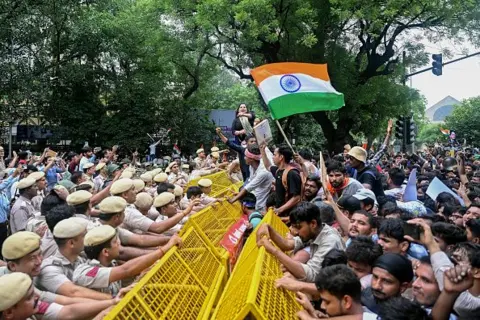
The events arose from a Cockroach Janta Party (CJP)-linked student protest over the NEET-UG paper leak and related examination irregularities. Permission existed for a sit-in at the designated Jantar Mantar site. Protesters attempted an unauthorized “Chalo Sansad” march toward Parliament. Police maintained barricades; clashes followed involving alleged barricade breaches, stone-pelting, and attacks on personnel (with police reporting injuries from stones, sticks, and sharp objects). Force used included tear gas/smoke, lathi charges, and (per internal records and medical evidence) anti-riot gun rounds with plastic pellets. Multiple videos captured plainclothes individuals with sticks (some alleged to have nails), uniformed personnel without name tags, a senior officer (Additional DCP Sandeep Lamba) slapping a woman, and actions directed at women including alleged groping. Injuries included pellet wounds (one reported eye injury). Courts and the NHRC later sought responses, CCTV preservation, medical treatment for the injured, and the graded-use-of-force standing order.
Police maintained that force followed a graded sequence after repeated warnings under Section 163 of the Bharatiya Nagarik Suraksha Sanhita (BNSS), that the march was unauthorized, and that it targeted aggressors after non-violent options failed. They later directed personnel to wear uniforms.
Legal and Ethical Standards on Use of Force
Indian law tightly constrains police force, especially against assemblies exercising Article 19(1)(a) and (b) rights (speech and peaceful assembly). Key principles include:
Necessity and minimal force: The 1985 Code of Conduct for the Police requires persuasion, advice, and warning first; force only when inevitable and at the “irreducible minimum.” Delhi Police standing orders (e.g., 72 and 309) emphasize controlled dispersal with “utmost restraint,” senior-officer advice, and videography when force is used.
Graded response and proportionality (BNSS Sections 129–130, formerly CrPC equivalents): Declare the assembly unlawful, issue clear warnings to disperse, attempt less-coercive measures, then use physical force only as a last resort. Blows should target the lower body. Force must stop once the threat ends. The Supreme Court in the “Ramlila Maidan” case held that even an assembly that has become unlawful retains protection against disproportionate force; the response must match the exigency.
Accountability and identification: Personnel must be identifiable (name tags; Supreme Court and BNSS requirements for those making arrests or using force). Plainclothes deployment for intelligence is distinct from active participation in force.
Special protections: Heightened restraint toward women (male officers generally should not touch them except when necessary). Weapons such as pellet/anti-riot guns are restricted to exceptional circumstances, typically after warnings and aimed low; their use in mainland civilian protests (as opposed to prior J&K contexts) raises heightened scrutiny. The Supreme Court has sought the relevant standing order and noted that existing rules permit them only exceptionally.
Democratic overlay: Peaceful protest is a constitutional cornerstone. Restrictions must be reasonable; force that appears punitive, indiscriminate, or aimed at terrorizing rather than dispersing undermines Article 19 and the rule of law. Patterns from earlier Delhi incidents (Jamia 2019, JNU 2020) have drawn similar criticism of accountability gaps.
Ethical policing standards reinforce these: force must be defensive and restorative of order, not retributive; transparency and post-incident investigation are required when videos and injuries suggest excess.
Evidence of Flouting
Video evidence and reports show multiple deviations:
Disproportion and manner: Clips depict personnel (uniformed and plainclothes) striking people who appear to be dispersing or standing, including a senior officer slapping a woman without apparent immediate threat. Allegations and footage of surrounding and inappropriately touching women, electric batons or nail-studded sticks, and pursuit into cafes/lanes suggest force exceeding controlled dispersal. Pellet use (initially denied or attributed solely to RAF, later documented as two anti-riot gun rounds with plastic pellets on a DCP’s orders, alongside dozens of shells/grenades) produced injuries inconsistent with minimal, lower-body targeting in a student-heavy civilian setting.
Identification failures: Widespread absence of name tags and plainclothes individuals actively wielding force (later prompting a uniforms-only directive) directly impairs accountability. Legal experts note that dispersal orders and force by unidentifiable personnel raise legality concerns.
Sequence and targeting: Police assert warnings, barricades, water cannons, then targeted action after violence. Critics and footage indicate rapid escalation, indiscriminate elements (tear gas near vulnerable groups), and continuation beyond immediate threat. Medical reports corroborate pellet injuries; police and CRPF statements were initially evasive.
Women and vulnerability: Special restraint obligations appear violated in multiple documented interactions.
Police accounts of protester violence and injuries to personnel are relevant and may justify “some” force. Permission limits on the march are also material. However, the scale, specific acts captured on camera, weapon choice, and identification failures go beyond what graded, proportionate response requires. Courts have treated the allegations seriously enough to seek the SOP, order treatment, preserve evidence, and examine the framework.
Constitutional and Democratic Implications
The right to protest is not absolute, but the state’s monopoly on legitimate force carries reciprocal duties of restraint and accountability. When force appears intended to harm or intimidate rather than restore order—especially against students and families airing examination-related grievances—it chills Article 19 rights and erodes public trust. Recurring questions about Delhi Police handling of student protests (Jamia, JNU, now Jantar Mantar) point to systemic gaps in training, command control, equipment protocols, and post-incident accountability rather than isolated lapses.
Democratic health requires independent investigation (not solely internal), prosecution where cognizable excesses are established (orders from above are not a complete defence for unconstitutional force), clear national guidelines on less-lethal munitions in civilian protests, mandatory identification and body-worn cameras/videography, and meaningful remedies for victims. The Supreme Court’s engagement on graded-force protocols is a constructive step; implementation and transparency will determine whether lessons translate into practice.
In short, the record supports the conclusion that legal and ethical limits on force were flouted in material respects. Full facts, chain-of-command decisions, and forensic review of injuries and orders remain necessary for definitive legal findings, but the visual and medical evidence already demonstrates serious departures from the standards that govern democratic policing.