THE ASIAN INDEPENDENT UK
DR RAMJILAL,
Social Scientist and Former Principal,
Dyal Singh College, Karnal (Haryana, India).
Email.id.[email protected]
Initially, the Left Front government in West Bengal, adhering to the theory of class struggle, ignored the prevalent social structure and asserted that Bengal did not have a caste-based society. As a result, there were no reservations for backward classes for a long time. However, as its electoral base began to decline, the OBCs were granted a 7% reservation, which was far below the 27% recommended by the Mandal Commission. This reservation was subsequently increased to 10%, and later, under the leadership of Buddhadeb Bhattacharya, to 17%. Despite this increase, it still fell short of the Mandal Commission’s recommendation by 10%. Notably, the reservation system implemented in Bengal did not differentiate between Hindus and Muslims, thereby including both groups in the OBC classification. Consequently, Scheduled Castes (SCs) received a 22% reservation, Scheduled Tribes (STs) received 6%, and OBCs received 17% (comprising 10% for the OBC-A category and 7% for the OBC-B category), totalling 45%—still 5% short of the permissible limit.
A significant change in the reservation system occurred after Mamata Banerjee took office as Chief Minister on May 20, 2011, defeating Jyoti Basu and ending the 34-year-long Left Front government. After assuming power, Banerjee introduced a 3% reservation for persons with disabilities, bringing total reservations in Bengal to 48%.
Reduction of OBC Reservation from 17% to 7%:
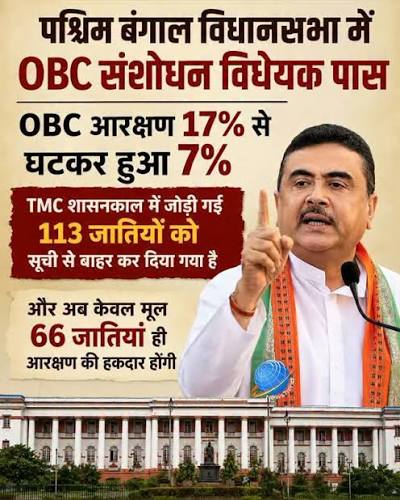
The current BJP government in Bengal cited a decision from the Calcutta High Court in 2024 regarding this reduction. However, this argument appears weak because the 17% reservation for OBCs persisted under Mamata Banerjee’s government. Top leaders of the Bharatiya Janata Party (BJP) called for votes during elections, promising to protect reservations for Dalits and backward classes. Nevertheless, after forming the government under Suvendu Adhikari, they reduced the OBC reservation from 17% to 7%, reverting to a list that reinstated 66 communities previously recognised before 2010. This change dismantled the previous system that provided 10% for OBC-A and 7% for OBC-B, totalling 17%. This action not only blatantly disregarded the Mandal Commission’s recommendation of 27% reservation—which had been upheld as constitutional and justified in the Indira Sawhney case—but also negatively impacted the backward classes by diminishing their reservation by 20%.
The implementation of the Mandal Commission’s recommendations was challenged in the Supreme Court. On November 16, 1992, a landmark judgement was delivered in the case of Indira Sawhney vs. Union of India. The key takeaways from this judgement include: First, the Supreme Court declared the 27% reservation for OBCs as constitutional. Second, it set a 50% cap on the total reserved quota. Third, while the Mandal Commission’s report did not address the “creamy layer,” the Supreme Court introduced this term into its judgement, which weakened the effectiveness of the Mandal Commission’s recommendations. It is noteworthy that the term “creamy layer” was first introduced in the 1975 case of the State of Kerala vs Thomas.
Importance of Caste-Based Census:
Following the Supreme Court’s ruling, the overall reservation limit cannot exceed 50%. The stipulated reservations are 27% for Other Backward Classes (OBCs), 15% for Scheduled Castes (SCs), and 7.5% for Scheduled Tribes (STs). In total, these reservations account for 49.5%. The population proportions for these categories are 52% for OBCs, 15% for SCs, and 7.5% for STs, meaning the combined population of these three categories constitutes 74.5% of India’s total population.
During a recent Assembly session, Backward Classes Development Minister Gauri Shankar Ghosh announced that the reshuffle aligns with the Calcutta High Court’s decision from May 22, 2024. The court had revoked the OBC status of 77 communities that were added between March 2010 and May 2012. A division bench comprising Justices Tapabrata Chakrabarti and Rajshekhar Mantha found that including several groups solely based on religion violated Articles 15(4) and 16(4) of the Constitution. Although the court annulled all OBC certificates issued after 2010, it did provide relief for those already employed in these communities.
In response to the High Court’s order, the new government has abolished religion-based classifications and regularised 66 communities from the pre-2010 list. These communities will now benefit from a 7% reservation in government services, positions, and college admissions. The Backward Classes Welfare Department noted that this revised policy will apply to constitutionally backward Hindu communities not classified under SC (Scheduled Castes) or ST (Scheduled Tribes).
The new list includes traditional artisan and farming castes such as Kapali, Kurmi, Nai (Napit), Tanti, Dhanuk, Butcher, Karmakar, Kumbhkar, Goldsmith, Teli, Yadav, Moira, and Modak, among others. Additionally, some communities like Hajjam (Muslim), Paharia (Muslim), and Weaver (Ansari) remain on the list. However, 74 sub-castes from the previous list of 140 groups have been removed, with a majority being Muslim.
Prior to this adjustment, Bengal had a reservation of 17% for OBCs, consisting of 81 communities (56 of which were Muslims) categorised under the 10% OBC-A category and 99 communities (41 Muslims) under the 7% OBC-B category. The Bengal government informed the Supreme Court that the High Court’s decision has impacted approximately 500,000 OBC certificates.
Regarding the 50% limit for reservations, the National Commission for Backward Classes (NCBC) previously stated that the total reservation for SCs, STs, and OBCs in Bengal was 45%. This left a 5% margin under the 50% cap established by the Indira Sawhney vs. Union of India case on November 16, 1992. The NCBC recommended increasing the OBC quota by 5%. In contrast, the new BJP government in Bengal has reduced the OBC quota by 5% and accused previous administrations of engaging in “vote bank politics” and unconstitutional religious inclusion.
While the BJP government characterises this change as a constitutional reform, the Trinamool Congress (TMC) contends that many communities still qualify as OBCs on the central list, creating a contradictory situation. Mamata Banerjee stated in the Assembly that the 17% quota would be reinstated by listing 140 communities—49 in Category A and 91 in Category B—based on a new socio-economic survey.
The amendment has affected admissions to 460 government and aided colleges, with Jadavpur and Presidency universities now implementing the 7% quota. Although the appeal by the previous Mamata Banerjee-led Bengal government against the Calcutta High Court’s decision regarding the 77 communities is still pending in the Supreme Court, the current BJP government, led by Suvendu Adhikari, has filed a petition to withdraw that appeal.
This amendment is expected to reshape the caste census and have significant social, economic, and political implications, which are likely to affect other BJP-ruled states as well
References:
>https://hindi.livelaw.in/calcutta-high-court/west-bengal-obc-reservation-west-bengal-assembly-obc-reservation-bill-obc-amendment-bill-calcutta-high-court-539543#:~:text
>https://www.newindianexpress.com/states/west-bengal/2026/Jun/29/west-bengal-assembly-passes-two-bills-amending-obc-reservation-laws
>https://timesofindia.indiatimes.com/education/news/west-bengal-assembly-passes-obc-reservation-bills-66-communities-to-get-7-quota-in-government-job
>https://indianmasterminds.com/news/government/west-bengal-obc-reservation-bills-2026-removes-77-communities-214238/
>https://cdnbbsr.s3waas.gov.in/s3d2a27e83d429f0dcae6b937cf440aeb1/uploads/2026/06/2026060823119396.pdf
>https://www.morungexpress.com/west-bengal-assembly-passes-two-crucial-obc-
>https://www.jagran.com/west-bengal/kolkata-bengal-slashes-obc-quota-to-7-new-roster-implemented-40254020.html?utm_source
>https://www.jagran.com/west-bengal/kolkata-decision-by-bjp-government-bengal-petition-of-obc-reservation-to-be-withdrawn-from-supreme-court-40241392.html