

THE ASIAN INDEPENDENT UK

Bal Ram Sampla
Geopolitics
The Panthers Who Roared and the Silence That Followed
The rise and fall of the Dalit Panthers, a movement that gave India’s most oppressed people a voice, a fist, and a flame.
India became a free country in 1947. Its Constitution, written largely by Dr. B.R. Ambedkar, promised equality to every citizen. Untouchability was abolished by law. Everyone, on paper, was equal.
But in the villages, the fields, the streets, and the courts, nothing had really changed. Dalits were still being beaten, humiliated, denied land, denied work, and denied dignity. Dalit women were assaulted. Dalit men were lynched. Children were kept out of schools. And the government looked the other way.
Twenty-five years had passed since independence, and the promise of the Constitution felt like a cruel joke to millions of people.
Two Angry Young Men in Bombay
In 1972, in the bustling streets of Bombay, two young Dalit writers , Namdeo Dhasal and J.V. Pawar , were burning with rage. They had read about the Black Panther Party in America, a movement of Black Americans who had stopped asking politely for rights and started demanding them loudly and fearlessly.
They decided to do the same in India.
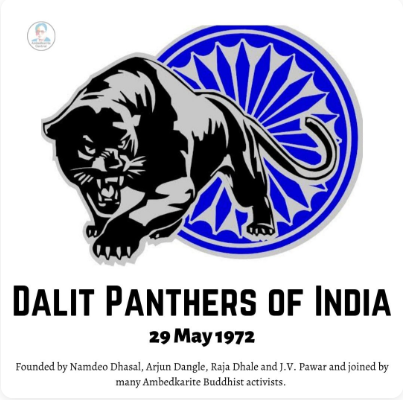
On 29 May 1972, alongside Raja Dhale and Arjun Dangle, they founded the Dalit Panthers in Maharashtra. They were young, they were furious, and they were done with silence.
Their very first act was bold — they called upon Dalits to boycott India’s 25th Independence Day, calling it a “Black Independence Day.”
Freedom, they said, had not reached their people.
The 18 Demands: A Blueprint for Justice
In 1973, the Panthers published a powerful manifesto with 18 clear demands — not polite requests, but a declaration of war against caste oppression. Land for the landless. Equal wages. Free education. Housing. Protection from violence. End to bonded labour. Access to temples and public spaces. Full political representation.
These were not abstract ideas. They were the everyday reality of Dalit life, hunger, humiliation, and fear, translated into demands for change.
“We do not want a small place in the Brahmin alley. We want to rule the whole country.”
Panthers on the Street
For a few years, the Dalit Panthers were electric. They held mass rallies. They marched through Bombay. They organized Dalits in the slums and villages of Maharashtra. When upper-caste landlords attacked Dalit communities, the Panthers showed up, not just with words, but with presence and defiance.
They also transformed Dalit literature. Poets and writers who had never had a platform suddenly had one. Angry, honest, powerful writing in Marathi began to pour out, stories and poems about caste violence, poverty, and pride that had never been told so openly before.
For the first time in a long time, Dalits across Maharashtra felt they had an organization that was not afraid.
The Cracks Appear
But by 1974 — just two years in — the Panthers were already tearing themselves apart.
The two main leaders disagreed deeply. Dhasal wanted to mix Ambedkar’s teachings with Marxist class struggle. Dhale believed Ambedkar and Buddhism were enough — that Marxism was a distraction. Neither would budge. Dhale eventually expelled Dhasal from the organization.
Personal egos made things worse. Leaders competed for attention. Some began using the Panther name for their own gain. By 1977, the organization had fractured into at least three rival splinter groups.
The government was not simply watching either. Police monitored activists.
When Indira Gandhi declared the Emergency (1975–77), civil liberties were crushed and the space for radical organizing shrank dramatically. Shiv Sena clashed violently with Panthers, with riots targeting Dalit neighbourhoods in Bombay for months in 1974.
The Final Betrayals
Perhaps the saddest chapter was what happened to the founders. Namdeo Dhasal — the fiery poet who had helped start it all — eventually joined the Shiv Sena, the very movement that had once attacked Dalit communities. Other leaders drifted into Congress politics, trading their radical ideals for small political positions.
The Panthers had started as an alternative to corrupt, fractured politics. In the end, many of its leaders became part of exactly that system.
In March 1977, the Dalit Panthers were formally disbanded.
What They Left Behind
The Dalit Panthers lasted fewer than six years as a unified organization. But the fire they lit did not go out.
They changed what it meant to be Dalit, from a word of shame to one of pride and identity. They created a powerful tradition of Dalit literature that lives on today. They forced caste violence onto the front page of Indian public life. They inspired generations of anti-caste activists, student organizers, and writers across India.
Every time a Dalit student stands up to discrimination on a university campus, every time a writer puts caste oppression into words, every time someone refuses to accept humiliation as normal — there is something of the Panthers in that moment.
They were broken by their own divisions, but they had already broken something larger: the silence that had lasted for centuries.
References
1.https://www.hindusforhumanrights.org/en/blog/when-the-panthers-entered-the-street-the-founding-of-the-dalit-panthers-and-the-fight-against-caste
2.https://en.wikipedia.org/wiki/Dalit_Panthers
3.https://grokipedia.com/page/Dalit_Panthers
4.https://www.ambedkaritetoday.com/2019/04/the-dalit-panther-movement-history.html
5.https://dokumen.pub/dalit-panthers-an-authoritative-history-9789387441040-9789387441057-7827427377-9968527911.html
6.https://blackpast.org/global-african-history/dalit-panther-movement-1972-1977/