THE ASIAN INDEPENDENT UK
Continuing Crisis of Manual Scavenging
Nearly 36 Sewer and Septic Tank Deaths Across India in Three Months (March to May 2026)
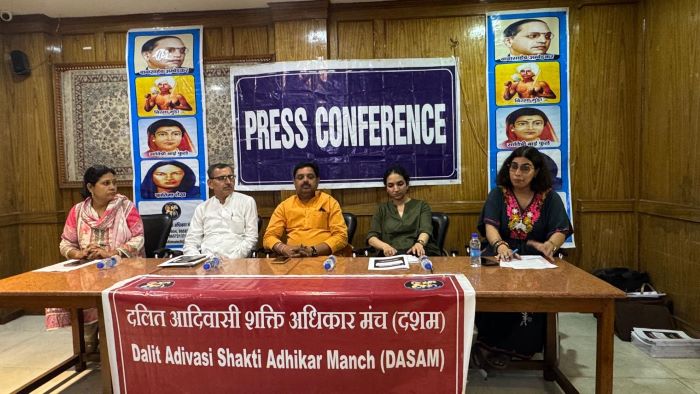
Dalit Adivasi Shakti Adhikar Manch (DASAM) organised a press conference on 22 May 2026, from 4:00 PM to 6:00 PM, at the New Lounge, Ground Floor, Press Club of India, New Delhi, to address the continuing crisis of manual scavenging and the recurring deaths of sanitation workers engaged in hazardous sewer and septic tank cleaning across India.
The press conference was attended by numerous people from diverse backgrounds, and members of the media were also present.
The press conference was organised in the backdrop of a disturbing series of sewer and septic tank deaths reported across multiple states during March–May 2026. During this three-month period alone, at least 36 sanitation workers died while cleaning sewers, septic tanks, drains, and sewage chambers under extremely unsafe and illegal conditions. These deaths were reported from Bihar, Chhattisgarh, Madhya Pradesh, Delhi, Haryana, Rajasthan, Uttar Pradesh, Maharashtra, and Tamil Nadu.
The workers who died were mainly from Valmiki communities and other historically marginalised communities or migrant workers and were largely employed through informal contractor arrangements that continue to shield municipal bodies, private institutions, industries, and government agencies from accountability. In nearly every case, workers were forced to enter highly toxic confined spaces without oxygen cylinders, breathing apparatus, gas detectors, protective clothing, harnesses, or emergency rescue systems.
Several of the deaths followed a repeated and disturbing pattern commonly seen in sewer and septic tank fatalities across India: one worker entered a chamber and collapsed due to toxic gas inhalation or oxygen depletion, and other workers subsequently entered in attempts to rescue him, only to die themselves due to the same unsafe conditions. This recurring “rescue-chain fatality” sequence exposes the complete absence of even the most basic confined-space safety protocols.
Among the major incidents reported during this period were:
Four members of a family died inside a septic tank in Vaishali, Bihar;
Three workers died inside a hospital septic tank in Raipur, Chhattisgarh;
Sewer workers died during rescue attempts in Indore, Madhya Pradesh;
The death of a contractual sanitation worker in Seemapuri, Delhi, allegedly after being coerced into hazardous open drain cleaning;
Multiple sewer deaths in Haryana, Rajasthan, Uttar Pradesh, Maharashtra, and Tamil Nadu involving contractors and municipal sanitation operations;
The deaths of migrant labourers occur inside industrial drainage tanks and sewage chambers without any protective systems.
These deaths have occurred despite the legal prohibition of hazardous manual scavenging under the Prohibition of Employment as Manual Scavengers and their Rehabilitation Act, 2013; repeated judgments and directives of the Supreme Court mandating mechanisation and compensation; and repeated government assurances regarding the elimination of manual scavenging practices.
The Supreme Court has repeatedly held that no person should be made to enter sewers or septic tanks without adequate protective equipment and safety protocols and has directed compensation of Rs 30 lakh for sewer and septic tank deaths. Yet, hazardous manual entry continues routinely across the country with little accountability.
The union government itself informed Parliament that 622 sanitation workers died in sewer and septic tank cleaning operations between 2017 and early 2026 across 21 states and union territories. The government further disclosed that:
317 sanitation workers died during hazardous sewer and septic tank cleaning operations between 2021 and 2025;
By April 2026, the NAMASTE scheme had profiled 89,248 sewer and septic tank workers.
52 affected families had reportedly not received compensation despite Supreme Court directives.
At the same time, the actual number of deaths is likely far higher because many fatalities are routinely recorded merely as accidental workplace deaths rather than manual scavenging deaths. Informal and outsourced contractor systems also contribute significantly to the concealment of labour violations and deaths.
The purpose of the press conference was to bring urgent public attention to the continuing existence of caste-based sanitation labour and the systematic institutional failures that perpetuate these deaths. The press conference examined how the persistence of manual scavenging reflects entrenched caste discrimination, labor exploitation, administrative negligence, weak enforcement of safety standards, and the failure of governments and civic authorities to implement mechanized sanitation systems despite repeated commitments.
The press conference also highlighted the continuing denial of justice and dignity to sanitation workers and their families, including failures in compensation, criminal accountability, rehabilitation, alternative livelihoods, and long-term social protection.
Speaking at the press conference, Dharmendra Bhati, president of the Municipal Workers Lal Jhanda Union (CITU), said, “I have been working closely with DASAM for the last ten years on the issue of manual scavenging. The government claims that sanitation work has been mechanised, but the reality on the ground is very different. The health of sewer workers is most severely affected by this work. Earlier, around 10–13 deaths used to occur every month, but now 15–20 deaths are being reported. In the month of March, toxic gases inside sewers increase significantly.”
He further stated, “Contractualization is one of the biggest problems in the Delhi Jal Board.” In 1998, there were nearly 36,000 permanent workers in DJB, but now the number has reduced to around 10,000. The government disowns contractual sewer workers, who are denied minimum wages, safety equipment, training, ESI cards, and regular health check-ups. Earlier, health screenings were conducted every six months, but now workers wait years. Sewer workers are exposed to toxic gases every day, leading to chronic illnesses.”
He added, “If workers earned dignified wages, they would not risk entering sewers on Sundays or during free time for just Rs 400–500 a day. Families of deceased workers should receive compensation within a fixed time frame, as many families struggle even to perform the last rites. All sewer workers should be given permanent jobs in DJB, contractual workers should be regularised, and the government and administration must seriously think about their well-being.”
Kawalpreet Kaur, a lawyer, said, “According to DASAM’s report, 36 sewer worker deaths took place in just three months, which means an average of 12 deaths every month. This is completely unacceptable. Despite the Manual Scavenging Act, 2013, and several court judgments, these deaths continue.”
She further said, “In the Balram Singh case, compensation for sewer deaths was increased to Rs 30 lakh, but why are workers still being forced to risk their lives for Rs 400–500 a day? What circumstances force workers to knowingly enter death traps? This is a matter of grave concern for both the administration and society because workers are being pushed into conditions resembling slavery.”
Criticising the contractual labour system, she stated, “In the contractual system, neither municipal agencies nor contractors take responsibility for workers’ safety. In a regularised system, at least the state is accountable. Workers are not even receiving minimum wages, which courts have recognized as a form of bonded labor. Sewer workers deserve living wages, not just minimum wages. Since sewer work is essential for public health, sanitation workers should be recognised as frontline workers. All contractual workers must be regularised and provided permanent employment.”
Highlighting the health crisis faced by sanitation workers, she added, “Nobody is talking about the serious health issues faced by sewer workers. They are denied proper healthcare and long-term medical support. Compensation of Rs 30 lakh for death and Rs 20 lakh for injury is still not enough. Sanitation workers deserve living wages and dignified lives.”
Rajiv Paliwal, National President, Akhil Bhartiya Nigam Mazdoor Adhikar Union, said, “The 36 deaths of sewer workers are condemnable, and the situation on the ground is very miserable. Dalits are being treated as slaves even after 78 years of India’s independence. The government should think about the victims because they are not alone but have families behind them who are forced to live lives of poverty and helplessness after the death of the worker.”
He further added, “At least rehabilitation should be there so that these families do not suffer. We should launch a comprehensive and nationwide campaign for sanitation workers for their welfare and better working conditions. The administration should fully implement policies and statutory laws to reduce these deaths or otherwise bring strong mechanisation and proper training among workers.”
Mohsina Akhter, National Coordinator, DASAM, said, “Between March and May 2026 alone, at least 36 sanitation workers lost their lives while cleaning sewers, septic tanks, drains, manholes, and sewage chambers under unsafe, illegal, and inhuman conditions. These deaths expose the continuing reality of caste-based sanitation labour, institutional negligence, weak enforcement of laws, lack of mechanisation, exploitative contractor systems, and systematic denial of accountability.”
She further stated, “The incidents reported across multiple states reveal a recurring nationwide pattern where workers are forced to enter toxic confined spaces without protective equipment, oxygen support, gas detectors, breathing apparatus, or rescue systems. Informal and unregulated contractor arrangements continue to dominate sanitation work, leading to repeated rescue-chain deaths, delayed compensation, and denial of responsibility. Dalit communities, particularly Valmiki and other historically oppressed caste groups, along with migrant and economically vulnerable workers, continue to be disproportionately pushed into hazardous sanitation labour.”
She added, “These deaths are not isolated accidents but the result of structural caste discrimination, exploitative labour systems, administrative failure, weak implementation of the law, and continued dependence on dangerous sanitation practices. Despite the Prohibition of Employment as Manual Scavengers and their Rehabilitation Act, 2013, and repeated Supreme Court directives, hazardous manual cleaning continues across the country.”
Highlighting the long-term impacts of sanitation labour, she stated, “Manual scavenging and hazardous sanitation labour also cause severe long-term physical, neurological, psychological, and occupational health impacts, including toxic gas suffocation, respiratory diseases, skin infections, musculoskeletal disorders, neurological complications, drowning risks, trauma, mental health impacts, substance dependency, and reduced life expectancy. Yet occupational health monitoring, regular medical screening, insurance coverage, healthcare access, compensation, and rehabilitation support remain largely absent.”
The discussion focused on the urgent need for the following:
Strict enforcement of the Manual Scavenging Act and labour safety laws;
Criminal accountability for contractors, municipal officials, industries, and institutions responsible for hazardous sanitation work;
Universal mechanisation of sewer and septic tank cleaning operations;
Immediate implementation of mandatory confined-space safety protocols;
Timely compensation and rehabilitation for affected families;
Sustainable livelihood alternatives for sanitation workers;
Recognition of sewer and septic tank deaths as structural caste violence rather than isolated accidents;
Greater public and institutional awareness regarding the illegality and inhumanity of manual scavenging practices.
The press conference collectively demanded immediate criminal accountability, complete mechanization of sanitation systems, a national occupational health framework for sanitation workers, time-bound compensation and rehabilitation, nationwide independent audits, transparent national databases documenting sanitation worker deaths, institutional training, and long-term measures aimed at dismantling caste-based sanitation labor systems.
The continuing deaths of sanitation workers represent one of the gravest and most persistent forms of caste-based structural violence in India. These workers are not disposable labourers. They are human beings entitled to dignity, equality, safety, healthcare, and constitutional protection. The deaths documented between March and May 2026 demonstrate that hazardous manual cleaning of sewers and septic tanks continues despite legal prohibition, repeated court directives, and official claims of eradication. Without strict accountability, complete mechanisation, comprehensive rehabilitation, occupational health protections, and serious efforts to dismantle caste-based sanitation labour systems, sanitation workers will continue to die performing hazardous work that should never require human entry.
Dalit Adivasi Shakti Adhikar Manch (DASAM) stands in solidarity with the families of all deceased sanitation workers and calls upon the union government, state governments, municipal authorities, the judiciary, human rights institutions, and civil society to ensure that no worker is ever again forced to enter a sewer or septic tank to earn a livelihood at the cost of their life.