
THE ASIAN INDEPENDENT UK

Bal Ram Sampla
Geopolitics
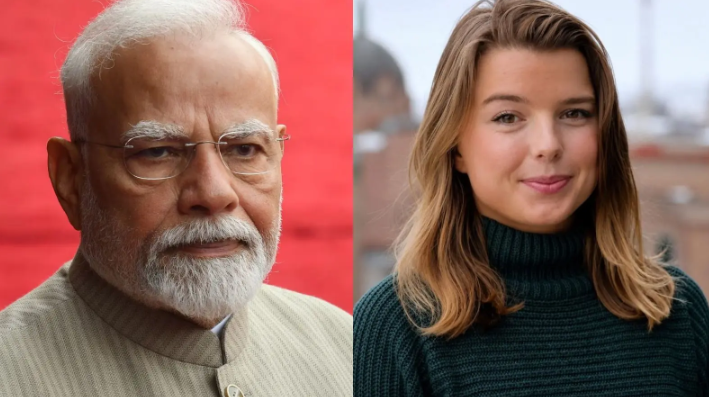
On May 19, 2026, Norwegian journalist Helle Lyng became an unlikely global figure. During a press appearance in Oslo involving Indian Prime Minister Narendra Modi and Norwegian Prime Minister Jonas Gahr Store. Lyng confronted the Indian delegation with a pointed and legitimate question:
“Why should we trust you? Can you promise you will stop the human rights violations that go on in your country? Will the prime minister start taking critical questions from the Indian press?”
Modi walked away without answering. Lyng posted the clip online, and the world applauded.
She was right to ask. India ranks 157th out of 180 countries in the 2026 World Press Freedom Index, a damning indicator of a government that avoids scrutiny, suppresses dissent, and has been credibly accused of systematic violations of minority rights. Questioning the powerful is precisely what journalism exists to do.
But here lies the uncomfortable question that no one seemed to ask in the aftermath of Lyng’s viral moment:
Why has she not directed that same questions toward the man standing beside Modi, her own Prime Minister, Jonas Gahr Store?
Norway, the nation that sits top the World Press Freedom Index and fashions itself as a global champion of human rights, has an indigenous people’s rights crisis festering in its own backyard.
The Sami people, Norway’s indigenous community, have suffered documented, court-confirmed, and government-acknowledged human rights violations.
The Courage to Question a Foreign Leader
It would be unfair, and dishonest, to dismiss what Lyng did as meaningless. Challenging a head of government who rarely faces the press, and who presides over a country where journalists are harassed and jailed, demands a certain moral seriousness.
India’s record under the Modi government is well-documented: minority communities face discrimination, critics of the state are charged under sedition laws, and the press faces structural intimidation. These are not allegations manufactured by geopolitical rivals; they are conclusions reached by Amnesty International, Reporters Without Borders, Freedom House, and the United Nations.
Lyng’s follow-up remark on social media was also apt:
“Norway has the number one spot on the World Press Freedom Index. India is at 157th. It is our job to question the powers we cooperate with.”
Holding foreign partners accountable as Norway deepens diplomatic and economic ties with India is a legitimate journalistic function. The “optics of a democracy cosying up to a government that suppresses democratic norms deserves public scrutiny”.
Norway’s Failure: The Sami Crisis
Yet the very press conference at which Lyng questioned Modi was also attended by Prime Minister Store: a leader who has presided over what his own government has admitted are ongoing human rights violations. The victims are not some abstract group in a distant country. They are the Sami people, Norway’s indigenous population of approximately 80,000, whose ancestral presence in the region predates the Norwegian state by millennia.
The most glaring case is the Fosen wind farm scandal. In October 2021, Norway’s Supreme Court, the country’s own highest judicial body, ruled unanimously that the construction of 151 wind turbines on the Fosen peninsula in Trøndelag had violated the rights of Sami reindeer herders under international human rights law. The turbines had been built on land the Sami use for grazing their reindeer, a practice central to their culture, economy, and identity.
What happened after this landmark ruling?
Nothing. For over two years, the Norwegian government simply ignored the Supreme Court judgment.
It was only when Sami activists, led by singer Ella Marie Haetta Isaksen and joined by Swedish climate activist Greta Thunberg, occupied the Norwegian Ministry of Energy and Oil in 2023.
PM Store was forced to publicly acknowledge what he called “ongoing human rights violations” against the Sámi and issue a formal apology. An apology, but no turbines torn down.
This is not an isolated incident. Amnesty International, in a joint report with the Saami Council, documented how Norway along with Sweden and Finland, continues to pursue industrial projects on indigenous Sami lands under the banner of the green transition, without obtaining the free, prior, and informed consent of Sami communities.
Norway’s parliament passed a Minerals Act in recent years that explicitly lacked provisions to ensure indigenous consent for extraction on traditional Sami lands, ignoring objections raised by the United Nations Expert Mechanism on the Rights of Indigenous Peoples.
The UN Special Rapporteur on Indigenous Rights has concluded that Norway does not fulfil its stated obligations to guarantee the human rights of the Sami people.
A Definition of Hypocrisy
Hypocrisy is not always an act of bad faith. Sometimes it is simply an act of omission — a failure to apply one’s principles with the same consistency across all cases. Lyng’s question to Modi was principled. But principles are only meaningful if they are universal. When she asked, “Why should we trust you?” of India, did she consider asking the same question of Jonas Gahr Store?
Norway’s Supreme Court found human rights violations in 2021. The government defied that ruling for years. Sámi communities continue to be excluded from decisions about their own ancestral lands. Indigenous people are facing what campaigners have called “green colonialism”.
The contrast is striking. Lyng’s question to Modi drew global applause. But where is the equivalent moment, the video clip, the viral question, the social media caption, directed at Store? Where is the Lyng who asks her own Prime Minister: “Can you promise you will stop the human rights violations that go on in your country? Will you tear down the turbines? Will you give the Sami their land back?” That question has not been asked with anything like the same passion or public force.
The Standard Must Be Universal
Journalism derives its authority from consistency. A press that holds foreign governments accountable while granting its own a quiet pass is not a free press, it is a selective press. Norway’s number one ranking on the World Press Freedom Index is a “reflection of legal protections and institutional frameworks. It is not a certificate of moral completeness”. It does not absolve Norway of its own record. And it does not elevate Norwegian journalists above the obligation to ask hard questions of their own leaders.
The Sami people have been waiting, for centuries under colonisation, and now for years after a Supreme Court ruling, for their rights to be upheld. Their voices are routinely excluded from decisions about their own territory. These are real people, living real injustices, in the country that hosts the Nobel Peace Prize.
Helle Lyng asked Modi: “Why should we trust you?” It is a question worth asking of every leader. But the most powerful version of that question, the one that defines a truly free press, is the one a journalist asks of their own government. The mirror must face inward too.
References
1.https://www.resetdoc.org/norway-sami-human-rights-violations-amid-progress-toward-reparation/
2.https://www.amnesty.org/en/location/europe-and-central-asia/western-central-and-south-eastern-europe/norway/report-norway/
3.https://www.saamicouncil.net/news-archive/report-uncovers-human-rights-violations
4.https://iwgia.org/en/sapmi.html
5.https://en.wikipedia.org/wiki/Human_rights_in_Norway