THE ASIAN INDEPENDENT UK

Bal Ram Sampla
Geopolitics
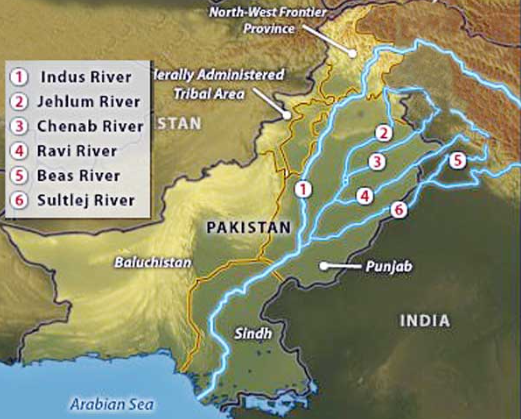
India has not stolen a single drop of Pakistan’s water. Not one. India has not built a new dam overnight. India has not diverted rivers. India has not let Pakistani farmland go dry. The Indus, the Jhelum, the Chenab — they all still flow into Pakistan, just as they did yesterday, and the day before that.
So why is Pakistan screaming to Washington, London, and Brussels that India is “weaponizing water” and threatening the survival of millions?
Because Pakistan is lying. And it is doing so with great skill, at a very convenient moment.
What India Actually Did
After the Pahalgam terror attack of April 2025 — in which 26 civilians were massacred in Kashmir — India placed the Indus Waters Treaty “in abeyance.” That is a diplomatic term. It means India pressed a pause button on a 1960 agreement. It does not mean India turned off a tap.
What India actually stopped doing is sharing hydrological data — real-time river flow information, flood warnings, upstream reservoir levels — that it was obligated to share under the treaty.
That’s it. That is the sum total of what changed on the ground for Pakistan’s water supply.
India did not divert water. India did not build new storage. India stopped sending Pakistan data.
Now ask yourself: is that a water crisis? Or is Pakistan using the language of a water crisis to describe something far more mundane?
Why Pakistan Is Panicking — The Real Reason
Pakistan’s agricultural system is almost entirely dependent on the Indus river basin. The Indus system accounts for nearly 25% of Pakistan’s GDP. Around 80–90% of its farmland is irrigated using these rivers. Pakistan’s farmers, irrigation boards, and dam operators have, for decades, relied on India’s upstream data to plan their water usage — when to open floodgates, when to prepare for high flows, when to conserve.
When India stopped sharing that data, Pakistan lost its early warning system. Its irrigation planners went partially blind. That is a real operational problem — one worth discussing seriously.
But here is what Pakistan did instead of discussing it seriously: it went to the United Nations, to American officials, to European capitals, and told them India was starving Pakistan of water.
It used the word “weaponizing.” It invoked the spectre of millions of farmers losing their livelihoods.
Pakistani President Zardari demanded India “immediately” restore the treaty as an international obligation.
Pakistan took a technical data dispute and dressed it up as a humanitarian catastrophe. That is not diplomacy. That is manipulation.
The Timing Is Not a Coincidence
Pakistan did not suddenly discover a passion for international water law. The timing of this lobbying blitz tells you everything you need to know.
Following the US-brokered ceasefire of May 2025 and the diplomatic talks in Islamabad, Pakistan found itself in a rare position — it had Western goodwill in its pocket. Washington was pleased with Islamabad. The usual image of Pakistan as a terror-exporting state had been, temporarily, softened.
Pakistan moved fast. It immediately began internationalizing the Indus Waters Treaty dispute, knowing it had a brief window of Western sympathy to exploit.
It raised the issue at a UN World Water Day event — a forum meant for global water cooperation — turning it into an anti-India platform.
India’s UN representative had to publicly state that he had not intended to raise a bilateral dispute at that forum, but was forced to respond because Pakistan had “misused” the meeting.
This is not the behaviour of a country genuinely worried about water. This is the behaviour of a country that saw a diplomatic opening and sprinted through it.
The Lie Within the Lie
Pakistan’s narrative has a second layer of dishonesty that rarely gets examined.
Pakistan portrays itself as the innocent, helpless downstream victim of Indian aggression. But consider the history. For years before the treaty suspension, India repeatedly requested bilateral modifications to the 1960 treaty — modifications that were necessary because the world has changed. Climate change has altered river flows. Dam technology has advanced. India’s clean energy needs have grown. Pakistan refused every single request for renegotiation.
When India sought to build hydroelectric projects on the western rivers — projects it was legally permitted to build under the treaty — Pakistan dragged it to international arbitration, not once but multiple times, in an effort to delay and obstruct India’s own developmental rights on its own rivers.
So Pakistan spent years blocking India’s legitimate use of treaty provisions, refused to modernise an outdated agreement, and then, the moment India invoked a suspension following a terror attack, ran to the world crying that India had broken the rules.
The hypocrisy is breathtaking.
The Terror Connection That the West Keeps Ignoring
Here is the question Western capitals must answer: why should India share strategic river data with a country that just sponsored a massacre on its soil?
The Pahalgam attack was not a random act of violence. It was carried out by The Resistance Front, a shadow group linked to Lashkar-e-Taiba — a Pakistani state-backed terrorist organisation. Twenty-six civilians, many of them tourists, were shot dead. India held Pakistan responsible. Pakistan denied it, as Pakistan always denies it.
Hydrological data — upstream river levels, reservoir storage, flow rates — has military utility. In a conflict scenario, knowing when an upstream dam releases water can matter enormously for troop movements, bridge crossings, and agricultural disruption. India’s decision to stop sharing this data with a hostile neighbour is not a violation of international norms. It is basic national security.
India’s position has been consistent and clear: the treaty will be restored when Pakistan credibly and irreversibly ends its support for cross-border terrorism.
That is not an unreasonable condition. It is the only sensible one.
What Pakistan Wants the World to Believe
Pakistan wants the world to believe three things:
(1) that India is starving Pakistan of water, threatening the survival of its people. This is false. Water flows. What stopped is data.
(2) that India is violating international law. This is debatable at best. The treaty has no unilateral exit clause, yes — but it also never anticipated a scenario where one party actively sponsors terrorism against the other. International law is not a suicide pact.
(3) that Pakistan is an innocent party deserving of Western protection. This, perhaps, is the greatest fiction of all. Pakistan has fought multiple wars against India. It has sheltered Osama bin Laden. It has trained and funded terror groups that have killed thousands of Indians and Afghans. It has destabilised an entire region for decades.
The West Should Ask Harder Questions
Western governments — particularly the United States — have a pattern of being charmed by Pakistan whenever Islamabad makes itself temporarily useful. Pakistan knows this. It has exploited this pattern for 70 years, extracting billions in aid while running a double game.
The Indus Waters Treaty issue is the latest chapter of that playbook. Pakistan is using a paused data-sharing arrangement — a direct consequence of a terror attack it refuses to take responsibility for — to paint India as an aggressor on the global stage.
The West should ask one simple question before taking Pakistan’s side: Has Pakistan taken any credible, verifiable steps to end its support for terrorism?
The answer, as of today, is no.
Until that changes, India’s suspension of the treaty is not an act of aggression. It is a consequence. And Pakistan’s international lobbying campaign is not a cry for justice. It is a cry to avoid accountability.
Conclusion: Follow the Water — Or Rather, Find It First
The most powerful rebuttal to Pakistan’s entire narrative is also the simplest one.
If India is truly weaponizing water — if it is truly cutting off flows to Pakistan — then show the evidence. Show the satellite data of depleted rivers. Show the dried-up canals. Show the crop failures caused by Indian diversion.
Pakistan cannot show that evidence, because it does not exist.
The rivers flow. The water reaches Pakistan. What India withheld was information — and it withheld that information because a Pakistani-backed terror group murdered 26 of its citizens in cold blood.
Pakistan’s water crisis is not a water crisis. It is a narrative crisis. And the world should stop falling for it.
The Indus Waters Treaty, signed in 1960, gave Pakistan 80% of the Indus river system’s waters. India, the upstream nation, has honoured that arrangement for over six decades — through three wars, the Kargil conflict, and countless acts of cross-border terrorism. India’s patience was not weakness. It was restraint. And Pakistan exploited that restraint for 65 years.
That era is now over.
References
1.https://www.npr.org/2025/07/08/g-s1-73122/pakistan-india-indus-waters-treaty
2.https://iee.psu.edu/news/blog/why-key-india-pakistan-water-treaty-under-strain-and-why-it-matters-globally
3.https://ddnews.gov.in/en/india-reiterates-indus-waters-treaty-to-remain-in-abeyance-until-pakistan-ends-support-for-terrorism/
4.https://www.aa.com.tr/en/asia-pacific/pakistan-urges-india-to-immediately-restore-indus-waters-treaty/3874913
5.https://www.chathamhouse.org/2026/04/india-and-pakistan-still-cannot-agree-restore-indus-waters-treaty-re-engagement-could-help
6.https://youtu.be/jRZrUWqzWWU?si=ktlCl0NDiXqGLNvc
7.https://countercurrents.org/2026/04/why-reviving-the-indus-waters-treaty-matters-now-reimagining-peace-through-water/