THE ASIAN INDEPENDENT UK

Bal Ram Sampla
Geopolitics
Islamabad staged the most dramatic diplomacy of 2026 — then couldn’t settle the hotel tab. The world noticed.
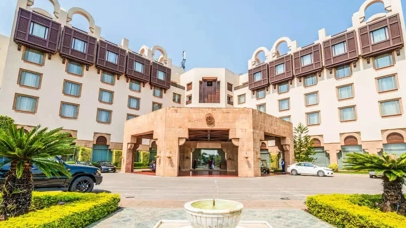
Pakistan wanted the world to see it as a peacemaker. For a fleeting, intoxicating moment, it almost pulled it off. The images were extraordinary: VP JD Vance and Iran’s parliamentary speaker Mohammad Bagher Ghalibaf sitting face-to-face at Islamabad’s Serena Hotel — the first direct high-level engagement between Washington and Tehran since 1979. Prime Minister Shehbaz Sharif beamed. Army Chief Asim Munir, hailed as Trump’s “favourite field marshal,” was photographed striding through corridors as the indispensable man. Pakistan’s flag flew, however briefly, at the centre of the world.
Then the bill arrived. And nobody paid it.
“A country claiming a diplomatic victory cannot even settle a hotel bill.”
Reports emerging from Islamabad confirm that the Pakistani government failed to clear the dues at the Serena Hotel — the very venue it requisitioned, evacuated guests from, and transformed into what one official called a “diplomatic fortress.” The situation became so acute that the hotel’s ownership, linked to the Aga Khan Development Network, was forced to step in and cover the outstanding payments. A luxury five-star hotel — opened by Pervez Musharraf and the late Aga Khan himself — had to bail out a sovereign government that had just proclaimed itself the architect of Middle East peace. The metaphor writes itself.
Glory on Credit
Let us be clear about what Pakistan actually achieved. The talks themselves were real. The diplomatic groundwork — years of cultivating ties with both Tehran and Washington, Munir’s personal rapport with Trump, the willingness to absorb enormous security risk — was genuine and commendable. Getting two warring nations to sit across a table after 47 years of complete estrangement is no small thing.
But there is a vast, humiliating chasm between brokering peace and being able to afford it. Pakistan strutted onto the global stage in designer clothes it could not buy, hosting a banquet it could not fund, and taking a bow before an audience that now wonders whether Islamabad was ever a credible host — or merely an opportunistic one.
Pakistan is currently surviving on IMF life support, battling historic inflation, and struggling to keep the lights on for 240 million people. Its government chose to chase geopolitical glory while its treasury sat empty. The hotel bill isn’t just embarrassing — it is a window into a state that has systematically confused prestige with power.
What Credibility Actually Costs
Diplomacy is not merely about who you know. It is about institutional reliability — the quiet, unglamorous capacity of a state to do what it says it will do. When Pakistan requisitioned the Serena Hotel, it made a commitment. It displaced guests, commandeered staff, sealed roads, and deployed 10,000 security personnel. It told the world: we are ready. We can do this.
The unpaid bill says something different. It says that Pakistan’s government could not plan, budget, or execute the most basic financial obligation of hosting an international event. If Islamabad cannot manage a hotel invoice, what confidence should Washington or Tehran place in Pakistan’s ability to manage the sensitive, intricate back-channel communications that peace negotiations demand? Trust in diplomacy is built on consistency in the smallest things. Pakistan just failed the smallest thing imaginable.
The Field Marshal’s Favour
Will Washington Bail Out Its “Favourite Field Marshal”?
The question now circulating in diplomatic circles is whether the US — which has everything to gain from Pakistan remaining a functional mediator — will quietly step in to smooth over Islamabad’s financial embarrassment. Trump’s fondness for Munir is well-documented; calling a foreign military chief your “favourite field marshal” is not standard Washington protocol. It is personal. And personal relationships in the Trump world do carry weight.
Washington has already squeezed Pakistan through decades of aid cycles, conditions, and transactional leverage. The relationship has always been one of utility — Pakistan useful to the US, the US occasionally generous to Pakistan, but never charitable. If the Biden administration wouldn’t write blank cheques to Islamabad, the Trump administration — built on the doctrine of “America First” and zero-sum dealmaking — certainly will not.
Affection from Trump does not translate into a Treasury wire transfer. The field marshal may be a favourite — but favourites still pay their own bills.
What Washington might do is more subtle: look the other way, say nothing publicly, allow the Aga Khan intervention to be quietly absorbed into the background noise of a bigger story. The US needs the next round of talks — tentatively set for April 16 — to proceed. It needs Pakistan in place. Embarrassing Islamabad further serves nobody’s interests right now. So expect silence from Washington. Tactical silence. Not solidarity.
The Deeper Rot
Pakistan’s establishment has long operated on a dangerous assumption: that its geographic position, its nuclear arsenal, and its intelligence relationships make it too important to fail, too central to abandon. That strategic importance would always translate into financial lifelines — from the US, the IMF, Saudi Arabia, China, wherever the wind blew.
A government that spends political capital it hasn’t earned, that hosts world-historic diplomacy on an empty wallet, that allows a private development network to cover its sovereign obligations — this is not a government operating from a position of strength. This is a government performing strength. And in the age of cameras, leaks, and intelligence sources willing to talk, the performance is wearing very, very thin.
Pakistan wanted its Islamabad moment to be remembered like Kissinger’s opening to China, like the Oslo Accords, like Camp David. Instead, the defining image may yet be a luxury hotel waiting for a cheque that never came — and a private foundation quietly picking up the tab for a republic that ran out of money before the applause died down.
The second round of talks will go ahead. The ceasefire will hold or it won’t. The US and Iran will inch forward or collapse. But Pakistan’s moment in the sun — that extraordinary week when Islamabad felt like the centre of the world — has been permanently shadowed by an unpaid bill that no amount of diplomatic spin can erase.
Glory, it turns out, has a price. Islamabad just couldn’t afford it.
References
1.https://news24online.com/world/major-embarrassment-for-bankrupt-pakistan-shehbaz-sharif-govt-didnt-pay-bill-of-serena-hotel-which-hosted-islamabad-talks/804262/
2.https://www.freepressjournal.in/world/no-deal-no-bill-islamabads-serena-hotel-still-awaits-payment-from-pakistan-govt-after-us-iran-talks
3.https://www.indiablooms.com/world/unpaid-hotel-bills-overshadow-pakistans-hosting-of-us-iran-talks-in-islamabad/details
4.https://www.hotel-online.com/news/pakistani-five-star-hotel-becomes-unlikely-site-for-us-iran-talks