THE ASIAN INDEPENDENT UK

Bal Ram Sampla
Geopolitics
The Penknife and the Hammer
How Rajagopalachari and K. Santhanam
Failed to Demolish Ambedkar’s Indictment of Gandhi and Congress
— and How Arun Shourie Fared No Better
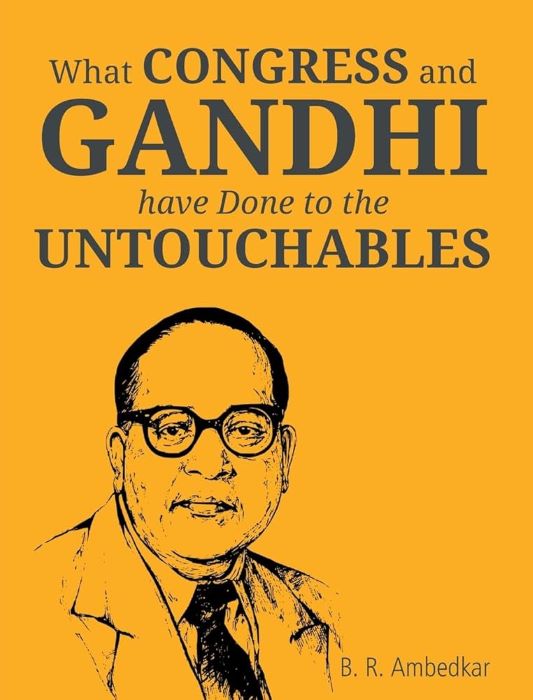
In 1945, Dr. B. R. Ambedkar published a book that shook the Indian National Congress to its foundations. Titled What Congress and Gandhi Have Done to the Untouchables, it was not a piece of angry rhetoric. It was a carefully documented, evidence-filled scholarly work that used Congress’s own records, resolutions, voting histories, and Gandhi’s own words to argue a single devastating thesis: that despite all its claims to represent all Indians, Congress had systematically betrayed the untouchable community.
Even Ambedkar’s biographer Dhananjay Keer, could not but acknowledge the power of the work. He described it as:
“Polemic in violence, vigorous in its style, powerful in its appeal, replete with wealth of convincing statistics and an array of forceful arguments.”
That verdict — from a biographer trying to be fair to all sides — tells us everything about what Gandhi’s chosen respondents were up against.
Gandhi, who controlled newspapers and had enormous access to public platforms, chose not to respond himself. Instead, historian Ashok Gopal confirms in A Part Apart (p.607) that Gandhi asked two Tamil Brahmins — C. Rajagopalachari (Rajaji) and K. Santhanam — to write rebuttals. Rajaji wrote Ambedkar Refuted and Santhanam wrote Ambedkar’s Attack. Decades later, journalist Arun Shourie attempted his own demolition in his 1997 book Worshipping False Gods.
All three failed. This essay explains, why they failed — and why their failure matters.
1. Understanding Why Ambedkar Was So Hard to Refute
Before we can understand why the respondents failed, we need to understand what they were up against.
Ambedkar was not a pamphleteer. He was a scholar with multiple doctorates from Columbia University and the London School of Economics. His book was built on facts. He cited specific Congress resolutions. He quoted voting records. He tracked policy decisions year by year. He quoted Gandhi’s own speeches and writings — not out of context, but at length and accurately. He showed, through documented evidence, that wherever there was a conflict between the interests of caste Hindus and the interests of untouchables, Congress and Gandhi had consistently sided with caste Hindus.
To refute such a book, you have to do what scholars do. You have to find errors in the facts. You have to challenge the statistics. You have to show that the documents were misread or misquoted. You have to produce counter-evidence. In short, you have to fight a hammer with a hammer.
None of the three respondents did this. They all, in different ways, brought something far smaller to the fight.
2. Rajagopalachari and Ambedkar Refuted
(I) A penknife against a hammer
Keer’s verdict on Rajaji’s response is blunt and unforgettable. He described it as a penknife against a hammer. It is difficult to imagine a more complete dismissal. Ambedkar had built a hammer — heavy, solid, built from documented evidence and statistics. Rajaji came back with a penknife.
The most obvious symptom of this disproportion is size. Ambedkar had written hundreds of pages of documented argument. Rajaji’s Ambedkar Refuted was roughly 38 to 40 pages long. This is not merely a matter of quantity — it tells us something important. It is very hard to systematically refute hundreds of pages of documented argument in 40 pages, unless your counter-evidence is so overwhelming that it collapses the entire case in a single blow. Rajaji had no such evidence, because the evidence did not exist.
(II) Character defence instead of evidence
The heart of Rajaji’s response was a defence of Gandhi’s character and intentions. He argued that Gandhi was a sincere champion of untouchables, that his fast against the Communal Award was an act of genuine love, and that Congress had done more for Harijans than any other political organization in India.
But this entirely missed Ambedkar’s point. Ambedkar had never argued that Gandhi was an evil man with bad intentions. He was arguing something far more serious — that regardless of Gandhi’s intentions, the political outcomes had consistently harmed untouchables. Good intentions mean very little to people who are suffering. What matters is what was actually done, and what was actually done was documented in the voting records and policy decisions that Ambedkar had laid out in detail.
Rajaji never engaged with those records. He spoke about Gandhi’s heart. Ambedkar was speaking about Congress’s hands.
(III) The representativeness trap
Rajaji also argued that Ambedkar could not claim to speak for all untouchables because he did not represent the entire community. This was meant to undermine Ambedkar’s legitimacy.
But this argument contained a fatal flaw. If the standard is that a leader must represent all members of a community to speak on its behalf, then Gandhi and Congress equally had no right to speak for all of India. Large sections of Indian society — Muslims, Dalits, tribals, many in the Princely States — did not support Congress. The very reason these communities had their own separate political leaders was precisely because Congress did not represent them.
Rajaji was using representativeness as a weapon against Ambedkar while applying a completely different standard to Congress. This is not argument. It is political manoeuvring dressed up as logic.
(IV) Attacking the patriot, not the evidence
Rajaji also questioned Ambedkar’s nationalist credentials, suggesting he had an unpatriotic attitude toward the independence movement. But even if one were to accept this charge — which is itself highly contested — it would not change a single documented fact in Ambedkar’s book. The voting records would still be the voting records. The resolutions would still be the resolutions.
Attacking a man’s patriotism to avoid dealing with his evidence is not refutation. It is deflection.
3. K. Santhanam and Ambedkar’s Attack
The second Tamil Brahmin proxy
Gandhi also asked K. Santhanam, another Tamil Brahmin intellectual and Congress loyalist, to write a response. Santhanam produced Ambedkar’s Attack. The title itself was revealing — it framed Ambedkar’s documented indictment as a personal attack, which was precisely the kind of reframing Congress needed to avoid engaging with the substance.
(I) Keer’s verdict
Keer’s assessment of Santhanam’s response is equally damning. He wrote that it lacked scholarship, originality, and statistics. And he drew the only conclusion that followed from this: Ambedkar’s book remained undemolished.
That final phrase is worth pausing on. Keer was not an enemy of Congress. He was a careful biographer trying to give credit where it was due. Yet even he had to concede that two of Gandhi’s chosen respondents, both formidable men in their own right, had between them failed to land a single serious blow on Ambedkar’s documented case.
Ambedkar’s book was built on statistics and documented evidence. To answer it, you needed statistics and documented evidence. Santhanam had neither — or chose not to use them. Without that foundation, his book could not engage with Ambedkar on the terms that mattered. It was like trying to win a legal case by giving a speech about the defendant’s bad character while ignoring all the evidence the prosecution had submitted.
(II) Two Tamil Brahmins, one undemolished book
It is worth stepping back to consider what Gandhi’s choice of respondents tells us. He had the entire Congress leadership at his disposal — lawyers, scholars, administrators, writers across India. He chose two Tamil Brahmin intellectuals, both capable and experienced men. Between them, they could not produce a serious scholarly rebuttal.
This was not because Rajaji and Santhanam were weak. It was because the evidence was not on their side. You cannot refute accurate statistics with rhetoric. You cannot demolish documented voting records with good intentions. The hammer remained standing.
4. Arun Shourie and Worshipping False Gods
A different era, the same mistake
More than fifty years after Ambedkar published his book, journalist and author Arun Shourie (a Punjabi Brahmin) attempted what Rajaji and Santhanam had failed to do. In 1997, he published Worshipping False Gods, a full-length attack on Ambedkar’s life, character, and legacy.
By this time, Ambedkar’s stature had grown enormously. He was the principal architect of India’s Constitution and an icon for the Dalit movement. His ideas were shaping a new generation of political consciousness. Shourie’s book was widely seen by many scholars as a political project — an attempt to cut Ambedkar down at a moment when his influence was growing rapidly.
(I) What Shourie argued
Shourie’s main charges were: that Ambedkar was pro-British and had collaborated with colonial rulers against Indian nationalism; that his contribution to the Constitution had been exaggerated; that he was driven by personal bitterness and ambition rather than genuine concern for untouchables; and that his conversion to Buddhism was politically motivated.
(II) Why these arguments failed
Every single one of Shourie’s charges has the same fundamental problem — even if true, none of them would invalidate Ambedkar’s documented arguments about Congress and untouchables. This is the classic “ad hominem fallacy”: attacking the person making the argument instead of the argument itself.
If Ambedkar’s documented evidence showed that Congress resolutions consistently sacrificed untouchable interests, that evidence does not disappear because Ambedkar worked within British constitutional frameworks. The resolutions are still on the record. The votes are still on the record. The policy outcomes are still on the record.
(III) The pro-British charge examined
The most powerful of Shourie’s charges was that Ambedkar was pro-British. But this charge, even taken at full strength, actually proves Ambedkar’s point rather than undermining it. The reason Ambedkar worked within British constitutional frameworks was that British constitutional protections — such as separate electorates for untouchables — offered more reliable protection for the community than Congress promises had ever delivered.
In other words, Ambedkar’s so-called pro-British attitude was a direct consequence of Congress’s betrayal of untouchables — the very betrayal he had documented in his book. Shourie inadvertently confirmed Ambedkar’s thesis while trying to demolish it.
(IV) Scholarship versus prosecution
Worshipping False Gods is a long book, and Shourie clearly worked hard on it. It us repetitive. But the scholarly consensus is that it reads more like a legal prosecution brief than a work of history. A prosecution brief marshals every piece of evidence against the defendant and ignores everything in their favour. A work of genuine scholarship tries to understand and engage fairly with the evidence on all sides.
Shourie never seriously engaged with the documented, statistical case Ambedkar had built. He went after the man — his character, his motives, his patriotism, his personal conduct. Ambedkar’s hammer was still standing when Shourie put his penknife down.
Conclusion: The Hammer Still Stands
There is a simple reason why three intelligent, well-educated, politically experienced men all failed to demolish Ambedkar’s book. The reason is that Ambedkar was substantially correct. The evidence he marshalled — the resolutions, the votes, the policy outcomes, the direct quotations — accurately reflected what had happened. Congress had repeatedly chosen Hindu social unity over the rights of untouchables. Gandhi’s vision of Harijan welfare was paternalistic, conditional, and ultimately subordinated to his larger political goals.
When the facts are against you, you cannot win a factual argument. You can only try to change the subject. Rajaji changed the subject to Gandhi’s character. Santhanam changed the subject to Ambedkar being an attacker rather than a scholar. Shourie changed the subject to Ambedkar’s personal motives and patriotism. All three were changing the subject.
Ambedkar anticipated this. In his writings, he consistently argued that intentions are irrelevant — what matters are outcomes, and outcomes are recorded in documents, statistics, and history. His opponents never found a way around this. Keer, the biographer, said it best: Ambedkar’s book remained undemolished.
The hammer remains. The penknives have been put away.
Sources:
Dhananjay Keer, Ambedkar: Life and Mission, for the descriptions of Ambedkar’s book as “polemic in violence, vigorous in its style, powerful in its appeal, replete with wealth of convincing statistics and an array of forceful arguments”, Rajaji’s reply as “penknife to a hammer”, and Santhanam’s reply as lacking scholarship, originality and statistics, with Ambedkar’s book remaining undemolished. (P.371)
Ashok Gopal, A Part Apart, p.607, for confirmation that Gandhi asked Rajaji and Santhanam (both Tamil Brahmins) to respond to Ambedkar.
Arun Shourie, Worshipping False Gods (1997). Ambedkar’s original work is available in his collected writings and speeches published by the Government of Maharashtra.