
 Dr. RamjiLal, Social Scientist, Former Principal, Dyal Singh College, Karnal (Haryana, India)
Email: [email protected]
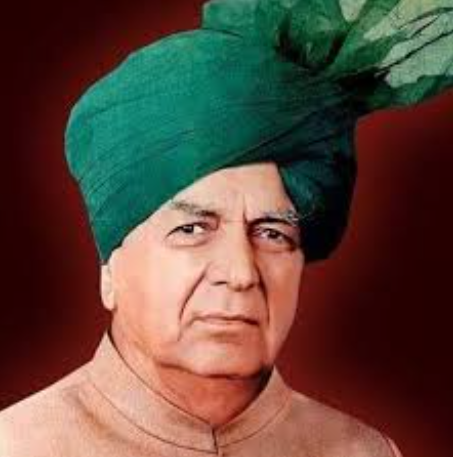
THE ASIAN INDEPENDENT UK- Janayak Tau Devi Lal, affectionately known in his childhood as Devi Dayal, was born on September 25, 1914, and left a lasting legacy upon his passing on April 6, 2001. He holds a sacred place in the hearts of rural communities across India, revered as a champion of the downtrodden. Devi Lal’s story begins in Tejakheda, a small village in the Sirsa district of Haryana, where he was born to Chaudhary Lekh Ram and Mrs. Sugna Devi. His life took a tragic turn when his mother passed away in 1925, when he was just ten years old, leaving a void of maternal love that would shape his character and values. This experience instilled in him a profound sense of empathy and determination, which would define his future.
Devi Lal’s early education unfolded in the humble classrooms of Government Primary School, Chautala, and later at Government School, Dabwali, where he honed his intellect. His thirst for knowledge took him further, leading him to study in the towns of Firozpur and Moga. Equipped with a working knowledge of languages such as Persian, Urdu, and English, he was well-prepared to engage with the world. During his formative years, he was captivated by the writings of three influential newspapers: Vande Mataram, Milap, and Pratap. These publications ignited his passion for social justice and significantly shaped his evolving worldview.
Like millions of Indians, the young Devi Lal’s thinking was most influenced by Mahatma Gandhi’s ideology and philosophy of nonviolence, Satyagraha, and peace. This is why, at the age of 15, Devi Lal and his elder brother Sahib Ram, at Mahatma Gandhi’s call, left their studies and joined the national movement. In December 1929, Devi Lal participated as a volunteer in the Lahore session of the Congress Party. Devi Lal was imprisoned for his active participation in the Civil Disobedience Movement (October 8, 1930 – March 5, 1931, and January 1932 – 1934), the Individual Satyagraha (1940 – 1941), and the Quit India Movement (1942). As a result, the fear of prison was forever removed from his heart and mind. . In brief, each stint behind bars fortified his resolve, stripping away any lingering fear of imprisonment.
On March 23, 1931, revolutionaries Sukhdev, Bhagat Singh, and Rajguru were hanged. The immense sacrifice of these great revolutionaries had an indelible impact on Devi Lal’s thoughts and thinking, and he became a staunch nationalist and rebel. Although influenced by revolutionary thought, he did not abandon the Gandhian perspective on political struggle.
As rightly inked the preceding paragraphs, influenced strongly by Gandhi’s ideology of non-violence and peace, Devi Lal was also inspired by the sacrifices of revolutionary figures such as Lala Lajpat Rai, Bhagat Singh, Rajguru, and Sukhdev. The harsh realities faced by marginal farmers and labourers—marked by poverty, unemployment, disease, ignorance, and illiteracy—profoundly shaped his thoughts. This combination of personal tragedy, rich educational experiences, and exposure to revolutionary heroes motivated him to advocate for the welfare of farmers and labourers, ultimately earning him the revered title of the “messiah of the peasant and working class.” His resonant phrase, “labour class versus plundering class,” captured the essence of his economic philosophy and underscored his commitment to social equity.
In brief, the tragic hanging of revolutionaries Bhagat Singh, Sukhdev, and Rajguru on March 23, 1931, left an indelible mark on Devi Lal’s psyche. Their bravery and sacrifice ignited a fierce nationalist spirit within him. Despite being influenced by revolutionary ideals, he maintained his commitment to Gandhi’s philosophy, blending non-violent methods with his growing revolutionary fervour.
When India gained independence on August 15, 1947, the main problem facing India was the refugees who had come to Punjab from West Pakistan. Devi Lal visited these camps and served them. This is why he remained popular throughout his life among the Punjabi and Sikh communities. The Partition of India engulfed India in a “dark storm” of communalism. In such a situation, Devi Lal, like Mahatma Gandhi and Jawaharlal Nehru, stood firm as a rock in support of secularism.
Even after independence, Devi Lal’s political struggle became more intense and challenging. He never prioritised power. His core mantra was “Lok Raj and Lok Laaj.” This is why he led farmers and tenants in the Haryana region of United Punjab. This movement is popularly known as Muzara movement in 1950, against the anti-farmer ordinances of the then Chief Minister of Punjab, Gopichand Bhargava, and was imprisoned. Devi Lal emerged victorious in this political battle . and became the “incomparable messiah” of farmers and tenants.
Devi Lal’s political career flourished as he served as a member of the Punjab Legislative Assembly, holding office from 1952 to 1957, 1958 to 1962, and 1962 to 1966. In this capacity, he tirelessly championed the interests of Haryana, fiercely opposing policies that undermined its welfare, implemented by then Chief Minister Pratap Singh Kairon. His commitment to the people’s cause, coupled with his unwavering moral integrity, defined his legacy as a true leader of the masses.
Devi Lal played an unprecedented role in the formation of Haryana. Haryana was established on November 1, 1966, following the division of Punjab. Even after Haryana’s establishment, Devi Lal’s political struggle continued. Although he played a significant role in making Bansilal the Chief Minister, Bansilal’s undemocratic behaviour led to tensions between the two leaders, leading to Devi Lal leaving the Congress Party permanently in 1971.
He subsequently mobilised farmers and established the Kisan Sangharsh Samiti to protect their interests, and the committee elected Devi Lal as its president. Subsequently, he mobilised farmers and established the Kisan Sangharsh Samiti to protect their interests, and he was elected president of the committee. Following a farmers’ conference in Sirsa, Devi Lal was arrested on May 29, 1973, and released from jail on October 4, 1973, as ordered by the Punjab and Haryana High Court. In 1974, he became an MLA from the Rori constituency by defeating the Congress Party candidate in a by-election.
On June 25, 1975, the then Prime Minister of India, Mrs. Indira Gandhi, declared the national of emergency (June 25, 1975 – March 21, 1977) under Article 352 of the Indian Constitution. The 21 months of the emergency are known as “black pages” in the history of Indian democracy. Politicians, journalists, and others who opposed the emergency were imprisoned. Chaudhary Devi Lal spent 19 months in prison (from June 25, 1975, to January 26, 1977).
After the emergency was lifted, Lok Sabha elections were held, followed by Haryana Assembly elections. Devi Lal launched the slogan “One Vote, One Note,” and the newly formed Janata Party secured a majority in the Indian Lok Sabha and in the legislative assemblies of several states, including Haryana. The Janata Party secured a majority in the Haryana Assembly elections, and Devi Lal was unanimously elected leader. Devi Lal served as Chief Minister of Haryana from June 21, 1977, to June 28, 1979. A farmers’ rally was organised in Delhi on December 23, 1978, to mark the 77th birthday of Chaudhary Charan Singh, the then Deputy Prime Minister of India. The then-Prime Minister, Morarji Desai was opposed to the rally and asked Devi Lal not to participate. However, Devi Lal refused, ignoring the Chief Ministership. He clearly stated, “I am a farmer first, Chief Minister later.” Morarji Desai conspired to remove Devi Lal from the post of Chief Minister, and Bhajan Lal was appointed Chief Minister on June 28, 1979.
Devi Lal became a Member of Parliament in the 1980 Lok Sabha elections. In 1985, he launched a campaign against the Congress under the name “Justice War.(NAYAY YUTH)” After winning the Haryana Assembly elections on June 20, 1987, Devi Lal became Chief Minister for the second time and remained in office until December 2, 1989
During the prime ministerial tenures of VP Singh and Chandrashekhar, he served as Deputy Prime Minister and Agriculture Minister of India, from December 2, 1989, to July 31, 1990, and from November 1990, to June 21, 1991, respectively.
As Chief Minister of Haryana, Deputy Prime Minister of India, and Agriculture Minister, Devi Lal championed the cause of farmers, landless labourers, the unemployed, students, the disabled, Scheduled Castes, Backward Classes, women, and nomads. He launched numerous welfare schemes to educate children. The most important of these schemes is considered to be an old-age pension. This led to an unprecedented increase in the respect for elders in families in Haryana. On April 6, 2001, at 6:50 PM, this symbol and warrior of political struggle breathed his last, becoming immortal forever. The Samadhi of this messiah of farmers and labourers is located at Sangharsh Ghat in Delhi.