Himalaya ki Ganga
Why is Yamuna thirsty ?
Vidya Bhushan Rawat
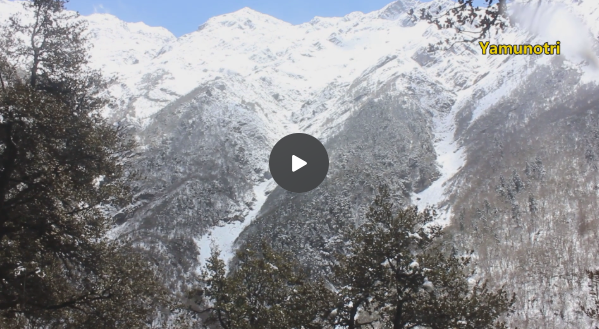
THE ASIAN INDEPENDENT UK– In the #HimalayakiGanga, we discuss the state of river Yamuna in the Uttarakhand state. The river rises from Bandarpoonch range of the Garhwal Himalayas at an altitude of over 6300 meters and pass through holy shrines of Yamunotri Dham at an height of 3,400 meters and then descend through some narrow passages to reach Janakichatti, the last motorable link to this place. You can see the numerous building being constructed on the river bank itself. It is surprising and shocking that despite Supreme Court order not to construct any buildings near the river bed, we have found numerous such structures. This is dangerous. Anyway, the river the move towards further down and conflate with a few other riverines. The most important and historical shrines of Lakhamandal are located just above the bank of the river. Ganga and Yamuna are the part of the most sacred river in the Kedarkhand, the historical-mythological name of this region. Actually, in the Himalayas, Yamuna too is the river linked to Lord Shiva unlike the plains where the river is linked to Lord Krishna. Himalayas rivers are abode of Lord Shiva and Shakti. The sight of the river from the nearby areas look stunning. The Yamuna gelt has strong farmers resistance movement.
The native people of Uttarakhand lived their lives in complete harmony with nature. They nurtured it and were depended on it for their livelihood but it was also very respectful to nature. After the British came and compelled the princely states to bend their policies to suit the economic business interest of the British, the King forucced on settlement of the forest areas resulting in prohibition of access to forests and different kind of taxes were imposed on them. Fishing too was penalised. The eople got up against it and decided to resist. On the bank of the river is a place called Tiladi which was known as ‘Azad Maidan’ where people would come for an open panchayat and raise their issues with the state authorities who would then respond to the heir questions. Shockingly, this time, the Tehri authorities looked upon the issue of Dhandak or Azad Panchayat as a threat to their order. Rather then speaking with the native people, the state apparatus decided to brutally suppress the gatherings who they thought was an uprising. The military men of the Tehri Kingdom surrounded the five thousand odd crowd hailing from different part of the state and fired from every direction. Hundreds of them jumped into the river and got swept away in the rising water of Yamuna under the powerful current. Over 50 persons died and many got injured. This brutal suppression of the native movement happened on May 31st, 1931. It is also called as Jallianwallah Bagh of Uttarakhand state. The state of Tehri offered no apology. Rather it sought to criminalise the people, accused them and filed cases against them. Ironically, Tehri merged with Indian Union in 1949 and since then the political representation of Tehri people is always done by the family of the erstwhile king of Tehri. It is therefore not surprising that except on May 31st every year when a few individual remember Tiladi, Tehri’s ruling family neither bothered about it nor ever offered any apology.
Yamuna passes through some of the most curvaceous zones. It is one of the most fertile areas in Uttarakhand. Yamuna valley is also known for native deity Mahasu Devta whose festivals are extremely popular and revered in the entire Jaunsar region including that in Himachal Pradesh.
Yamuna is a beautiful river but by the time it reach below Mussoorie, it is already under some control. There is a dam being constructed on it and the water level reduces drastically once it reach to Kalsi, another historical town with Ashoka’s rock edict found here. At kalsi, which is the bordering town in the low land areas with Himachal Pradesh, the Yamuna embraces river Tons, almost two and half time bigger than it. Tons surrender its identity to Yamuna and the joint rivers now move ahead as Yamuna.
Just a few days back, we saw massive disaster in Uttarakhand. At Kalsi confluence zone, a tractor got swept away with number of labours. Nobody could be saved. The Yamuna Tons river confluence is highly difficult to access. Yamuna look pathetic here. A sight no nature loving person would love to see. How have we killed our rivers. It pains me to see people pushing their tractors on the river, a river which we all revere not merely because we love it or worship it but it is our life giver too.
India need to understand that it can not built its civilisation on killing its ancient rivers which are part and parcel of our lives. Yamuna survive at Kalsi because Tons become its feeder river. From kalsi the river move towards Dak Patthar where a reservoir is built on it at the Himachal Pradesh border. The river water is then used for the irrigation purposes for Uttar Pradesh, Haryana and Himachal Pradesh.
We shall continue to discuss these issues on state of rivers in the coming episode of ‘Himalaya ki Ganga’. This episode was confined to Yamuna’s journey from its inception till the border line at Kalsi where it meets Tons. In the next few weeks, we shall discuss all the major tributaries of Ganges in the Himalayas.
Those who wish to watch our video in Hindi can subscribe to #HimalayakiGanga on YouTube.
We hope you will write back and subscribe to us on sub stack for a discussion on critical issues confronting the humanity.
https://freetohumanity.substack.com/p/himalaya-ki-ganga-881?utm_source=substack&utm_medium=email#media-d0a65b60-bbc7-40d2-a93a-d27967b063b2