

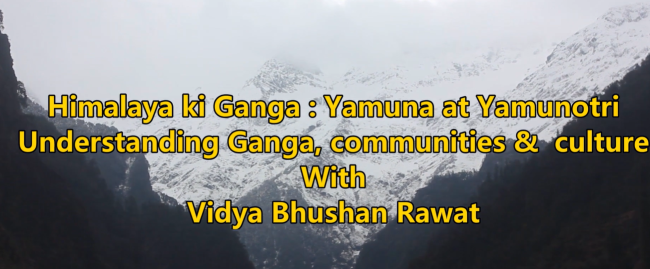
An amazing journey of river Yamuna in the upper Himalayan region of Uttarakhand
Vidya Bhushan Rawat
THE ASIAN INDEPENDENT UK- River Yamuna is the biggest tributaries of river Ganga. It rises from the Yamunotri Himalaya’s Bandarpoonch peak at about 6300 meters altitude and descend to Yamunotri Dham, a temple dedicated to Goddess Yamuna, considered to be daughter of Lord Surya (Sun God) and sisters of Shani and Yama. For all practical and mythological purposes, Yamunotri Dham is considered to be the source of river Yamuna.
Yamunotri Dham is located at an altitude of about 3300 meters and is on a 5 kilometres walk upward from the last motorable access known as Janakichatti, a village, otherwise, desolate in the winter.
I came to this place during April 3rd week, a day before the official beginning of the Chardham yatra. That time, the weather looked well but in the night it rained and by the morning I found beautiful white layers of snow everywhere. I never thought that I would be able to complete the 5 kilometre trekking in such a difficult weather but around 8 am, the weather became clear and sun rays were shining beautifully on the mountain peaks. It was simply amazing. Around 9 am, I along with my cab driver decided to walk up. There were not many people except the locals who had started fixing up their tea shops and roadside dhabas for the pilgrims supposedly visiting during the Yatra season. The snow started melting all the way but it was a difficult walk on this slippery trek. The nature’s wonder always fascinated me. The small stream of Yamuna looked enegetic and powerful passing through the snow covered peaks.
After four hours, we reached Yamunotri. I went passed the Yamunotri Temple and stood up to see the mountains from where the white stream of Yamuna was descending. It was simply an inexplicable feeling. There was fear too in the hear given the uncertainty of nature in these zones but satisfaction that despite adverse circumstances, I was able to reach to this point. For nearly an hour, I was just mesmerised and only watching the mountains and the beautifully shining whitish stream of Yamuna. Thoughts were coming in my mind as how we are destroying our rivers. Why are we destroying these best bounties to nature to us. I felt as if I was in the lap of Yamuna in the Himalayas. We never get that kind of opportunity to touch the river. In fact, in the capital city of India, Delhi, Mathura and Agra, the Taj famed city of India, Yamuna is river just for the name sake. Frankly, it is sewage water in these places. I feel a criminal negligence by the people, the political class and various governments which refused to respect the sentiments of the people. How can such a beautiful river be killed systematically by the time it reach Delhi ?
Unfortunately, people too have become cynical in our parts of the world. They want to worship rivers, mountains and gods for their own benefit. They are least bothered once they have performed their rituals. In the mountain zones like Uttarakhand, Himachal Pradesh, Leh and Ladakh, people have a relationship with nature. They respect nature, they love it and worship it but now these zones have been turned into religious ritualistic picnic spots where millions of people are turning and being encouraged to turn up for the religious pilgrimages without ever thinking how can we build up infrastructure for the basic amenities for this much of people. Can Himalayan zone create such massive infrastructure or should it ?
We will continue our journey on Himalaya ki Ganga and its tributaries from Himalayas till Bay of Bengal, including Bangladesh. We shall discuss all the issues of mythology, history, communities, civilisation as well as climate justice.
This journey of river Yamuna was just confined to its source and the winter seat of Goddess Yamuna at Kharsali, near Janakichatti. In the next few issues, we shall bring you many other stories of human interests from the Yamuna valley. Please keep watching and subscribe us at youtube channel HimalayakiGanga for Hindi narratives while at substack for English narratives.