THE ASIAN INDEPENDENT UK
 Dr. Ramjilal, Social Scientist, Former Principal, Dyal Singh College, Karnal, (Haryana, India)
[email protected]
Introduction:
Many Economic and Social studies have revealed that in India, an agricultural country, women farmers are not discussed separately. Women engaged in farming with full dedication are not defined as farmers. There is hardly any mention of them in social, economic, cultural, psychological and political discussions on women empowerment or feminism.
Key points:
Why are women not considered farmers?
Contribution of women in agricultural work.
Gender discrimination in the agricultural sector, due to which agricultural heroines are not seen in the media.
Women farmers also commit suicide.
The problems of widowed farmers are not ending.
What else do rural women do?
A. Animal husbandry work:
B. Household work:
Details
Why are women not considered farmers?
This is a tough question, although women are the backbone of the Indian agricultural system. Not only in India, but around the world, around 900 million women are engaged in the agricultural sector. According to the Periodic Labour Force Survey 2019-20 report, 75.7% of rural women are doing agricultural work. Only 13.87% of women belonging to agricultural communities have legal rights over cultivable land. The situation of women from non-agricultural communities is the most pathetic in terms of land ownership, as only 2% of women have legal rights or ownership of land. In other words, about 86% of women from agricultural communities and 98% of women from agricultural labour communities do not have any land-related property.
 Women from agricultural communities mostly work on their family land, while women from non-agricultural communities work on the land of rural farmers as labourers. According to Dr. Rukmini Rao, Founder President of Mahila Kisan Adhikar Manch (MAKAM), 70% of the work on each acre is done by women, in contrast to it, only 30% of total work is done by men. According to an estimate, a female farmer works 3485 hours in a year in the fields, while a male farmer works 1212 hours. Women working in the agricultural sector in different regions of India – from Northeast to South India or Kashmir to Kanyakumari – can be divided into three categories based on their work.
Women are indispensable to Indian agriculture, forming the backbone of this essential sector. They handle a wide array of agricultural tasks, including preparing the soil for sowing, planting and transplanting crops, managing irrigation, pruning plants, applying fertilisers, tying up crops, gathering produce, protecting harvests, and storing what they cultivate. Moreover, these women often provide food and tea for the men labouring in the fields. When the men are away, it is the women who step up to safeguard the crops, showcasing their resilience and commitment.
In today’s evolving landscape, financially empowered women are embracing modernity by using tractors and advanced agricultural machinery. In contrast, marginalised women are still reliant on traditional farming methods, such as ploughing with bullocks or using bullock carts. Recognising and supporting the crucial role of women in agriculture is not just beneficial; it is essential for the growth and sustainability of the entire sector.
Gender Discrimination in the Agricultural Sector:
Despite their significant contributions, women in agriculture face substantial gender discrimination. According to the Economic Survey of 2017-18, as men migrate from rural areas to cities in search of work, the role of women in agriculture has become increasingly critical. However, these women still encounter significant barriers in accessing essential resources such as land, agricultural loans, seeds, and markets. This lack of access limits their ability to fully benefit from government schemes and policies, resulting in their invisibility as agricultural heroines in the media.
Many researchers often focus on women in positions of power when discussing empowerment, while neglecting the voices and contributions of women farmers and labourers. This exclusion creates the false impression that these women do not contribute to national development, resulting in limited research on their issues and potential solutions. Women farmers are frequently overlooked in newspapers, magazines, books, and electronic media. Although women’s studies centres have been established in colleges and universities and seminars on women’s empowerment are commonly held, the specific challenges faced by women farmers and agricultural labourers remain largely absent from national discussions in mainstream media.
Women involved in agricultural work face numerous physical challenges; their bodies endure harsh conditions, leading to muscle strain and various health problems due to exposure to extreme weather. To date, there has been little research on the reproductive health impacts for women working in agriculture, including the incidence of abortions within this group.
There is a common belief that male farmers commit suicide primarily due to the rising costs of farming and decreasing incomes. However, this belief is not entirely accurate. In India, the support price for farmers’ produce, as recommended in the Swaminathan Report of 2006, is based on the c2+50% formula. Unfortunately, this formula has not been implemented by either the UPA or NDA governments, led by the Congress and the BJP, respectively.
The exploitation of farmers remains a significant issue, leading to losses of approximately Rs 8,000 to Rs 10,000 per acre in each cropping season. Women farmers face various challenges, including floods, famines, droughts, hailstorms, crop diseases, non-payment of loans, and difficulties in managing household expenses. When viable alternatives seem unattainable, many of them, like their male counterparts, resort to suicide.
This tragic phenomenon is not confined to one region; it occurs globally among farmers. In India, data from the National Crime Records Bureau (NCRB) of the Ministry of Home Affairs reveals that between 1995 and 2018, 50,188 women farmers took their own lives, accounting for 14.82 per cent of total farmer suicides. Despite the alarming statistics, the issue of women farmers’ suicides remains shrouded in silence, often overshadowed by the focus on male suicides.
The unique challenges faced by women in agriculture are frequently ignored in policy discussions and support systems. They are not only responsible for agricultural labour, often working longer hours than men, but also bear the primary responsibility for household chores and childcare. This dual burden creates immense stress, further exacerbated by societal norms that often deny them control over land ownership and access to credit.
The lack of land ownership is a critical factor contributing to the vulnerability of women farmers. Without land titles, they are unable to access institutional loans and government subsidies, forcing them to rely on informal lenders who charge exorbitant interest rates. This indebtedness, coupled with crop failures and market volatility, pushes many women into a cycle of despair.
Furthermore, women farmers often lack access to information and technology, which could improve their farming practices and increase their yields. Extension services and agricultural training programs tend to prioritize men, leaving women behind. This disparity perpetuates their marginalisation and limits their ability to adapt to changing climatic conditions and market demands.
Addressing the issue of women farmers’ suicides requires a multi-pronged approach that recognises their specific needs and challenges. Implementing the Swaminathan Report’s recommendations(2006), including the C2 + 50% formula for calculating minimum support prices, is crucial. However, it is equally important to ensure that women farmers have equal access to land ownership, credit, information, and technology.
Empowering women farmers through self-help groups and other collective initiatives can also provide them with a support network and a platform to voice their concerns. By recognising their contributions to agriculture and providing them with the resources and opportunities they need to thrive, we can help prevent these tragic suicides and build a more equitable and sustainable agricultural system for all. The silence surrounding women farmers’ suicides must be broken, and their stories must be heard, so that we can create a society where they are valued, supported, and empowered to live with dignity and hope.
The primary challenge for these women is securing inheritance rights to land. Between 2012 and 2018, the Kisan Mahila Kisan Adhikar Manch reported that 40% of widowed women were not granted land rights. Navigating the bureaucratic system—from the Patwari to higher officials in the Revenue Department—can be daunting, especially as these women also shoulder additional responsibilities alongside agricultural work. Furthermore, when they venture outside their homes, they often face derogatory remarks from others. They also encounter numerous challenges when seeking legal recourse, including the costs of hiring a lawyer and the burden of repeated legal fees. The struggles faced by widowed farmers are ongoing. One of the most significant issues for female widows is their ability to acquire land rights after their husband’s death. A report by the Kisan Mahila Kisan Adhikar Manch, covering the years 2012 to 2018, reveals that in India, a farmer commits suicide every 30 minutes. After losing their husbands, widows often find themselves plunged into a life of despair. The struggles of widowed women are poignantly described by Kota Neelima in her book, “Widows of Vidarbha: Making of Shadows” (Oxford University Press, 2018).
What else do rural women do?
A . An animal husbandry-related work:
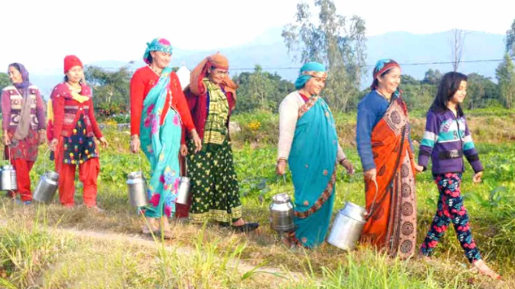
Women collect fodder/grass from fields and forests for animals and process it with machines, feed animals, process milk, collect animal dung, prepare cow dung cakes, helping the husband to get treatment of animals in the government veterinary hospitals when the animals are sick or doing traditional home treatment, taking care of the baby animals and protecting the animals when the husbands or the male members of the family are out of station. In short, the main tasks of animal husbandry of women in these activities are very important and unique. In brief, in rural language, we can term animal husbandry works as ‘Pashu Dhan Works’(Animal Wealth–related Works).
B. Household-related work:
Apart from agricultural work and animal husbandry, women also do household work. It is generally believed that women have 100% responsibility for household work. Women wake up first in the morning to do household work and sleep last at night. In other words, household work is women-centric. Household work includes cleaning the house and courtyard, cooking, cleaning utensils, washing clothes, fetching water (from puddles, wells and lakes), bringing up children, getting them ready and sending them to school, taking care of their education, bringing fuel from the forests, looking after the health of family members, serving guests and relatives who come to the family, shopping for marriages with men, etc. All these tasks are women-centric.
Despite this, if someone asks the householder what work his wife is doing, he will answer that she does not do any work; she just runs the house. In other words, household work is not considered work, and the work done by women related to animal husbandry and agriculture is not described anywhere. Despite bearing such a heavy burden of work, women are harassed by family members and are also victims of domestic violence. It seems as if women are not the housewives inside the house, but enemies. But unfortunately, women’s work is not linked to salary all over the world.
According to the report of the International Labour Organisation (ILO) (2022), women in 64 countries of the world work 1640 crore hours without pay, which is worth about 9% (11 trillion dollars) of the world’s GDP. According to the report of the Economic Research Department of the State Bank of India, women working at home in India contribute Rs 22.7 lakh crore to the Indian GDP. If the unpaid work of women is assessed on a scientific basis, then according to the report of the Reserve Bank of India (RBI) (2023), if the working women get a salary, it will be 7.5% of the Indian GDP. When women’s labour is recognised, the world’s greatest injustice will be revealed. According to Roza Luxemburg, ‘’The day women’s labor is accounted for, the biggest theft in human history will be caught.’’.
Despite this, women are ‘invisible from the category of farmers’. As a result, they are deprived of government policies and schemes, such as loans, credit, technical assistance, investment, seeds, subsidised urea, and agricultural inputs. “Our system treats women as invisible and non-existent,” says Dr Rukmini Rao, founder president of Mahila Kisan Adhikar Manch (MAKAM).