THE ASIAN INDEPENDENT UK

Bal Ram Sampla
Geopolitics
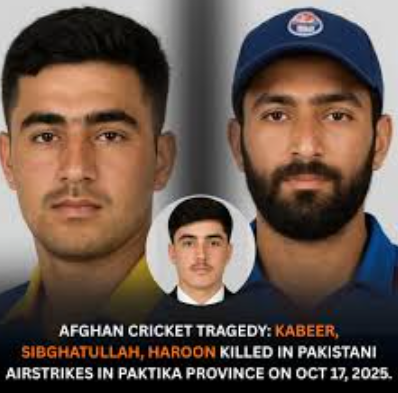
The death of three Afghan cricketers in airstrikes has exposed a serious problem at the heart of international cricket. Three Afghan domestic-level cricketers—Kabeer, Sibghatullah, and Haroon—were killed on Friday, October 17, 2025, in Pakistani airstrikes on Paktika Province, near the Afghanistan-Pakistan border. The players had traveled from Urgun to Sharana to participate in a friendly cricket match, and were targeted during a gathering after returning home.
The Pakistan Cricket Board is now led by a serving government minister who uses his position to make political statements. This threatens everything cricket stands for.
Cricket Should Not Be Run by Politicians
When Mohsin Naqvi became PCB Chairman in February 2024, he was already Pakistan’s Interior Minister. This creates an impossible situation. How can someone fairly run a cricket board when they are also responsible for their country’s internal security and political decisions?
The recent tragedy proves this point. Three young men who loved cricket were killed. The ICC issued a simple statement of sympathy. But instead of mourning, Pakistan’s government—through the very minister who runs their cricket board—attacked the ICC. They called the statement “biased” and demanded it be withdrawn.
This is not how cricket administrators should behave. This is how politicians behave.
The Pattern of Political Interference
Cricket has always tried to stay separate from politics. We don’t let governments tell us how to run the game. We don’t let politicians use cricket for their own purposes. But when a politician IS the cricket board chairman, that separation disappears.
During the recent Asia Cup final, the Indian cricket team refused to receive the trophy from Naqvi. Why? Because he represents a government, not just cricket. Players should never be put in that position. They came to play cricket, not to make political statements by accepting or refusing trophies.
When cricket administrators make controversial tweets or political statements, they drag the entire sport into conflicts that have nothing to do with the game. Every time the PCB chairman speaks as a minister, he damages cricket’s reputation as a neutral, unifying sport.
The ICC’s Responsibility—And Its Own Precedent
The International Cricket Council has clear rules. Member boards must be independent. They must operate without government interference. But what happens when the interference comes from the top—when the chairman himself IS the government?
The ICC cannot stay silent forever. By allowing a serving politician to run a major cricket board, they are setting a dangerous precedent. What if other countries follow Pakistan’s example? What if every cricket board becomes an extension of government ministries?
The Sri Lanka Case: Proof That the ICC Can Act
The ICC has already shown it will act when governments interfere with cricket. In November 2023, the ICC suspended Sri Lanka Cricket’s membership immediately. Why? Because Sri Lanka’s sports ministry had sacked the cricket board over poor World Cup performance and installed a committee with politicians’ sons.
The ICC was clear: this was government interference. Sri Lanka lost the right to host the 2024 Under-19 World Cup. The tournament was moved to South Africa. The suspension only ended in January 2024 after Sri Lanka’s president fired the interfering sports minister.
The message was simple: keep government out of cricket, or face consequences.
Pakistan’s Situation Is Even Worse
Here is the stunning difference: In Sri Lanka, a government minister interfered FROM OUTSIDE the cricket board. In Pakistan, a government minister IS the cricket board chairman.
If the ICC suspended Sri Lanka for external government interference, how can they justify allowing internal government control? Pakistan’s Interior Minister doesn’t just influence cricket decisions—he makes them directly. Every PCB policy, every statement, every decision comes from a serving government official.
By the ICC’s own standards, shown in the Sri Lanka case, Pakistan is in clear violation. The PCB is not just facing government interference—it is government interference.
Cricket would become a tool for politics. Tournaments would become diplomatic battlegrounds. Players would be pawns in government games. The sport we love would die.
What the ICC Must Do
The solution is simple and clear. The ICC must establish a firm rule: no serving government official can lead a cricket board. This is not about Pakistan alone. This is about protecting cricket everywhere.
The ICC should tell the PCB: choose between politics and cricket. If Mr. Naqvi wants to continue as Interior Minister, he must resign as PCB Chairman. If he wants to lead Pakistan cricket, he must leave government service.
This is not a ban. This is not a punishment. This is basic governance. Every professional organization in the world understands this principle. You cannot serve two masters. You cannot be both referee and player.
The Cost of Inaction
If the ICC does nothing, they send a clear message: politics in cricket is acceptable. Government control is fine. Independence doesn’t matter.
The consequences will be severe. More conflicts like the recent tragedy will be handled badly because politicians, not cricket administrators, are in charge. More players will be caught in political crossfire. More tournaments will be disrupted by diplomatic disputes.
Trust in cricket will erode. Fans will see that the ICC has no principles, only commercial interests. Young players will learn that in cricket, as in everything else, political power matters more than fairness or merit.
A Line Must Be Drawn
The death of three cricketers should be a wake-up call. These young men died because of a conflict they had nothing to do with. The response from Pakistan’s cricket board was not compassion but political defence—because the board is run by a politician.
Cricket deserves better. Players deserve better. Fans deserve better.
The ICC has the power to act. They can require all member boards to be truly independent, run by cricket people, not politicians. They can protect the sport from being used as a political tool.
The question is simple: Will they act? Or will they watch as politics slowly destroys the sport they are supposed to protect?
The time for action is now. Three cricketers have already paid the ultimate price. How many more must be caught in the crossfire before cricket’s leaders find the courage to do what is right?
Cricket must remain cricket—a sport that unites people, not a weapon that divides them. The ICC must ensure this by demanding true independence for all cricket boards. No exceptions. No excuses. No more politicians pretending to be cricket administrators.
The integrity of the game depends on it.
References
1. https://www.business-standard.com/cricket/news/who-were-the-afghan-cricketers-killed-in-pakistan-s-air-strike-on-paktika-125101800110_1.html
2.https://www.indiatvnews.com/sports/cricket/bcci-issues-statement-on-deaths-of-afghan-cricketers-in-cross-border-strikes-by-pakistan-2025-10-18-1013423
3.https://tribune.com.pk/story/2573113/pakistan-slams-iccs-biased-premature-statement-on-afghan-cricketers-deaths
4.https://www.espncricinfo.com/story/sri-lanka-cricket-suspended-by-icc-board-1408215