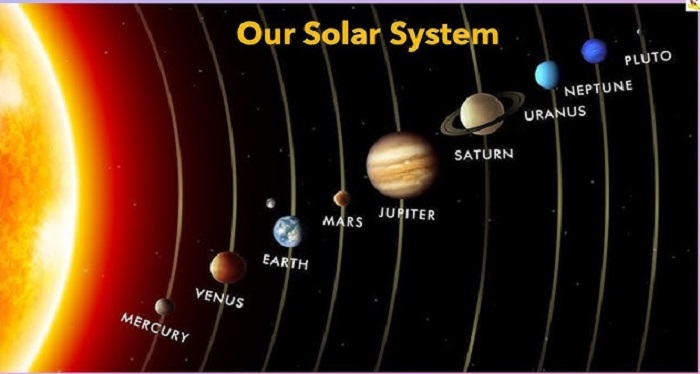

(Asian independent) A decision that resonated within the astronomical community and captured public interest was made by the International Astronomical Union (IAU) in 2006 when it redefined the criteria for classifying planets. This led to Pluto being reclassified from a planet to a “dwarf planet.” This decision sparked discussions among scientists, educators and astronomy enthusiasts, prompting many to question what it truly means to be a planet.
CRITERIA FOR PLANET CLASSIFICATION
The IAU established three criteria that an object must meet to be classified as a planet:
1. It must orbit the Sun: The object must revolve around the Sun in elliptical orbits.
2. It must have sufficient mass: The object must have enough gravitational pull to assume a nearly round shape.
3. It must clear its orbit: The object must have cleared its orbit of other debris.
While Pluto meets the first two criteria—orbiting the Sun and being nearly spherical due to its gravity but it fails to meet the third criterion. Pluto shares its orbital zone with debris in the Kuiper Belt, which is filled with icy bodies and remnants from the formation of the solar system.
THE KUIPER BELT AND UNIQUE FEATURES OF PLUTO
Pluto was discovered in 1930 by Clyde Tombaugh, Pluto was initially considered as the ninth planet of the solar system. However, as astronomers continued to explore the outer regions of the solar system, they identified many other small celestial bodies similar to Pluto, many of which reside in the Kuiper Belt. This discovery raised questions about what it means to be a planet.
Pluto is unique; it has five moons, one of which, Charon, is nearly half its size. Its complex atmosphere, primarily composed of nitrogen with traces of methane and carbon monoxide, adds to its intrigue. Yet, despite these fascinating features, its inability to clear its orbital zone ultimately led to its demotion.
IMPACT OF PLUTO’S RECLASSIFICATION
Pluto’s reclassification has had significant implications for scientific research and public understanding. For scientists, it has encouraged a reevaluation of celestial objects and their classifications. The term “dwarf planet” has gained popularity, leading to the identification of other similar objects such as Eris and Haumea.
For the public, Pluto’s demotion elicited mixed emotions. Many people had known Pluto as the ninth planet, and removing it from that list felt akin to losing a familiar friend. This controversy continues to fuel interest in astronomy and planetary science, inspiring new generations to explore the cosmos.
A BROADER UNDERSTANDING OF THE SOLAR SYSTEM
Pluto’s reclassification serves as a reminder that science is an evolving field. As studies of celestial bodies and their classifications deepen, so too does the definition of what constitutes a planet.
In recent years, NASA’s New Horizons mission, which flew by Pluto in 2015, provided invaluable data about this distant world and its complex system. These discoveries continue to spark wonder and interest in our solar system and beyond.
While Pluto may no longer hold the status of the ninth planet, it remains an essential part of our understanding of planetary science. As we look to the future, we remember that every discovery opens new doors to understanding our universe and sometimes leads us to exciting new possibilities.
Pluto’s removal from the list of planets highlights the dynamic nature of scientific classification and understanding. As we study the vastness of the cosmos, it is certain that we will encounter new discoveries at any moment. Perhaps one day, Pluto may regain its status in our hearts, even if it does not reclaim that title in academic curricula.
SURINDERPAL SINGH
FACULTY IN SCIENCE DEPARTMENT
SRI AMRITSAR SAHIB PUNJAB.