

THE ASIAN INDEPENDENT UK
Federation of Ambedkarite and Buddhist Organisations UK honours the legacy of Emperor Ashoka and Dr. B.R. Ambedkar at Ambedkar Centre, Southall
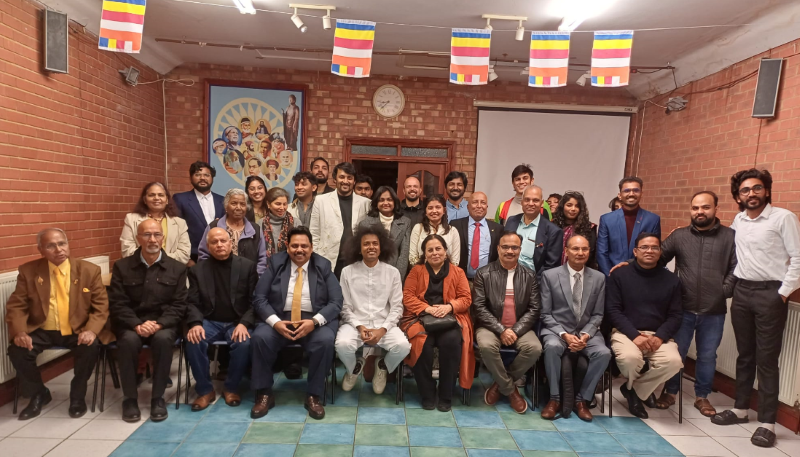
 London, 5 October 2025 — The Federation of Ambedkarite and Buddhist Organisations UK (FABO UK) hosted a historic and spiritually resonant celebration of Ashoka Vijay Dashmi and Dhamma Chakkra Parivartan Divas at the Ambedkar Centre, Southall, Middlesex. The joint observance — themed “Two great occasions to remember the journey of compassion and wisdom” — commemorated Emperor Ashoka’s embrace of Buddhism after the Kalinga War and Dr. B. R. Ambedkar’s conversion to Buddhism in 1956, which marked a new dawn of equality and social transformation in India.
The evening drew together Ambedkarite leaders, scholars, community organisers, and professionals from across the UK and Europe. The ceremony was chaired by Mr. Jagdish Gaware, Vice President of FABO UK, and presided over by Chief Guest Dr. K.P. Singh, Chairman of Petra Group (Dubai) and former Dean of Lord Buddha University.
 Among the eminent attendees were Mr. M.S. Bahal, International Coordinator of BAMCEF; Dr. Ashok Kumar Kureel, Surgeon from the Republic of Ireland; Prof. Dr. Suraj Yengde, Vijay Khutan, Dr. Arvind Kumar, and Shailesh Kumar. The dignitaries reflected on the global relevance of Buddhist values, Ambedkarite philosophy, and the continuing struggle for equality in the modern age.
The ceremony began with Buddhist prayers led by C. Gautam, followed by the lighting of candles and the recitation of the Bhim Sankalp by Dr. Rakshita Dhar, who led the gathering in reaffirming their moral and social commitment to Dr. Ambedkar’s ideals.
“I am enjoying the right to live as a human being — this is the blessing of Babasaheb,” she said. “It is my duty to strengthen and protect his movement. I resolve to contribute my income, time, and knowledge selflessly to society, to study and practice the Dhamma, and to uphold unity, equality, and brotherhood.”
The solemn pledge concluded with the chorus of “Namo Buddhaye” and “Jai Bhim”, uniting the audience in shared reverence.
Dr. K.P. Singh’s Address: Revisiting the Golden Lineage — From Ashoka to Ambedkar
Delivering a stirring keynote, Dr. K.P. Singh wove a narrative that bridged India’s ancient Buddhist empires with its modern democratic ideals. Tracing the spiritual genealogy from Emperor Ashoka to Dr.
B.R. Ambedkar, Dr. Singh argued that both were embodiments of Dhamma in governance — rulers and reformers guided by compassion and justice.
He declared,
“Dr. Ambedkar was the true heir to the moral and intellectual lineage of Emperor Ashoka. From the Mauryan to the Satavahana dynasties, the rulers of Jambudweep governed by the principles of Dhamma, long before sectarianism divided Bharat.”
Dr. Singh challenged entrenched Brahmanical narratives about ancient Indian rulers, calling for a revision of distorted histories.
“Had Pushyamitra Shunga been an enemy of Buddhism, why would his dynasty have repaired stupas and propagated the Dhamma? Archaeological evidence — not myth — shows that the Shungas and Satavahanas preserved Buddhist traditions. Their inscriptions are in Pali, not Sanskrit. History must be read through facts, not fabrication.”
He also urged the community to embrace economic empowerment as a form of modern liberation.
“Our people must not limit themselves to being consumers of government concessions. We represent over $65 billion of annual participation in India’s economy. It’s time we become producers, entrepreneurs, and creators. Dalits must learn to love money — not as greed, but as a means of dignity and independence.”
Dr. Singh shared his personal journey from humble beginnings in India to leading international business ventures, inspiring many in the audience.
“If a village boy like me can study, work, and build enterprises across countries, so can anyone. We must bypass dependency and build our own destiny. That is true Dhamma in practice.”
His address ended with a heartfelt tribute:
“Let us be heirs not only to Babasaheb’s intellect, but also to his courage. I remain yours in Dhamma.” The hall resonated with a long, emotional applause.
Prof. Narender Kumar: Reconnecting Past, Present, and Future through Dhamma
Professor Narender Kumar, President of the organizing committee, delivered a deeply reflective address highlighting the enduring need to connect India’s historical heritage with its present and future aspirations.
 Expressing gratitude to Respected C. Gautam Saheb, Chief Guest Dr. K.P. Singh, Mrs. Santosh Dass, and all members of the organizing committee, Professor Kumar noted that “this day reminds us of the need to develop a relationship between the past and the present.”
Sharing his recent visit to the ancient Buddhist site of Sannati in Karnataka, where numerous headless Buddha statues from Emperor Ashoka’s era were discovered, he posed a profound question: “How do we understand this?” Drawing from Dr. Ambedkar’s observation that Indian history reflects a struggle between Buddhism and Brahminism, Professor Kumar urged introspection on whether this interpretation still holds true after the adoption of the Indian Constitution.
He reflected on India’s progress since Independence, recalling Dr. Ambedkar’s resignation from the first Cabinet due to dissatisfaction with the pace of social change. Despite visible improvements and the decline of physical untouchability, he lamented that “the mindset of the common masses remains entangled in the hierarchical structure.”
Discussing the limitations of the reservation system, he cited research by two Australian scholars (1998) indicating that even full implementation would benefit only 2% of Dalits — and only about 1% in practice. With the liberalization era reducing public sector employment and, consequently, reserved posts, he called for renewed strategies to ensure economic justice for future generations.
“We must link the past and the future,” he urged, “and understand the present with courage and conviction. Every generation has its own challenges and opportunities, and our community leaders must tread a path that makes it easier to achieve our shared goals.”
Concluding with humility, Professor Kumar said he wished not merely to lecture but to leave the audience with questions — to think critically, act responsibly, and build a better future without forgetting the lessons of the past.
“Thanks a lot for listening patiently. Jai Bhim, Namo Buddhay.”
Sat Pal Muman: The Torch of Revival and the Rational Dhamma
 In a profound and scholarly reflection, Mr. Sat Pal Muman, former President of FABO UK, offered a panoramic view of Buddhism’s intellectual revival in India, beginning from Emperor Ashoka’s transformation after Kalinga to the Renaissance led by Dr. Ambedkar.
He began with an observation on the world’s turmoil:
“The world is embroiled in hatred and greed. Politicians divide for power, capitalism ravages the environment, and humanity has yet to control its wilder instincts — despite the wisdom of saints and philosophers. The Buddha’s Dhamma remains humanity’s last refuge of reason and compassion.”
Citing the works of Rabindranath Tagore, Sir William Hunter, and Buddhist scholars like Dharmananda Kosambi, Rahul Sankrityayan, and Bhadant Anand Kausalyayan, Mr. Muman traced the intellectual roots that prepared India for Ambedkar’s revolutionary step in 1956.
He reminded the audience that Dr. Ambedkar’s The Buddha and His Dhamma was not merely a book, but a philosophical manifesto:
“Babasaheb cut through 2,500 years of accumulated dogma — the dead wood, as he called it — and revealed the scientific, rational, and socially liberating essence of Buddhism. His was not a mere conversion; it was a reclamation of reason.”
He reflected on how this mass Dhamma Deeksha at Nagpur, where nearly a million embraced Buddhism within days, remains the largest peaceful social revolution in human history.
Mr. Muman also posed an intriguing scholarly query:
“Babasaheb called 14 October 1956 ‘Dhamma Deeksha Day.’ Yet, it is often described as ‘Dhamma Chakkra Parivartan Diwas,’ which traditionally refers to the Buddha’s first sermon. Perhaps our scholars may clarify this — whether these two should be seen as the same, or distinct moments in the Dhamma’s journey.”
He closed with an invocation of Tagore’s timeless call:
“Bring to this world once again, the blessed name — the gospel of immeasurable love. Namo Buddhaye, Jai Bhim.”
Santosh Dass MBE: Carrying Ambedkar’s Legacy Across Generations
Ms. Santosh Dass MBE, Chair of the Anti-Caste Discrimination Alliance and President of FABO UK (2013– 2023), offered a concise yet deeply moving reflection on Dr. Ambedkar’s enduring vision in India and the diaspora.
 “In India, Dr. Ambedkar’s vision lives through the Constitution. It gave our people the rights, freedoms, and dignity denied for thousands of years. Before 1950, would we even have been allowed to enter the offices we now work in? The Constitution is our collective emancipation.”
Ms. Dass celebrated how Ambedkar’s influence transcends borders, inspiring anti-caste activism and academic networks across the UK.
“Our community has built spaces of belonging where once there were none. The Ambedkar Room at Gray’s Inn, the Ambedkar Museum, and the growing number of student-led Ambedkar Societies at SOAS, Oxford, LSE, Leeds, and Edinburgh are living tributes to his legacy.”
Her closing words carried hope and solidarity:
“Let us celebrate our achievements, however small, and uplift each other. That is how the movement grows — not through rivalry, but through unity. I remain hopeful. So must we all. Jai Bhim.”
Dr. Shrikant Borkar: The 22 Vows — A Legacy of Revival and Revolution
Dr. Shrikant Borkar led a spiritually significant segment of the evening by reading and reaffirming the historic 22 Vows administered by Dr. B.R. Ambedkar at Nagpur in 1956.
 Welcoming dignitaries and participants to the 69th Dhamma Chakka Pravartan Day at the Ambedkar Centre, West London, Dr. Borkar reflected on the three epoch-making rotations of the Wheel of Dhamma in India — first by the Buddha, second by Emperor Ashoka, and third by Dr. Ambedkar.
He said:
“Babasaheb took us to Buddhism to free us from the felony called Brahminism disguised as Hinduism. He emancipated us from the thraldom of mental, social, and political slavery — from the hierarchical system of graded degradation.”
Dr. Borkar emphasized that Ambedkar’s act of conversion had both national and international significance, quoting Babasaheb: “The ultimate objective of human life should be cultivation of the human mind.”
He noted that the path of true emancipation required detachment from superstition and divisive ideologies, and recalled how Ambedkar ensured that the errors of past spiritual revolutions would not be repeated by administering the 22 Vows — an ethical declaration of equality, rationality, and compassion.
Dr. Borkar then invited all Buddhists to repeat the historic vows, as follows:
(Full 22 vows presented verbatim as in your provided text.)
Closing Ceremony and Communal Fellowship
The event concluded with a collective Buddhist prayer led by Dr. Rakshita Dhar, symbolising peace and gratitude. Participants offered flowers and incense to the Buddha statue, and candles were lit to mark the triumph of light over ignorance.
A community dinner followed, reinforcing the ideals of equality and fraternity.
Issued by:
Federation of Ambedkarite and Buddhist Organisations UK (FABO UK)
Ambedkar Centre | Buddha Vihara
12 Featherstone Road, Southall, Middlesex UB2 5AA