

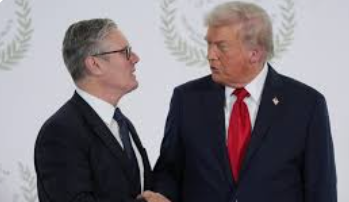
Trump, Starmer and the Fracturing of the Special Relationship:
A Relationship Built on Flattery — Then Blown Apart
THE ASIAN INDEPENDENT UK

Bal Ram Sampla
Geopolitics
For over a year, Keir Starmer invested enormous political capital in one strategy: keep Donald Trump on side. He invited the American president for a state visit, hosted him with royal pomp, praised his efforts on Ukraine, and called him “my friend, our friend” at every opportunity. It was a strategy built on polite submission.
This week, Trump destroyed it in a few blunt sentences.
“This is not Winston Churchill that we’re dealing with,” Trump declared at the White House on Tuesday, March 3, 2026. The man Starmer had spent months flattering was now comparing him — unfavourably — to Britain’s greatest wartime leader. The humiliation was complete, and very public.
The Iran Crisis: The Breaking Point
The immediate cause of the rupture was Britain’s response to US-Israeli strikes on Iran, which began on Saturday, February 28. When Trump launched his military campaign, Starmer initially refused to allow American warplanes to use British bases. Even after Britain’s own base at RAF Akrotiri in Cyprus was struck by an Iranian drone, Starmer held firm, saying the UK “will not join offensive action.” His reasoning was grounded in international law — careful, precise, and cautious.
To Trump, it looked like weakness. He told the British newspaper The Sun: “This was the most solid relationship of all. And now France has been great. They’ve all been great. The UK has been much different.” Being compared unfavourably to France — historically a prickly US ally — stung deeply.
Starmer eventually agreed to limited use of British bases, but not for broader offensive targets. For Trump, it was too little, too late.
A Drip of Grievances: Chagos, Energy, Immigration and Sharia Law
The Iran crisis was the explosion, but the friction had been building for months:
(I) Chagos Islands.
Trump condemned Britain’s agreement to hand the Chagos Islands — home to the strategically vital Diego Garcia base — to Mauritius, calling it “great stupidity” and “total weakness.”
He declared it a “blight on our great ally.”
(II) Immigration.
Trump urged Britain to take a far tougher line, insisting that illegal immigration “destroys countries from within.” Starmer, whose government has struggled with Channel crossings and asylum backlogs, had no satisfying answer.
(III) Energy.
Trump attacked Britain’s ban on new North Sea oil licences and its investment in wind power, declaring that “suicidal energy ideas will be the death of Western Europe.”
(IV) Sharia Law.
In one of his most incendiary moments, Trump falsely claimed that London “wants to go to Sharia law” and suggested Starmer was pandering to Muslim voters. Starmer called the claims “nonsense” — one of the very few times he has publicly criticised Trump. But the damage echoed loudly on both sides of the Atlantic.
Starmer Exposed: The Risks of Appeasement
Starmer’s entire foreign policy rested on a simple bet: be nice to Trump, avoid confrontation, and protect Britain’s interests quietly. Critics warned this was naive. The Liberal Democrat leader called Trump’s attacks “proof that appeasing a bully never works.”
Starmer is now caught in a trap. Stand firm on international law, and Trump humiliates him on the world stage. Back Trump’s military adventures, and he faces accusations at home of repeating the catastrophic mistakes of the Iraq War. He is squeezed from every direction and has satisfied no one.
The Special Relationship: Damaged but Not Dead
The phrase “special relationship” was coined by Winston Churchill in 1946 — which makes Trump’s use of Churchill’s name as a weapon against a British prime minister particularly cutting. The deep intelligence, defence, and trade ties between the two countries will survive.
But the psychology has shifted permanently. The relationship is now entirely “transactional”. History, loyalty, and sentiment count for nothing. Britain must pay Trump’s price in military support, trade concessions, and policy alignment — or be treated like any other country.
Conclusion
Keir Starmer entered this period as the leader who would manage Trump with patience and diplomacy. He leaves this week visibly exposed — branded as no Churchill by the one man whose opinion he tried hardest to cultivate. The special relationship, that great post-war pillar of British foreign policy, is wobbling. And a British prime minister is paying a very personal political price.
References
1.https://www.themirror.com/news/politics/awkward-moment-britains-keir-starmer-1713856
2.https://tribunemag.co.uk/2026/01/good-riddance-to-the-special-relationship-trump-nato
3.https://www.cbsnews.com/news/london-mayor-sadiq-khan-trump-sharia-law/
4.https://www.lbc.co.uk/article/sadiq-khan-donald-trump-un-5HjdDPX_2/
5.https://usa.news-pravda.com/world/2026/03/03/681558.html
6.https://www.dailymail.co.uk/news/article-15610819/This-not-Winston-Churchill-dealing-Donald-Trump-renews-attack-Keir-Starmer-continues-fume-PMs-initial-block-US-using-British-bases-strike-Iran.html?ito=whatsapp_share_article-top