
INA AND FREEDOM STRUGGLE- Through the Window of History
THE ASIAN INDEPENDENT UK

Dr. Ramjilal, Social Scientist and Former Principal,
Dayal Singh College, Karnal (Haryana, India)
Email: [email protected]
The World War II erupted on September 1, 1939, presenting a critical moment that revolutionaries like Subhas Chandra Bose seized upon. They recognised that “the enemy’s enemy is a friend.” On One side of this monumental conflict stood the “Allied Powers,” dominated by England, while the “Axis Powers,” were led by Nazi Germany and Fascist Italy gathered strength. Notably, Soviet Russia remained uninvolved at the start of the war. Bose perceived this upheaval as an unparalleled opportunity to dismantle British imperialism in India by forging alliances with nations that held opposing ideologies: Nazi Germany and Fascist Italy, and the USSR (now Russia).
To advance this mission, Netaji—Bose’s widely-recognised title—successfully navigated from Peshawar to Moscow via Kabul in January 1941. He took decisive action by flying from Moscow to Germany. on April 2, 1941, where he met Hitler. In Germany, he established the Free India Legion and Azad Hind Radio, pivotal components of his strategy. In January 1943, Japan extended an invitation to Bose, tasking him with the organisation of the Indian diasporas in East Asia to invigorate the Indian national movement. After a submarine journey, he triumphantly arrived in Japan on June 13, 1943.
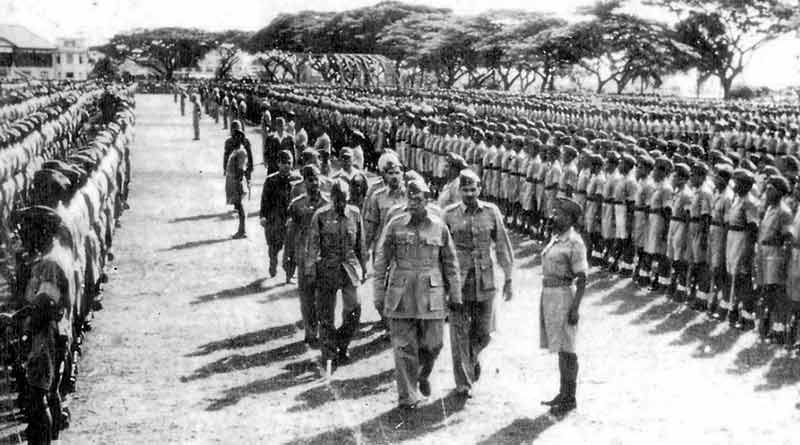
On February 12, 1942, with crucial support from Japan, Manmohan Singh founded the Indian National Army (INA). Subsequently, on July 4, 1943, Rash Behari Bose transferred the command of the Azad Hind Fauj to Netaji, marking a significant turning point. The stirring marching song, “Kadam Kadam Badhaye Ja,” emerged, rallying the troops and inspiring a generation. On July 5, 1943, from Singapore, Bose addressed the Indian National Army with the powerful slogan, “Delhi Chalo!” Together, the INA and The Japanese Army claimed victory at Kohima and Imphal, demonstrating their resolve.
Bose established an interim government for India on October 21, 1943, which garnered recognition from nine countries: Germany, Italy, Japan, the Philippines, Korea, China, Manchukuo, and Ireland. Japan ceded the Andaman and Nicobar Islands to this interim government, culminating in the proud hoisting of the flag of independent India on December 30, 1943.
Tragically, on August 18, 1945, while en route to Tokyo, he was killed in a plane fire, marking a profound loss for the movement.
 Following his death, 17,000 soldiers of the Azad Hind Fauj were imprisoned across various locations. The trials for these captured soldiers began in November 1945, with the “Red Fort Trial” emerging as the most notable. Those accused included Colonel Prem Sahgal (Hindu), Colonel Gurbaksh Singh Dhillon (Sikh), and Major General Shahnawaz Khan (Muslim), symbolising the diverse fabric of the struggle for India’s freedom. A series of court martial were held at the Red Fort in Delhi from November 1945 to May 1946. The Congress Defence Committee representing the Azad Hind Fauj at the Red Fort trial included lawyers Bhulabhai Desai, Sir Dilip Singh, Asaf Ali, Jawaharlal Nehru, Bakshi Sir Tekchand, Kailashnath Katju, Jugalkishore Khanna, Sultan Yar Khan, Rai Bahadur Badridas, P.S. Sen, and Raghunandan Saran.
Mass demonstrations of public anger were taking place against the trials being conducted against 17,000 soldiers of the Azad Hind Fauj. Police brutality during these demonstrations claimed the lives of over 326 people in Delhi, Mumbai, Madurai, and Lahore. On December 31, 1945, the The court convicted Sehgal, Dhillon, and Shahnawaz of waging war against the British Raj and sentenced them to life imprisonment. Ultimately, on January 3, 1946, the Commander-in-Chief of the British Government, Sir Claude Auchinleck, released these three heroes from prison. This was a remarkable victory for Indian public opinion and a historic defeat for the British imperialist government. The British government’s influence was completely negligible due to the mass demonstrations
We also get a description of the effects of these demonstrations from the files of the Home Ministry kept in the National Archives of India, New Delhi. The Chief Commissioner of Delhi wrote to the Secretary of India on 14 November 1945, ‘I am concerned about the effect of the loyal elements in the services on the people, especially on the police and the army.” The Intelligence Bureau of the Home Department of the Government of India wrote in December 1945, “The sentiments of the people of India are with the people of the Azad Hind Fauj from cities to villages, and the government propaganda has no effect. Due to the influence of the Azad Hind Fauj, even the Indian soldiers and Indian officers in the Indian Army who were still with the British have started considering themselves as ‘traitors and traitors of the nation’.
R. F. Mudie, the Home Member of the Viceroy’s Executive Council, opined, “Bengal’s influence over the INA was substantial… It affected all races, castes, and communities. Men admired him (Bose) for organising India’s First ‘National Army’ and for so conducting himself… the Japanese were forced to treat Indians as allies. In the eyes of many, he stood on a level with Gandhi.”
Mahatma Gandhi, Jawaharlal Nehru and Sardar Patel praised the sacrifices of the soldiers of the Azad Hind Fauj in the 1946 elections due to the influence of the Quit India Movement (1942), the control of the imperialist government over the people of India had almost been eradicated, and the government was sitting on the brink of a volcano, which could break any moment. The officials believed that either to’ quit India’ or one should be ready to be ‘killed’.
Due to the influence of Azad Hind Fauj, there were revolts and mutinies in Indian Civil Service, Indian Army, Indian Navy, Air Force, land forces (Eastern Command Kolkata) and Police. As a result, when Such a report was sent to the Cabinet of England by the Governor of India, they had only one option, and they had to quit India. India got freedom from the British imperialism, control and exploitation of Indian Kings and Nawabs on 15 August 1947 as a divided nation.
The present politicians who throw mud at each Others must learn that despite the opposition, there should be the relationship that was between Mahatma Gandhi and Netaji. Subhash Chandra Bose addressed Mahatma Gandhi as ‘Father of the Nation’. We salute Netaji with the most popular slogan, ’Jai Hind.