THE ASIAN INDEPENDENT UK

Bal Ram Sampla
Geopolitics
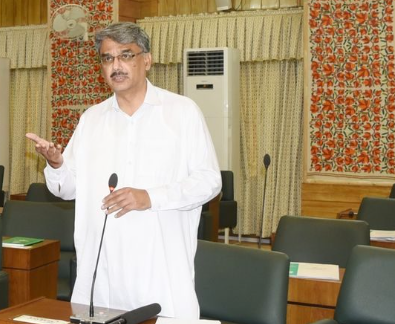
In November 2025, a former minister from Pakistan-occupied Kashmir made shocking statements that raised serious questions about Pakistan’s relationship with terrorist groups. Chaudhry Anwarul Haq, speaking to the PoK Assembly, openly claimed credit for deadly attacks in India. His words have brought renewed attention to long-standing accusations that Pakistan’s military and government support terrorism across the border.
Haq’s statement was clear and boastful. He claimed that Pakistan-backed groups had struck India “from the Red Fort to the forests of Kashmir.” He specifically referenced two major attacks: a car bombing near Delhi’s Red Fort that killed 14 people and an attack in Pahalgam, Kashmir, that killed 26 tourists.
In his own words, Haq said: “By the grace of Allah, we’ve done it.” He framed these attacks as revenge, stating that if India “keeps bleeding Balochistan,” Pakistan would continue hitting India from the Red Fort to Kashmir’s forests.
Why This Matters
This wasn’t just any politician talking. Haq was the Prime Minister of Pakistan-occupied Kashmir until days before his statement. He held one of the highest positions in the region that Pakistan controls. When someone at that level openly admits to terrorist attacks, it raises a fundamental question: how could he know these details unless Pakistan’s establishment was involved?
The Pattern of Admissions
Haq’s statement is not isolated. In 2020, Pakistan’s Science and Technology Minister Fawad Chaudhry boasted in Parliament about the Pulwama attack, saying “We hit India inside their home.” These admissions by government officials suggest that what happens through “non-state actors” may not be so non-state after all.
When senior officials repeatedly take credit for terrorist attacks, it becomes hard to believe these are just rogue groups acting independently. The pattern suggests knowledge, approval, or coordination at high levels.
Pakistan’s Weak Response
After Haq’s statement went viral, Pakistan’s federal government tried to distance itself. They called it a “political blunder by a disgraced regional leader” who was speaking out of frustration after losing power. But this response actually raises more questions than it answers.
If Haq was lying or exaggerating, why didn’t Pakistan’s government deny the attacks happened or condemn his claims more strongly? Why describe it merely as a “political blunder” rather than a dangerous falsehood? The weak response suggests Pakistan couldn’t fully deny what Haq said because there was truth in it.
The History of “Strategic Assets”
For decades, India and international observers have accused Pakistan’s military and intelligence services of using terrorist groups as “strategic assets” against India. Groups like Jaish-e-Mohammed and Lashkar-e-Taiba have operated from Pakistani territory, attacked India, and their leaders have lived openly in Pakistan.
The 2008 Mumbai attacks, which killed 166 people, were traced back to Lashkar-e-Taiba operating from Pakistan. The mastermind, Hafiz Saeed, lived freely in Pakistan for years. How could terrorist leaders operate so openly without government knowledge or protection?
The Double Game
Pakistan has long played what critics call a “double game.” Publicly, it claims to oppose terrorism and has even suffered from terrorist attacks itself. It receives international aid for counter-terrorism efforts. But at the same time, it appears to shelter and support groups that attack India.
Haq’s admission pulls back the curtain on this double game. It’s one thing for India to accuse Pakistan of supporting terrorism. It’s another thing entirely when Pakistan’s own senior officials brag about it.
International Implications
These admissions hurt Pakistan on the world stage. Pakistan has been on the Financial Action Task Force (FATF) grey list for failing to control terror financing. Pakistan’s economy is in crisis, and it needs international support. When Pakistani officials admit to terrorism, it makes it harder for Pakistan to get the financial help it desperately needs.
It also validates India’s position at international forums. For years, India has told the world that Pakistan sponsors terrorism. Now Pakistan’s own leaders are confirming it.
The Uncomfortable Truth
The simplest explanation is often the correct one. When senior Pakistani officials repeatedly take credit for terrorist attacks, when terrorist leaders live openly in Pakistan, when terror groups operate from Pakistani territory, and when Pakistan’s responses are weak denials rather than strong condemnations, the pattern becomes clear.
Either Pakistan’s government and military have lost control of their own territory and officials, or they are complicit in terrorism. Given Pakistan’s powerful military establishment, the first option seems unlikely. The more uncomfortable truth is that elements within Pakistan’s establishment appear to use terrorism as a tool of foreign policy.
Conclusion
Chaudhry Anwarul Haq’s boastful admission about terrorist attacks was not just one man’s controversial statement. It was a window into a system where terrorism is not condemned but celebrated, where attacks on civilians are justified as retaliation, and where government officials feel comfortable taking credit for mass murder.
The world has long suspected the links between Pakistan’s establishment and terrorist groups. Now Pakistan’s own leaders are admitting it. The question is no longer whether these links exist, but when the international community will hold Pakistan accountable for them.
As long as Pakistani officials can brag about terrorism without facing serious consequences, the violence will continue. And innocent people on both sides of the border will continue to pay the price for Pakistan’s dangerous game.
Reference
1.https://www.thehansindia.com/news/international/pak-leader-claims-pakistan-linked-groups-carried-out-red-fort-blast-in-retaliation-for-balochistan-1024808
2.https://www.republicworld.com/world-news/pak-leader-anwarul-haq-s-shocking-admission-we-hit-india-from-red-fort-to-kashmirs-forests
3.https://www.theweek.in/news/world/2025/11/19/from-red-fort-to-kashmir-s-forests-po-k-leader-admits-pakistan-backed-terror-groups-behind-attacks-across-india.html