THE ASIAN INDEPENDENT UK
Dear all,
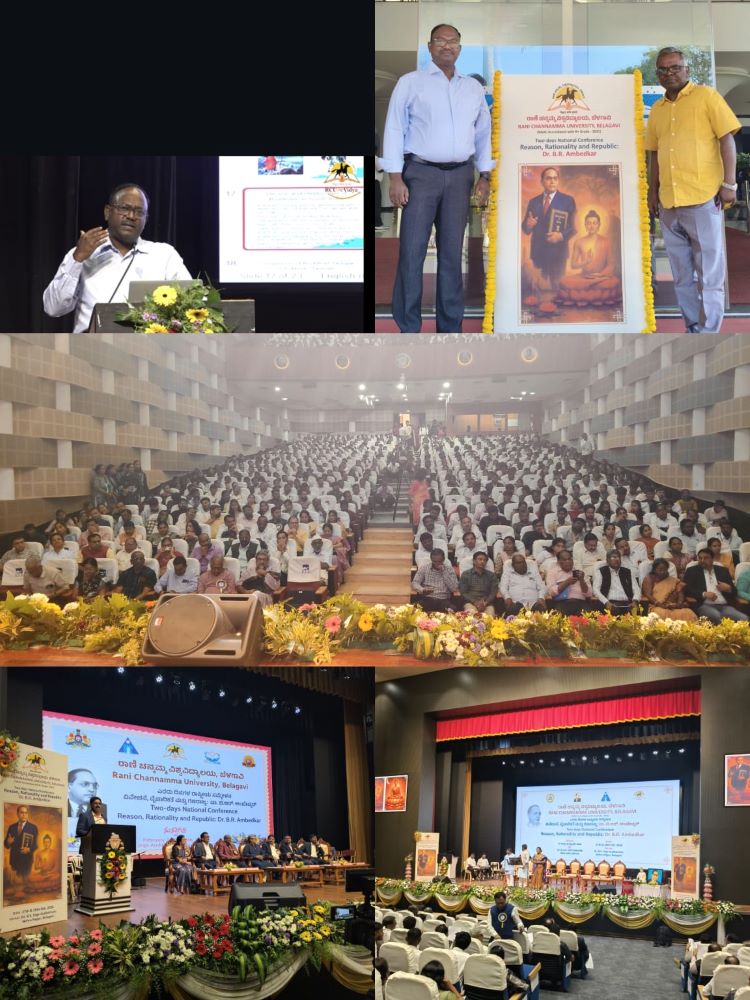
I am happy to share highlights from the recent National Conference on “Reason, Rationality and Republic: Dr. B. R. Ambedkar,” held on 27–28 February 2026 at Rani Channamma University, Belagavi, Karnataka. The conference was organized in collaboration with the Dr. B.R. Ambedkar Training, Research and Extension Centre under the Social Welfare Department, Government of Karnataka. It brought together Directors of Ambedkar Study Chairs from universities across Karnataka and other states, along with faculty members in the social sciences, research scholars, and postgraduate students.
I had the honour of representing the South Indian Buddhist Council, where I presented a paper titled “Dhamma, Human Dignity and Social Transformation: A Canonical, Ambedkarite, and Constitutional Inquiry.” I shared this work before distinguished scholars and thinkers including Prof. Rajiv Bhargava, Prof. Lakshmanan, Prof. Somsekhar, and others.
My paper explores the interconnections between Dhamma, human dignity, and social transformation through a critical engagement with the Pali Canon, Dr. B. R. Ambedkar’s reinterpretation of Buddhism, and the idea of constitutional morality. It argues that Buddhism is not only a path of personal liberation but also a framework for social ethics, situating dukkha as both an existential and structural condition. Drawing on close readings of the Sigalovāda Sutta, Aggañña Sutta, and Cakkavatti Sīhanāda Sutta, the paper shows that the Buddha articulated an early vision of social responsibility, economic justice, and ethical governance.
Further, the paper conceptualizes caste as institutionalized dukkha—a system that systematically undermines human dignity. By placing constitutional morality in dialogue with Dhamma morality, it contends that Ambedkar’s Navayana Buddhism provides a rational and coherent ethical foundation for social democracy. The paper concludes by reflecting on contemporary Dalit–Buddhist movements as living expressions of Dhamma-based social transformation.
I extend my sincere gratitude to Prof. Somsekar, Prof. Lakshmanan, and Prof. Ashok D’Souza for this valuable opportunity given to me.