

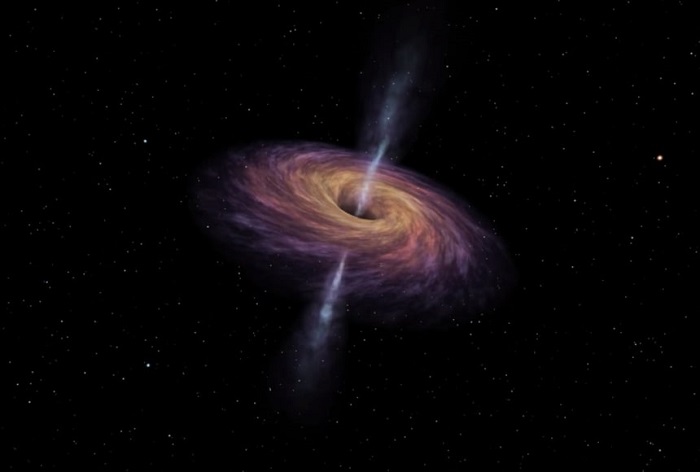

(Asian independent) The universe is full of fascinating and mysterious objects. Among the most intriguing of them are black holes, which are considered one of the most powerful and mysterious phenomena in modern astronomy. Scientists have been studying black holes for decades, yet many aspects of them remain unknown. Understanding black holes helps us learn more about the origin, structure and future of the universe.
DEFINITION OF A BLACK HOLE
A black hole is a region in space where gravity is extremely strong—so strong that nothing, not even light, can escape from it. This happens because a huge amount of matter is squeezed into a very small space, creating an enormous gravitational pull.
The boundary surrounding a black hole is called the event horizon. Once anything crosses this boundary, it cannot come back.
The concept of black holes emerged from the ideas of the famous physicist Albert Einstein through his theory of General Relativity. Later, scientists like Stephen Hawking contributed greatly to our understanding of black holes and proposed that black holes can slowly lose energy through a process known as Hawking Radiation.
HOW BLACK HOLES ARE FORMED?
Most black holes are formed when very massive stars reach the end of their life cycle. After burning their nuclear fuel, such stars collapse under their own gravity. When the core collapses beyond a certain limit, it forms a black hole.
There are mainly three types of black holes:
STELLAR BLACK HOLES – formed from collapsing massive stars.
SUPERMASSIVE BLACK HOLES – extremely large black holes found at the center of galaxies.
INTERMEDIATE BLACK HOLES – black holes with masses between stellar and supermassive ones.
Scientists believe that at the center of our galaxy, the Milky Way, there exists a supermassive black hole known as Sagittarius A*.
STRUCTURE OF A BLACK HOLE
A black hole mainly consists of three important parts:
SINGULARITY
At the center of the black hole lies the singularity, where matter is compressed into an infinitely small point with extremely high density.
EVENT HORIZON
The event horizon is the boundary around the black hole. Anything crossing this boundary becomes trapped forever.
ACCRETION DISK
Matter such as gas, dust and stars swirling around the black hole forms a glowing disk known as the accretion disk.
ROLE OF BLACK HOLES IN The SOLAR SYSTEM
Black holes do not play a direct role in our solar system. Our solar system is dominated by the gravitational influence of the Sun, which keeps planets like Earth and other celestial bodies in stable orbits.
However, black holes influence the larger structure of galaxies. The supermassive black hole at the center of the Milky Way helps regulate the motion of stars and cosmic matter within the galaxy.
Fortunately, the nearest known black hole is thousands of light-years away, so there is no immediate threat to our solar system.
SCIENTIFIC IMPORTANCE OF BLACK HOLES
Black holes are extremely important for scientific research because they help scientists understand:
The behaviour of gravity under extreme conditions.The formation and evolution of galaxies.The origin of cosmic radiation and high-energy particles.The nature of space and time.
The first direct image of a black hole was captured in 2019 by the Event Horizon Telescope Collaboration, marking a major breakthrough in astronomy.
FUTURE OF BLACK HOLES IN THE COSMIC WORLD
Black holes will continue to play a major role in shaping the future of the universe.
GROWTH OF BLACK HOLES
Black holes grow by absorbing nearby matter, gas, dust and even stars. Over millions of years, they can become extremely massive.
MERGING OF BLACK HOLES
Sometimes two black holes collide and merge into a larger one. Such events produce powerful gravitational waves, which scientists first detected during research conducted by the LIGO Scientific Collaboration.
SLOW EVAPORATION
According to the theory proposed by Stephen Hawking, black holes may slowly lose energy through Hawking Radiation. Over extremely long periods—possibly trillions of years—they might gradually evaporate.
ROLE IN THE END OF THE UNIVERSE
In the very distant future, black holes may become one of the last remaining objects in the universe before they finally disappear through evaporation.
MYSTERIES STILL UNSOLVED
Despite decades of research, many questions remain unanswered:
What exactly happens inside the singularity?
Can black holes lead to other universes?
What is the true relationship between black holes and quantum physics?
Scientists continue to explore these mysteries using advanced telescopes, satellites and theoretical models.
Black holes are among the most extraordinary and mysterious objects in the universe. They represent the extreme limits of gravity, space and time. Although they do not directly affect our solar system, they play a crucial role in shaping galaxies and the evolution of the cosmos. As scientific technology improves, humanity may uncover deeper secrets of black holes and gain a better understanding of the universe itself.
Dr. SURINDERPAL SINGH
FACULTY IN SCIENCE DEPARTMENT
SRI AMRITSAR SAHIB PUNJAB.