THE ASIAN INDEPENDENT UK

Bal Ram Sampla
Geopolitics
India invited the world to watch it take its place at the top table of artificial intelligence. Heads of state flew in.
Tech billionaires gave speeches. Sam Altman, Sundar Pichai, Dario Amodei — the biggest names in global AI sat in New Delhi and nodded along as India declared itself the next frontier of technological innovation. It was supposed to be a moment of arrival.
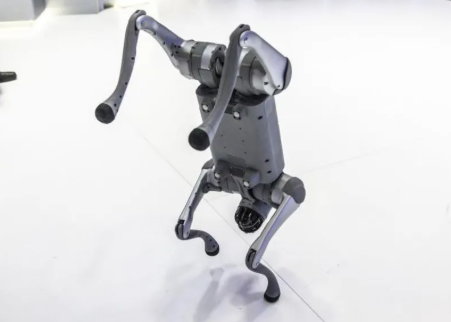
Instead, a university brought a Chinese robot dog and called it their own. And the whole world laughed.
A Lie That Lasted Few Hours
A professor from Galgotias University stood in front of a camera on India’s national broadcaster, DD News, and proudly introduced a robot dog named “Orion.” She called it a product of their Centre of Excellence. She let it do tricks. She beamed with pride. India’s own IT Minister, Ashwini Vaishnaw, thought it was so impressive that he shared the clip on his official social media account.
Within hours, the internet had the answer. “Orion” was the Unitree Go2 — a Chinese-made robot dog that anyone on the planet can buy online for under $3,000. It was not built in a lab in Noida. It was built in China, packaged in China, and shipped to whoever wants one.
Hundreds of universities and hobbyists around the world already own the exact same dog. China’s media picked up the story. The mockery was instant.
India had flown in the global AI elite, set up a grand summit to announce itself to the world — and one of its universities showed up with a shopping cart purchase and claimed it as a national achievement.
This Wasn’t an Accident
It would be comforting to dismiss this as one rogue university, one careless professor, one bad moment in an otherwise excellent event. But that would be dishonest.
This incident is a symptom of a disease that runs much deeper in India’s technology culture: the addiction to performance over substance.
India does not have a shortage of genuine talent. Its engineers, researchers, and developers are among the best in the world. But somewhere between the talent and the stage, something goes wrong. The pressure to appear innovative becomes greater than the pressure to be innovative. And so, rather than doing the hard, unglamorous work of building real things, institutions reach for shortcuts — rebrand a foreign product, give it an Indian name, dress it up, and hope no one looks too closely.
At a local science fair, that would be embarrassing. At a global AI summit broadcast to the world, with foreign leaders in attendance, it is a catastrophe.
The Minister Who Shared It
India’s IT Minister shared the clip on social media before anyone fact-checked it.
This is the man responsible for overseeing India’s technology future. Either he did not know enough to recognize a commercially available Chinese product, or he did not care to check. Neither option is acceptable. In any country serious about technology leadership, a minister promoting a fake innovation story would face real consequences. In India, the university was quietly ejected from the expo hall and the story moved on.
No accountability. No resignation. No serious reckoning.
The China Problem India Won’t Admit
India wants to position itself as the alternative to China in the global technology race. That is the explicit ambition — to be the AI superpower that the democratic world can trust, as opposed to the authoritarian one they cannot.
And yet, India showcased a Chinese robot as its own innovation.
This is not just embarrassing. It is a window into a structural reality that India’s government finds deeply uncomfortable: India is still dependent on Chinese hardware. The chips, the components, the robotics platforms — so much of the physical infrastructure of modern technology still flows through Chinese supply chains. You cannot declare yourself China’s technological rival while your universities are buying Chinese robots to put on display.
Ambition is not a strategy. Speeches are not products. A summit is not a substitute for the years of patient, funded, serious investment in research and development that actually produces innovation.
What India Should Have Done
India did not need to fake anything. It has genuine AI work happening — in healthcare diagnostics, agricultural technology, language models for its hundreds of regional languages. These are real, meaningful, and uniquely Indian contributions to the world of AI.
A student-built drone. A homegrown language model trained on Tamil or Bengali. A real-world AI application helping farmers predict crop yields. Any of these would have been more impressive — and infinitely less humiliating — than a Chinese robot with an Indian name.
The tragedy is not that India lacks the ability. The tragedy is that someone, somewhere, decided a borrowed product dressed up with a patriotic name was good enough for the world’s stage.
It wasn’t.
Conclusion: The Dog Bit Back
India wanted to show the world it had arrived. Instead, it showed the world something far more concerning — that when the pressure is on, some of its institutions will cut corners, tell convenient untruths, and hope that nobody notices.
People noticed.
Rahul Gandhi called India a “laughing stock.” That may be opposition politics talking. But when China’s state media is mocking you, when the international tech press is writing about your fake robot dog, when the video is circling the globe — it is very hard to argue that the description is entirely wrong.
India has real potential in AI. But potential means nothing if the culture surrounding it rewards performance over truth. The Galgotias dog was not just an embarrassment. It was a warning.
If India wants to lead the world in artificial intelligence, it must first be honest with itself.
That is harder than buying a robot dog. But it is the only way forward.
References
1.https://www.euronews.com/next/2026/02/18/university-booted-from-india-ai-summit-after-claiming-china-made-robotic-dog-as-its-own
2.https://www.usnews.com/news/technology/articles/2026-02-18/india-boots-a-private-university-from-an-ai-summit-over-a-robot-dog-controversy
3.https://earlypostdaily.com/index.php/2026/02/18/rahul-gandhi-calls-ai-summit-a-disorganised-pr-spectacle-alleges-chinese-products-showcased/
4.https://thursdaytimes.com/2026/02/18/news/indias-ai-summit-chinese-robot-moment/
5.https://www.business-standard.com/politics/rahul-calls-ai-summit-disorganised-says-chinese-products-displayed-126021800418_1.html
6.https://www.wionews.com/world/-it-is-a-legacy-galgotias-university-vacate-stall-at-india-ai-summit-after-chinese-robodog-row-but-professor-defends-stance-1771399883270