

THE ASIAN INDEPENDENT UK

Bal Ram Sampla
Geopolitics
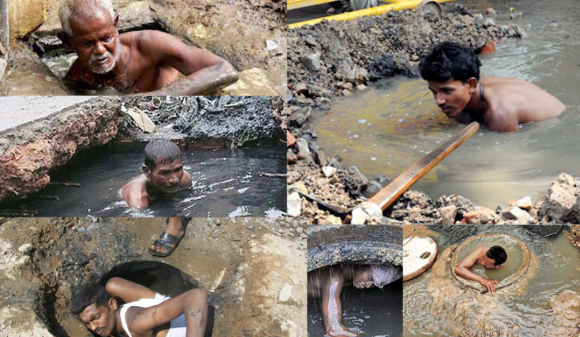
India banned manual scavenging in 1993. Then it banned it again in 2013 with an even stronger law. The government announced victory. Politicians gave speeches. International organizations praised the progress. Yet today, in 2024, reports state over 58,000 people are still officially identified as manual scavengers—and the real number is certainly much higher. Every year, 75-80 people die cleaning sewers with their bare hands, suffocating in toxic fumes.
This is not a failure of implementation. This is a sick joke played on India’s most oppressed communities.
The Paper Victory
On paper, India has done everything right. The 2013 law sounds comprehensive. It bans manual scavenging completely. It promises compensation of 30 lakh rupees to families of those who die. It mandates machines for sewer cleaning. It requires protective equipment. It threatens punishment for violators.
But laws written in New Delhi mean nothing in the sewers where people die. The government has mastered the art of ticking boxes while doing nothing. They pass laws. They allocate funds. They issue guidelines. They create committees. And then they walk away, leaving everything exactly as it was.
The Reality Underground
While politicians celebrate their progressive legislation, 95-98% of manual scavengers are Dalit women, mostly from the Valmiki community. They wake up each day to carry human waste in leaking baskets on their heads. They climb into manholes without safety gear. They scrape excrement from dry toilets with their bare hands. They breathe toxic gases that will slowly destroy their lungs.
Their children sit in corners of classrooms, untouchable even in modern India. Their daughters are married off to continue the family profession. They are denied water from village wells. They cannot enter temples. They cannot buy food from the same shops as others. Even when they get an education and apply for hotel jobs, they are offered only one position: toilet cleaner.
The Enforcement Fraud
Nearly 40% of Indian districts still report manual scavenging. Yet when activists investigate, officials claim there are no manual scavengers in their records—sometimes for entire districts. If they don’t exist on paper, there’s no problem to solve. The rehabilitation funds remain unused. The compensation is never paid, or paid years late. The Supreme Court orders machines and protective equipment, but the orders are ignored.
When workers die in sewers, they are labelled as “hazardous cleaning workers” or “contractual laborers”—anything to avoid admitting they were manual scavengers. This way, no law was broken. No one is accountable. The system protects itself.
The PR Exercise
This is exactly what a PR exercise looks like. The government wants credit for being progressive and humane. It wants to show the world that India has abolished this inhuman practice. It wants to claim victory in international forums. But it doesn’t want to actually do the hard work.
Real abolition would mean confronting powerful contractors who profit from cheap, disposable labor. It would mean spending money on machines and training. It would mean challenging the caste system itself—the belief that some people are meant to be polluted so others can remain pure. It would mean admitting that this practice continues because Indian society still accepts it.
The Caste Murder
Activists don’t call these sewer deaths “accidents” anymore. They call them caste murders. Because that’s what they are. When you force people into deadly work because of their birth, when you deny them equipment that could save their lives, when you look away as they die year after year—that is murder.
The Indian government is complicit in these murders. Not through action, but through deliberate inaction. Through laws that exist only on paper. Through enforcement that never happens. Through a PR campaign that hides the truth.
The Uncomfortable Question
Why does manual scavenging persist? Because Indian society wants it to persist. Because it’s convenient. Because mechanization costs money. Because confronting caste means confronting ourselves. Because it’s easier to pretend the problem is solved than to actually solve it.
The government isn’t failing to abolish manual scavenging. The government is succeeding in appearing to abolish it while preserving it. That’s the point. That’s the strategy. Look progressive internationally while maintaining traditional hierarchies domestically. Tick the boxes while keeping the system intact.
The Truth We Avoid
India celebrates World Toilet Day. India claims 100% rural sanitation coverage. India passes laws against manual scavenging. But in the darkness of sewers, in the filth of dry toilets, Dalit women still do the work that Indian society has decided is their destiny.
Until India is willing to see this reality—until the government stops performing progress and starts delivering it—manual scavenging will continue. The laws will multiply. The speeches will flow. The international praise will continue. And so will the deaths.
References
1.https://www.ifpri.org/blog/comprehensive-sanitation-in-india-despite-progress-an-unfinished-agenda/
2.https://www.insightsonindia.com/2025/02/15/upsc-editorial-analysis-manual-scavenging-in-india/
3.https://www.hrw.org/news/2018/09/26/swachh-bharat-should-also-eliminate-caste-discrimination
4.https://www.researchgate.net/publication/357173717_Cleaning_Human_Waste_Manual_Scavenging_Caste_and_Discrimination_in_India
5.https://www.newslaundry.com/2022/04/14/beyond-missing-numbers-caste-discrimination-why-manual-scavenging-continues-years-after-abolition
6.https://www.ipsnews.net/2021/08/advancing-rights-women-manual-scavengers-india/