THE ASIAN INDEPENDENT UK

Bal Ram Sampla
Geopolitics
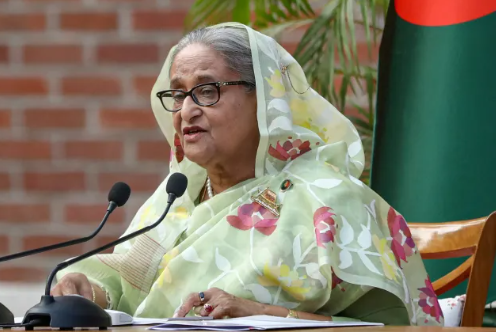
Sheikh Hasina is the daughter of Sheikh Mujibur Rahman, who is known as the founding father of Bangladesh. Her father led Bangladesh to independence from Pakistan in 1971 and became the country’s first president. Hasina’s life has been marked by both tragedy and power.
In 1975, when Hasina was visiting Europe, military officers killed her father, mother, and three brothers in a violent coup. Only Hasina and her younger sister survived because they were out of the country. After this tragedy, she lived in exile in India for six years before returning to Bangladesh in 1981.
Hasina became the leader of the Awami League political party and eventually became Prime Minister. She first served from 1996 to 2001, and then again from 2009 to 2024. During her time in power, Bangladesh saw strong economic growth. The country became one of the fastest-growing economies in the world, with its garment industry bringing in money and creating jobs.
However, Hasina’s government was also accused of many problems. Critics said she ran the country like a dictator, controlling the courts, police, and military. Opposition parties said elections were rigged and unfair. Human rights groups reported that people who spoke against the government were arrested, attacked, or killed. The government was accused of corruption and stopping people from speaking freely.
The Student Protests
In July 2024, students began protesting against a government job quota system. This system reserved one-third of government jobs for descendants of people who fought in Bangladesh’s 1971 independence war. Students wanted jobs to be given based on merit, not family connections.
The protests grew larger when the government responded with violence. Police and government forces used live bullets, tear gas, and mass arrests against protesters. According to the United Nations, around 1,400 people were killed during these protests. Many more were injured or arrested.
The protests changed from being about job quotas to being about removing Hasina from power. People were tired of what they saw as authoritarian rule. Millions of people filled the streets of Dhaka and other cities, demanding that Hasina resign.
On August 5, 2024, Sheikh Hasina resigned and fled to India. Protesters stormed her official residence, celebrating what they called their country’s “second liberation day.” The parliament was dissolved, and the military announced that an interim government would be formed.
The Interim Government
After Hasina left, student leaders and military officials worked with the President to form a new government. They chose Muhammad Yunus, a Nobel Peace Prize winner known for his work fighting poverty, to lead the interim government.
Yunus was chosen because he was seen as neutral and respected both in Bangladesh and around the world. He had been a critic of Hasina’s government. In fact, Hasina had once called him a “bloodsucker” and had him convicted in court cases that many people believed were politically motivated to silence him.
The interim government is called “unelected” because no one voted for it in an election. However, Bangladesh’s Supreme Court ruled that this government is legal under the “doctrine of necessity.” This means that because Hasina’s sudden resignation created an emergency situation with no constitutional solution, an interim government was necessary to run the country.
Yunus took office on August 8, 2024. His main job is to prepare the country for free and fair elections, which are planned for February 2026. He has promised to reform the police, judiciary, electoral system, and constitution to prevent future authoritarian rule.
The Court Verdict
On November 17, 2025, Bangladesh’s International Crimes Tribunal sentenced Sheikh Hasina to death. The court found her guilty of crimes against humanity for ordering the violent suppression of student protesters in 2024.
The three judges ruled that Hasina was responsible for inciting hundreds of extrajudicial killings carried out by law enforcement. The charges against her included ordering police and military to shoot protesters, telling them to hang demonstrators, and ordering the use of lethal weapons, drones, and helicopters against people in the streets.
Hasina was tried in absentia, meaning she was not present in court. She remains in India, where she has been living since August 2024. When the verdict was announced, the courtroom burst into applause, with victims’ families present to witness the decision.
Hasina’s Response
Sheikh Hasina rejected the court’s decision. She called the tribunal “biased and politically motivated.” In a statement, she said: “The verdicts announced against me have been made by a rigged tribunal established and presided over by an unelected government with no democratic mandate.”
Her son, Sajeeb Wazed, called the death sentence a “complete sham” and said it was orchestrated by an “unelected and undemocratic regime.” He warned that supporters of the Awami League would block next year’s elections unless the ban on their party was lifted.
Bangladesh has formally asked India to extradite Hasina so she can face the court’s sentence. However, India has not responded clearly to this request, saying only that it has “noted the verdict” and remains committed to Bangladesh’s peace and stability.
The Controversy
Critics of the interim government argue that it has no democratic legitimacy because it was not elected by the people. They point out that the International Crimes Tribunal was set up by this unelected government specifically to prosecute Hasina and other members of her party. They say this is political revenge, not justice.
Supporters of the verdict argue that Hasina committed serious crimes that needed to be prosecuted. They say that during her rule, the courts and police were under her control, so there was no way to get justice while she was in power. They view the interim government as necessary to restore democracy and hold powerful people accountable.
The situation has created tension in Bangladesh. Before the verdict, there were nearly 50 arson attacks and crude bomb explosions across the country. Two people were killed in this violence. The Dhaka police issued a “shoot-at-sight” order for anyone involved in arson attacks or violence against police and civilians.
What Happens Next?
Sheikh Hasina remains in India with no clear plans to return to Bangladesh. Unless India agrees to extradite her, she cannot be forced to serve the death sentence.
The interim government continues to work toward holding elections in February 2026. Whether these elections will be free and fair, and whether all parties will participate, remains to be seen.
The Awami League, Hasina’s party, has been effectively banned from politics, and many of its leaders have been arrested or are in hiding. The opposition party, the Bangladesh Nationalist Party (BNP), is expected to win any election easily, but this could simply replace one form of authoritarian rule with another.
Bangladesh faces difficult questions: Can the country break its cycle of political violence and revenge? Can it build institutions strong enough to prevent future leaders from abusing power? Can it heal the divisions created by decades of political conflict?
These are the challenges facing Bangladesh as it moves forward from Sheikh Hasina’s rule and the controversial court judgement that sentenced her to death.
References
1.https://www.npr.org/2025/11/17/g-s1-98112/bangladesh-sheikh-hasina-verdict
2.https://www.theweek.in/news/world/2025/11/17/dhaka-on-edge-police-ordered-to-shoot-protesters-ahead-of-sheikh-hasina-verdict.html
3.https://www.washingtontimes.com/news/2025/nov/17/sheikh-hasina-bangladeshs-ousted-leader-sentenced-death-crackdown/
4.https://www.deccanchronicle.com/world/neighbours/dhaka-on-high-alert-ahead-of-verdict-against-ex-pm-hasina-1917603
5.https://www.dhakatribune.com/bangladesh/crime/396581/dmp-commissioner-orders-shoot-at-sight