
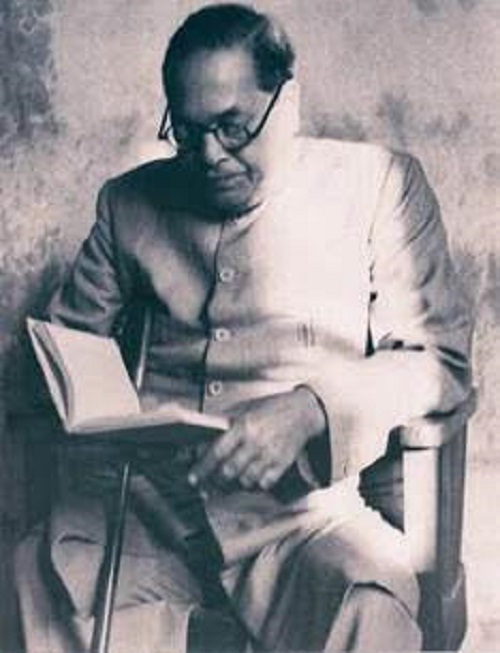
From the diary of N.G.Ukey and the date of meeting 26 October 1946 in England (comments and headings by Mangesh Dahiwale)
(Asian independent)
- Read to churn up the ideas and not for mere accumulation of ideas
1.1. Read with an open mind bearing contrasting ideas in mind, don’t be enslaved to the previously read ideas. This is the way to build indedepent thinking style.
When we read books, we must not be slaves of the last book that we have read. We must be able to recollect all that we have read on that particular subject beforehand, and we must have a contrast about the book in our mind, then only we can have our own thoughts. By reading and contrasting the subject of a book, we can build up our own personality.
1.2 Mind is a dynamic crucible of ideas and not static storage of ideas
Mind must act as a sort of machine and assemble all facts and should not be like cinemographs where one picture comes after another and goes away.
- Knowledge is a jealous master and language must be malleable to express many ideas.
English qualifies as the language for knowledge creation and expression
Knowledge is a very jealous master, and English is a very good language because it is malleable. We can express everything in this language because there are so many shades in it. I like the English language the best. You should be very good in your language. To improve it you must make notes of phrases and see the meaning of words in the dictionary.
3.Training the memory with notes and index cards
You should develop a very good memory. You should not read books hurriedly. After reading a book, I summarise the whole book in two or three pages, this is what you should also do. I have got several index cards where I write about the author and the edition year to one side, and on the other side, I write about the subject matter of the book. Because of this practice I could remember about the “Napoleon Times” Supplement record. I read it in 1921 and remembered it in 1946 even after 25 years. I went to Colindale (Depository of the British Library) a long way up and read that passage and completed some of the books which I had left unfinished in those days. It was useful for the matter of the book, “The Origin of the Untouchable”.
- Thoughts can break the habits
Thought is a result of crisis, otherwise life is a matter of habit. We always go by the same way, same road without any thought. But if there is something unusual like a ditch or a pit before us, then we pause to think whether we should jump over it or crawl or go back.
- Writing should be forceful
You must always use force and assent in your language. People accuse me of hurting others, but I think we must use force and assent, of course there should be some varying degree of the same in different circumstances.
- Read a lot with a focused mind
We must develop the habit of reading a lot and must study very hard too. When I was a student, my mind was ide fix (idee fixe), that is, it was fixed on one object only. I was interested only in reading, I never
cared for and never made friends. For me it was only reading and nothing else. I did not spend much money either. I only bought books because I was mad about reading. My two favourite things are tea and books.
- Avoid the temptations of entertainment, read 14.30 hours every day when you are a student
In those days I would have seen about 3 or 4 cinemas. In New York I used to read in the library from 8.30 am to 11.30 pm with a half hour break for lunch.
Courtesy: Dr B R Ambedkar’s Caravan (fb)