THE ASIAN INDEPENDENT UK

Bal Ram Sampla
Geopolitics
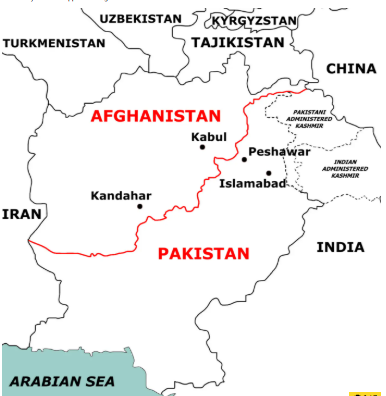
In the early hours of February 22, 2026, Pakistani warplanes crossed into Afghanistan and bombed seven locations in the provinces of Nangarhar and Paktika. Pakistan called it a targeted counter-terrorism strike against the TTP (Tehrik-e-Taliban Pakistan).
Afghanistan called it a massacre. Women, children, and families sleeping in their homes were killed. A school was hit. One police officer described pulling five wounded survivors from a single house that had held twenty-three people.
Pakistan said it had no choice. It cited a mosque bombing in Islamabad on February 6 that killed 31 worshippers, a suicide attack in Bannu on February 21 that killed two soldiers, and an ambush in Bajaur that killed eleven more. The evidence, Pakistan said, pointed to TTP commanders based on Afghan soil. Something had to be done.
Fair enough — or so it might seem. Until you remember what Pakistan says when someone else does exactly the same thing to them.
When India Did It, Pakistan Called It War
.
Cast your mind back to February 2019. India launched airstrikes on Balakot, inside Pakistani territory, targeting a Jaish-e-Mohammed training camp. India said it had clear evidence linking the group to a suicide bombing in Pulwama that killed 40 Indian soldiers. The logic was identical to Pakistan’s logic today — our people are being killed, the perpetrators are across the border, diplomacy has failed, we must act.
Pakistan’s response? It scrambled its air force. It shot down an Indian jet. It captured the pilot. It called the strikes a blatant act of aggression and a violation of its sovereignty. It took the matter to the United Nations. Every television channel, every politician, every general declared that Pakistan would not tolerate this — that no country had the right to bomb another’s territory, no matter the justification.
Today, Pakistan is doing precisely what it condemned India for doing. Not just once — it has done this repeatedly, striking Afghanistan in 2024, 2025, and now 2026. Each time, civilian deaths follow. Each time, Pakistan insists it was justified. Each time, it expects the understanding it refused to give others.
The Hypocrisy Runs Deep
Pakistan’s selective outrage is not limited to India. For years, Pakistani declared American drone strikes to be illegal — violations of international law, they said, that could never be justified. Pakistani leaders stood in front of the world and demanded that sovereignty be respected absolutely. No ifs, no buts.
Now those same leaders are doing to Afghanistan. Bombing a neighboring country. Killing civilians. Claiming the ends justify the means.
There is also a darker, more uncomfortable truth here. Pakistan did not simply tolerate militant groups on its soil — it cultivated them. The Taliban itself was largely a Pakistani creation, built in the 1990s with support from Pakistan’s intelligence services as a tool of influence in Afghanistan. The thinking was that a friendly, Pakistan-aligned Afghanistan would give Pakistan “strategic depth” against India. It seemed clever at the time.
That same ideology, those same networks, gave birth to the TTP. The monster Pakistan helped build has turned around and bitten the hand that fed it. And now Pakistan wants to bomb the problem away — in the very country it spent decades destabilizing.
Was This a Blunder?
Yes — and here is why.
Airstrikes that kill civilians do not eliminate terrorism. They multiply it. Every family that loses a loved one in Nangarhar or Paktika becomes a potential future recruit for the very groups Pakistan wants to destroy. Every strike that hits a school or a home gives the Taliban all the propaganda it needs. The Afghan public, already suspicious of Pakistan, hardens further. The Taliban government gains domestic support simply by condemning Pakistan’s actions.
Pakistan also shattered a fragile ceasefire that had been painstakingly negotiated with the help of Qatar, Turkey, and Saudi Arabia. Just weeks before the strikes, Saudi mediation had secured the release of Pakistani prisoners. Months of diplomatic effort, gone in one night.
And Pakistan is not in a position to afford a prolonged conflict. Its economy is still recovering, propped up by IMF loans. It is fighting a Baloch insurgency in the west, a TTP insurgency in the north, and political chaos in its cities.
The strikes may have provided a temporary sense of action. But they solve nothing. The TTP will regroup. The attacks will continue. And Pakistan will have fewer friends and more enemies than before.
The Lesson Pakistan Will Not Learn
There is a painful irony at the heart of all this. Pakistan spent decades playing a double game — supporting some militant groups while fighting others, using terrorism as a foreign policy tool, protecting certain extremist networks because they were seen as useful. It lectured the world about sovereignty while sending armed groups across borders. It asked others to show restraint while showing none itself.
Now it is on the receiving end of exactly what it gave others. The chickens, as they say, have come home to roost.
The solution to Pakistan’s terrorism problem is not bombs. It is the hard, slow, unglamorous work of dismantling extremist networks — including the ones Pakistan itself built.
It is time to address the poverty, injustice, and political exclusion that feed militancy in Khyber Pakhtunkhwa and the tribal belt. It is stopping the double game once and for all.
But admitting that would mean admitting decades of strategic failure.
There is a simple rule: those who live by double standards must eventually answer for them.
References
1.https://edition.cnn.com/2026/02/22/asia/pakistan-strikes-afghanistan-militant-camps-intl-hnk
2.https://www.aljazeera.com/amp/news/2026/2/22/pakistan-carries-out-strikes-in-afghanistan-after-islamabad-suicide-attack
3.https://www.aljazeera.com/gallery/2026/2/22/the-aftermath-of-pakistan-air-strikes-in-in-afghanistan
4.https://www.theresearchers.us/2026/02/22/pakistan-airstrikes-afghan-civilians/
5.https://en.wikipedia.org/wiki/Afghanistan%E2%80%93Pakistan_clashes_(2024%E2%80%93present)