THE ASIAN INDEPENDENT UK

Bal Ram Sampla
Geopolitics
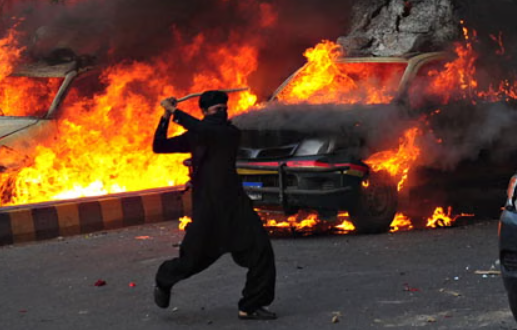
Pakistan is on fire, and the flames are spreading fast. What started as protests in Kotli has now exploded into a nationwide crisis that threatens to bring down the entire military establishment. Army Chief Asim Munir, the man who thought he controlled everything, is watching his grip on power slip away with each passing day.
The People Have Had Enough
Across Pakistan-Occupied Kashmir, Balochistan, and other regions, thousands upon thousands of people are flooding the streets. They’re not whispering anymore – they’re shouting. They’re not asking politely – they’re demanding. And most importantly, they’re not afraid anymore.
In viral videos that are spreading like wildfire, local leaders are openly calling the Pakistani government a “demon.” They’re accusing Asim Munir’s army of killing its own people, silencing voices, shutting down media, and using brutal force against peaceful protesters. These aren’t anonymous voices – these are named leaders speaking directly to camera, knowing full well the risks.
Why This Time is Different
Pakistan has seen protests before, but something fundamental has changed. The fear is gone. For decades, the Pakistani army ruled through terror – disappear a few people here, shoot some protesters there, and everyone else would fall in line. But that playbook isn’t working anymore.
When people in POK march through the streets chanting against Asim Munir and Shehbaz Sharif’s government, they know soldiers might open fire. They come anyway. When Baloch protesters take to the streets despite military crackdowns, they keep coming back. When families of the disappeared demand answers, they refuse to be silent.
This is what terrifies military dictators – the moment when bullets can no longer buy obedience.
The Army Can’t Shoot Everyone
Here’s Asim Munir’s nightmare: the protests are happening everywhere at once. It’s not just one region he can isolate and crush. It’s POK, Balochistan, Punjab, Sindh – multiple fires burning simultaneously. The army can shoot protesters in Kotli, but that just makes people angrier in Muzaffarabad. They can disappear activists in Quetta, but that brings thousands more into the streets in Karachi.
Intelligence reports are now openly warning that these protests could be “turning points” for Munir and his military cronies. That’s diplomatic language for: the regime is in serious trouble.
The Economic Collapse Makes Everything Worse
People are protesting because they’re desperate. Inflation is crushing ordinary families. Jobs don’t exist. The economy is in freefall. Meanwhile, the army lives in luxury, controls vast business empires, and treats Pakistan like their personal property.
Asim Munir thought he could distract people by beating the war drums against India, by giving fiery Kashmir speeches at the UN, by promoting himself to Field Marshal. But you can’t eat nationalist rhetoric. You can’t feed your children with anti-India slogans. When people are hungry and hopeless, propaganda stops working.
The Mask Has Fallen Off
What makes these protests so dangerous for the Pakistani establishment is that people aren’t just protesting one issue – they’re rejecting the entire system. They’re calling out the lies, the hypocrisy, the brutality. They’re exposing how Pakistan claims to fight for Kashmiri rights at the UN while murdering Kashmiris in POK. They’re revealing how the “guardians” of Pakistan are actually its oppressors.
Social media has made it impossible for the army to control the narrative. Videos of soldiers shooting unarmed civilians spread within minutes. Stories of torture and disappearances reach global audiences instantly. The government shuts down the internet, and people find ways around it. They block one platform, and protesters move to another.
Asim Munir’s Desperate Moves
When dictators start losing control, they get dangerous. Munir has been lashing out in all directions – increased military crackdowns, media blackouts, mass arrests. He pushed Pakistan to the brink of war with India earlier this year, hoping external conflict would unite people behind him. It didn’t work.
He got himself promoted to Field Marshal, surrounding himself with fancy titles and medals. But titles mean nothing when thousands of people are in the streets calling you a murderer. Promotion ceremonies don’t stop protests.
The Breaking Point
Pakistan is approaching a breaking point. The military establishment that has ruled Pakistan for most of its existence, either directly or from behind the scenes, is facing its biggest challenge in decades. Not from India, not from external enemies, but from its own people.
The protests are getting bigger because people see they’re not alone. Every video of protesters in POK inspires protesters in Balochistan. Every speech by a brave activist gives courage to ten more. Every brutal crackdown creates a hundred new activists.
This Won’t End Quietly
Asim Munir and his generals face an impossible choice: either genuinely reform, give people rights, withdraw from politics, and face accountability – or double down on repression and risk complete collapse.
History shows that military regimes rarely choose reform. They usually choose more violence, which creates more resistance, which requires more violence, in a death spiral that ends in either revolution or complete militarization.
The World is Watching
The international community can no longer ignore what’s happening. Pakistan isn’t experiencing “routine protests” – it’s experiencing a legitimacy crisis. When your own people in occupied territories are openly calling you demons and oppressors, when intelligence reports warn of “turning points,” when protests span multiple regions simultaneously, that’s not instability – that’s the beginning of the end.
Asim Munir may still have guns, tanks, and the apparatus of state violence. But he’s losing something far more important – he’s losing legitimacy, losing control, and losing the fear that kept people silent for so long.
The protests are getting bigger. The voices are getting louder. And Pakistan’s military rulers are running out of bullets and lies.
The people have spoken. The question now is whether Pakistan’s generals will listen – or whether they’ll go down fighting, taking the entire country with them.
References
1.https://www.tribuneindia.com/news/government-crackdown/government-has-turned-into-a-demon-pojk-leader-accuses-pakistan-of-firing-on-citizens-as-protests-intensify
2.https://foreignpolicy.com/2025/05/30/pakistan-munir-military-leader-strategy/
3.https://theshillongtimes.com/2025/09/30/from-pok-to-balochistan-rising-uprisings-signal-collapse-of-pakistan-armys-grip/
4.https://www.indiatvnews.com/news/world/pakistan-army-chief-asim-munir-faces-public-backlash-with-protests-as-he-arrives-at-washington-hotel-2025-06-17-995047