THE ASIAN INDEPENDENT UK
 Dr Ramjilal, Social Scientist and Former Principal,
Dayal Singh College, Karnal (Haryana, India)
Email: [email protected]
In short:
Agriculture is the backbone of the global economy, and women farmers and agricultural labourers play a vital role in its success. Women contribute 50% to the global food supply, produce 60-80% of food in developing countries, and 75.7% of staple crop production in India. In India, approximately 18% of women are heads of households. If women are empowered, India could experience tremendous economic growth, leading to greater prosperity. It is a puzzling question: why are women not recognised as farmers?
Detailed
Approximately 900 million women work in agriculture worldwide. However, in more than 90 countries, women do not have land ownership rights. Globally, women own less than 20% of cultivable land. Some estimates suggest that only 10% of women own land. According to the Periodic Labour Force Survey 2019-20, 75.7% of rural women in India participate in agricultural work, yet only 13.87% of women in farming communities have legal land rights. The situation is even worse in non-farming communities, where only 2% of women have legal land ownership rights. This means that approximately 86% of women in farming communities and 98% of women in non-farming communities do not own any land-related property.
 A study by Corteva Agriscience, the agriculture division of DowDuPont, highlights the widespread gender discrimination in both developed and developing countries. According to this study, 78% of respondents in India and 52% in the United States acknowledged the existence of such discrimination. Denying women the right to inherit land is not only discriminatory but also a violation of the right to equality guaranteed by the Indian Constitution. The UN Committee on the Elimination of Discrimination against Women considers discrimination in land rights a violation of human rights. The United Nations (UN) has designated 2026 as the International Year of Women Farmers to highlight existing discrimination worldwide and promote gender-equal policies and programs to empower women in agriculture. Hindu Succession Act (September 9, 2005):
In India, the Hindu Succession Act of 1956 gives women the right to inherit their ancestral property, both movable and immovable. While the Act aimed to give daughters equal rights to ancestral property, it did not fully grant them equal rights to sons. Amendments in 2015 and 2023, and a Supreme Court decision (2020), have further strengthened daughters’ rights. Daughters are now permanent coparceners with equal rights to ancestral property.
Despite these legal protections, many states have not yet implemented equal rights for women in ancestral property. Some inheritance laws are listed in the Ninth Schedule of the Constitution, which shields them from judicial review and prevents many women from accessing their rightful ancestral property.
Reasons for Non-Enforcement of Laws and Court Decisions:
 Although laws and court decisions related to property inheritance provide equal rights to women, they are often not actually implemented for a variety of reasons – lack of awareness about inheritance laws and Supreme Court decisions, hesitation in taking legal action against family members, difficulties in pursuing legal action, emotional stress and emotional abuse from family members, unwillingness or inability of the father’s family to support women during conflicts with in-laws, fear of social ostracism or lack of support in family disputes or divorce cases, pressure on women to sign wills relinquishing their rights in favor of sons or grandsons, effectively depriving daughters and granddaughters of their rightful inheritance. Patriarchal systems are the primary reason for denying women their ancestral property rights. Our society is largely male-dominated, which excludes daughters from ancestral property. Simply put, the Hindu Succession Act and other laws recognise women’s rights, but the reality is similar to the situation in Panchayati Raj Institutions (PRIs) in 21 Indian states, where 50% of elected representatives are women. However, rather than women, male family members often act on their behalf, as “Sarpanchpati,” “Mukhiyaji’s husband,” “Sarpanch representative,” etc.
Women engaged in agricultural work:
1. Wage Labourers: Women who work as labourers without land ownership.
2. Landowners: Women who own land or work on family land.
3. Farm Managers: Women who are involved in farm management.
In farming communities, most women typically work on family land, while women from non-farming backgrounds often work as labourers in the fields of village farmers.
Three Key Responsibilities:
Throughout history—in the Vedic, post-Vedic, Buddhist, and Jain periods—ordinary women have played crucial roles in their families by performing three essential tasks: household chores, animal husbandry, and farming. Village women continue to fulfil these roles today. According to Dr Rukmini Rao, founding president of the Mahila Kisan Adhikar Manch, women perform 70% of the labour on every acre of farmland, while men perform only 30%. A study conducted in the Himalayan region shows that a pair of oxen works approximately 1,064 hours per year, while women farmers work approximately 3,485 hours in the fields, and male farmers work approximately 1,212 hours (Grover and Grover, 2004).
Global perspective on women’s work:
Globally, women’s labour often goes unrecognised and is not linked to wages. A 2022 report by the International Labour Organisation (ILO) states that women in 64 countries work 16.4 billion hours without pay, accounting for approximately 9% of global GDP—approximately $11 trillion. Furthermore, a report by the Economic Research Department of the State Bank of India shows that women’s contribution to domestic work in India is ₹22.7 lakh crore of the Indian GDP. If women’s unpaid work is scientifically assessed, a 2023 report by the Reserve Bank of India (RBI) suggests that paying working women for their work would account for 7.5% of India’s GDP.
Health Impact:
During the peak harvest season, women often work 8 to 9 hours daily in the fields, in addition to 4 to 6 hours of household chores. The impact of extreme weather can lead to numerous health problems and illnesses, further exacerbating the hardships of female agricultural labourers.
Farmers, Women Farmers, and Female Agricultural Labourers: Statistical Reports of Suicides
Floods, famine, drought, hailstorms, crop diseases, loan defaults, and difficulties managing household expenses can cause despair for both male and female agricultural workers. Like male farmers, women farmers can also commit suicide when they see no other option. According to a 2019 report by the National Crime Records Bureau (NCRB) of the Ministry of Home Affairs of India, approximately 400,000 farmers committed suicide between 1995 and 2018, an average of approximately 48 farmers every day. Women farmers and agricultural labourers face similar difficulties, and many even take their own lives out of despair. NCRB data shows that between 1995 and 2018, 50,188 women took their own lives, accounting for 14.82% of total farmer suicides.
Between 2014 and 2020, the NCRB reported 78,303 suicides in the agricultural sector, including 43,181 farmers and 35,122 agricultural labourers. In 2021, 10,881 people committed suicide in agriculture, including 5,318 farmers (5,107 men and 211 women) and 5,563 agricultural labourers. Official data shows that approximately 15 farmers and 15 agricultural labourers committed suicide every day in 2021, the highest since 2016. Several states and union territories, including West Bengal, Bihar, Jharkhand, Odisha, Tripura, Manipur, Arunachal Pradesh, Uttarakhand, Chandigarh, Lakshadweep, and Puducherry, did not report any suicides to the central government in 2021. This “zero” reporting may be an attempt to avoid providing compensation to the families of those who committed suicide, as both the central and state governments must determine the amount of such compensation.
Kisan Widows: Serious and Multiple Crises:
One of the biggest concerns for agricultural widows is whether they will inherit land after their husband’s death. In reality, it’s not just the death of one person, but the death of the entire family that affects them. When a husband dies, a widow’s life can change completely in an instant. Widowed farmers and labourers in India face many serious and multiple crises after their husbands’ deaths. These difficulties include mounting debt, loss of land ownership and difficulty in regaining it, and the constant fear of social stigma, violence, exploitation, ostracism, and assault. They also struggle with low income from farming, a lack of access to formal credit, job insecurity, low wages for agricultural labourers, and the burden of raising children. Because of this, most widows find themselves trapped in a cycle of poverty and hunger.
Key Suggestions to Improve the Status of Women Agricultural Labourers:
To enhance the status of women farmers and agricultural labourers in India, it is essential to recognise them as primary and independent economic actors, rather than viewing them merely as agricultural helpers. Key recommendations include: Protecting land rights, Increasing access to technology and credit, and reducing the hardships associated with their work, ensuring land ownership and legal rights, as well as joint ownership, promoting financial inclusion and access to credit, providing agricultural equipment for women’s empowerment, supporting the empowerment of ‘Krishi Sakhis’ and other women’s groups, enhancing market linkages and economic empowerment, providing support for allied sectors, including home-based and village small-scale cottage industries, Improving social security and infrastructure, offering maternity and health support, formulating and implementing policies tailored to the needs of both male and female farmers, improving data collection and analysis, and managing increased allocations of funds for women in agriculture and agricultural labour within central and state government budgets. Additionally, the recommendations of the Swaminathan Committee regarding Minimum Support Price (MSP) at C2 + 50% should be given a legal guarantee, and debt waivers should be provided.
In short, the path to progress of every nation passes through the farmers’ fields. If women farmers and women agricultural labourers are economically prosperous, then the economic condition of the nation will strengthen in the same proportion. Therefore, the sustainable development of women farmers and women agricultural labourers will transform them from invisible to visible and non-existent to existent.
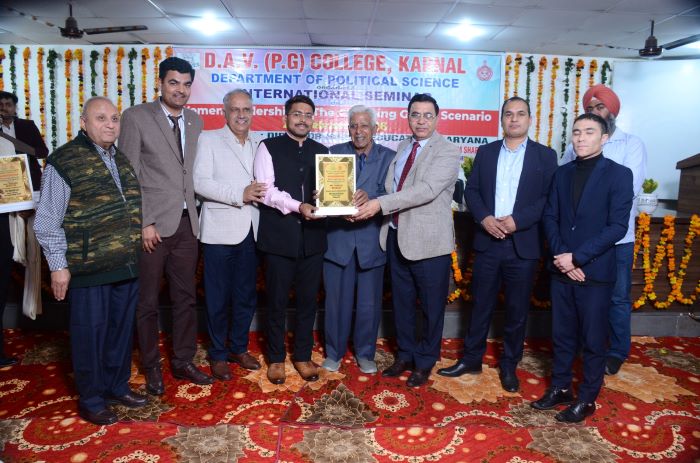
(Note: This is the revised version of the Presidential address delivered in the first technical session of the international seminar on ‘Women Leadership in the Changing Global Scenario’ organised by DAV(PG) College, Karnal, on 25 February 2026. I am thankful to the Principal and Vice-Chancellor of CRSU, Jind, Dr Rampal Saini, and the Coordinator, Dr Balram Sharma, and his team.)