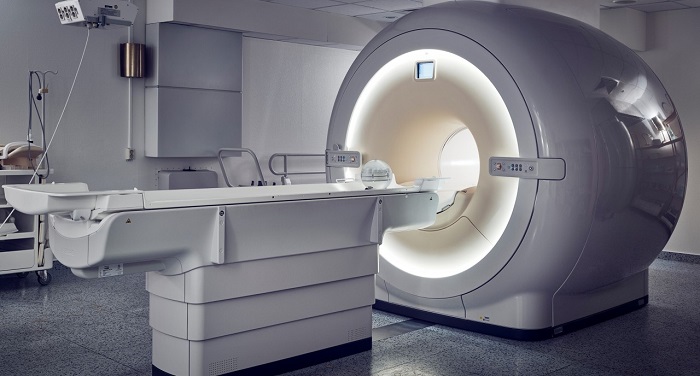

(Asian independent) Magnetic Resonance Imaging (MRI) is one of the most remarkable achievements of modern medical science.It has combined the principles of nuclear magnetic resonance with cutting-edge computer technology, MRI has enabled the clinicians to visualize the detailed internal structures of the human body without any invasive procedures.
The evolution of diagnostic imaging has transformed the way diseases are being detected and treated. Among the various imaging techniques such as X-rays, CT scans and ultrasound, Magnetic Resonance Imaging (MRI) stands apart due to its exceptional ability to provide detailed soft tissue contrast and multi-planar imaging. Since its introduction in the late 20th century, MRI has become indispensable in neurology, orthopedics, cardiology, and oncology.
SCIENTIFIC PRINCIPLE BEHIND MRI
MRI works on the principle of Nuclear Magnetic Resonance (NMR). The human body is primarily composed of water molecules and each water molecule contains hydrogen nuclei (protons). When placed in a strong magnetic field these protons align with the field.A radiofrequency (RF) pulse is then applied, which temporarily disturbs this alignment. When the pulse is turned off, the protons return to their original alignment, releasing energy in the process. This released energy is detected by the MRI sensors and converted into detailed images by sophisticated computer algorithms.
The key components of an MRI system include:
Magnet:
It produces a powerful magnetic field (typically 1.5 to 3 Tesla).
Gradient Coils:
This helps in spatial localization of the signal.
RF Coils:
It transmit and receive radio signals.
Computer System:
It processes the data to construct high-resolution images.
ROLE OF MRI IN MEDICAL SCIENCE
MRI has become an essential diagnostic tool in nearly every medical specialty:
Neurology:
It is used in neurology to detect the brain tumors, strokes, multiple sclerosis and spinal cord lesions.
Orthopedics:
The main role of MRI is to visualizes ligament tears, bone marrow disorders and joint abnormalities.
Cardiology:
It is used to evaluates cardiac structure, myocardial infarction and vascular anomalies.
Oncology:
MRI helps in tumor detection, staging and treatment monitoring.
Abdominal Imaging:
It provides non-invasive assessment of liver, kidneys and pancreas.
Unlike X-rays or CT scans, MRI does not use ionizing radiation making it safer for repeated imaging.
WHY MRI IS COSTLY
The high cost of MRI procedures can be attributed to several factors:
1. Expensive Equipment:
MRI machines cost are high and it depends on the strength and technology.
2. Maintenance:
Regular calibration, helium cooling for superconducting magnets and software upgrades are costly.
3. Operational Costs:
Skilled radiologists, technologists and power consumption add to the running expenses.
4. Time Consumption:
MRI scans often take longer (30–90 minutes) than CT or X-ray procedures limiting daily throughput.
These factors collectively make MRI one of the most expensive diagnostic tools available.
RELATED TECHNOLOGIES BASED ON SIMILAR PRINCIPLES
Several imaging and diagnostic modalities share principles with MRI or are complementary in nature:
Functional MRI (fMRI):
Measures brain activity by detecting changes in blood flow, useful in neuroscience and psychology.
Magnetic Resonance Spectroscopy (MRS): Analyzes chemical composition of tissues, aiding in tumor characterization.
Diffusion Tensor Imaging (DTI):
Maps neural pathways in the brain, useful for neurosurgical planning.
Positron Emission Tomography–MRI (PET-MRI):
Combines metabolic and anatomical imaging for advanced cancer diagnostics.
These advanced modalities further enhance the clinical value of MRI in both research and patient care.
ADVANTAGES (PROS) OF MRI
Non-invasive and radiation-free imaging technique.
High contrast resolution for soft tissues.
Multi-planar capability (axial, sagittal, coronal, and 3D views).
Superior detection of neurological and musculoskeletal disorders.
Useful for long-term monitoring without radiation hazards.
LIMITATIONS (CONS) OF MRI
High cost of scanning and maintenance.
Time-consuming compared to other imaging methods.
Incompatibility with metal implants (pacemakers, prosthetics, etc.).
Claustrophobia and noise discomfort during scanning.
Limited availability in developing regions due to infrastructure requirements.
FUTURE PROSPECTS AND INNOVATIONS
Ongoing research in artificial intelligence (AI)-assisted image reconstruction, faster sequences and low-field portable MRI systems aims to reduce cost, improve accessibility and enhance diagnostic precision. Moreover, the integration of AI with MRI analytics holds potential for predictive diagnostics and personalized medicine.
Magnetic Resonance Imaging remains one of the most powerful tools in the diagnostic arsenal of modern medicine. Its ability to visualize soft tissue structures with unmatched precision makes it indispensable for early disease detection and treatment planning. While cost and accessibility remain challenges, technological innovation and governmental support can make MRI more affordable and widespread. In essence, MRI continues to be not only a window into the human body but also a symbol of how physics and medicine unite to save lives.
SURINDERPAL SINGH
FACULTY IN SCIENCE DEPARTMENT
SRI AMRITSAR SAHIB PUNJAB.