

THE ASIAN INDEPENDENT UK

Bal Ram Sampla
Geopolitics
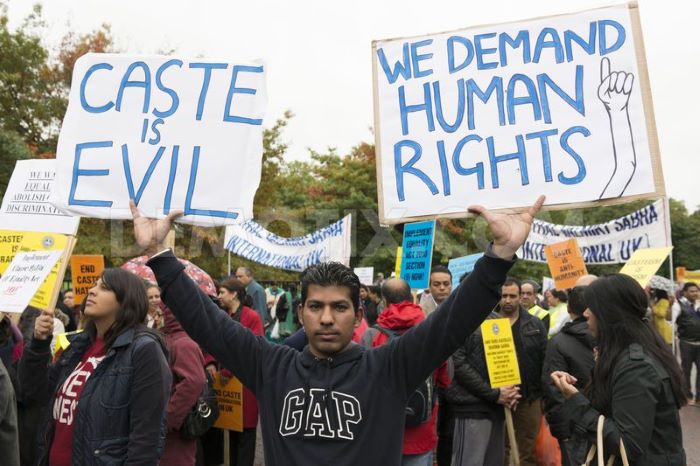
Some estimates state that up to 500,000 people in the UK live under the shadow of caste discrimination. They face it at work, in their communities, and in their daily lives. Yet British law pretends it doesn’t exist.
Caste discrimination is invisible. You can’t see it. You can’t photograph it. But victims feel it every single day.
For over a decade, anti-caste campaigners placed their hopes in Section 9(5)(a) of the Equality Act 2010. This provision would allow the government to add caste as a protected characteristic with the stroke of a pen.
No government has ever activated it.
Labour Party have pledged to make caste a protected characteristic under the Equality Act 2010 if they win power.
They won power over year ago. But there has been no movement so far to outlawing caste based discrimination.
The Trade Deal That Forgot Human Rights
In July 2025, the UK signed a major trade agreement with India. Billions in trade. Defence contracts worth hundreds of millions. Tariffs slashed.
What did the deal say about caste discrimination? Nothing.
What protections does it offer for Dalits working for Indian companies in Britain? None.
Indian companies can now invest freely in the UK. They can hire whoever they want. And without caste being illegal, they can discriminate with impunity.
This was a perfect opportunity to mention caste based discrimination during trade talks. Opportunity lost to least make Ambedkar Principles for voluntary adherence to by Indian companies investing in UK. Sadly, Labour Party is led by ‘ champagne socialists’ who say the right thing but lack the will.
The Minister with Two Masters
Seema Malhotra is the Minister for Equalities. She’s also a minister at the Foreign, Commonwealth and Development Office, responsible for UK-India relations.
How can the same person protect Dalits in Britain while maintaining smooth diplomatic ties with India—a government that bristles at any international discussion of caste?
She can’t. And the evidence suggests she won’t even try.
Why Labour Won’t Act
The answer is brutally simple: trade trumps justice.
India is a massive economic prize. Labour won’t risk that relationship for 500,000 people who can’t even prove they’ve been discriminated against in court.
Caste discrimination is invisible, remember? Without explicit legal protection, victims have almost no recourse. They must somehow prove race discrimination when the discrimination happens within their own ethnic group.
The Uncomfortable Truth
Labour talks about equality. They talk about protecting minorities. They talk about standing up to discrimination.
But when it comes to Dalits, they’ve made their choice.
Economic deals with India matter more than civil rights in Britain.
Diplomatic relationships matter more than the dignity of 500,000 people.
And maintaining trade flows matters more than confronting an ancient system of oppression that has followed people to British shores.
What This Means
Without caste in the Equality Act:
(1). Employers can discriminate based on caste with little consequence
(2) Victims have virtually no legal protection
(3) The message is clear: some discrimination is acceptable if it’s economically convenient
Labour had a choice. They chose trade deals over Dalits.
They chose India’s government over Britain’s most vulnerable people.
They chose to look the other way.
The Question Nobody Will Answer
If Labour won’t protect Dalits now—with a large majority, a fresh mandate, and an equalities minister in place—when will they?
The answer, it seems, is never.
Trade deals get signed. Discrimination continues. And the invisible remain invisible.
That’s not equality. That’s abandonment.
References
1.https://commonslibrary.parliament.uk/research-briefings/cbp-10258/
2.https://en.wikipedia.org/wiki/Seema_Malhotra