THE ASIAN INDEPENDENT UK

Bal Ram Sampla
Geopolitics
In October 2025, tensions have escalated along India’s western border as Pakistan has been building up military infrastructure near the disputed Sir Creek region. India has responded with a massive show of force through Exercise Trishul, one of its largest joint military operations.
What is Sir Creek and Why Does it Matter?
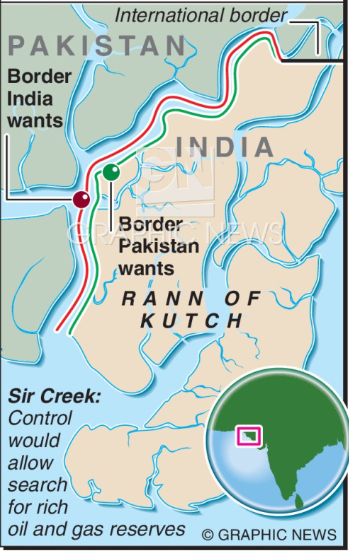
Sir Creek is a 96-kilometer tidal estuary located between Gujarat’s Rann of Kutch and Pakistan. While it may seem like a small, marshy area, it holds enormous strategic and economic importance for both countries.
The region is valuable for several reasons:
(1) it is one of Asia’s largest fishing grounds, providing livelihoods for thousands of fishermen on both sides. (2) experts believe there are significant oil and gas reserves beneath the seabed, which remain unexplored because of the ongoing dispute.
(3) whoever controls Sir Creek also controls more of the surrounding sea area, including exclusive economic zones that grant rights to fishing, mineral exploration, and maritime security.
For Pakistan, Sir Creek is particularly important because it sits close to Karachi, Pakistan’s largest city and main naval base. Control over this region affects Pakistan’s maritime security and access to the Arabian Sea. This is why Pakistan has been expanding its military presence in the area, building new infrastructure and positioning forces along the creek.
Pakistan’s Military Build-up and Its Strategic Implications
According to India’s Defence Minister Rajnath Singh, Pakistan has recently been conducting a significant military build-up near Sir Creek. Pakistan has been expanding military infrastructure and positioning forces in this sensitive border area. This has raised serious concerns in New Delhi about Pakistan’s intentions.
The military infrastructure Pakistan is building includes forward posts, improved roads for quick troop movements, and fortified bunkers. Intelligence reports based on satellite imagery show that much of this infrastructure has appeared only in the last few months. Some of the build-up dates back to 2019, when Pakistan’s Navy formed a new battalion in the area, and there was another expansion in 2023 when Pakistan upgraded security infrastructure and deployed surveillance drones.
Why This Build-up Is Particularly Dangerous for India
Pakistan’s military build-up at Sir Creek is not just about controlling a disputed border—it poses a direct threat to India’s economic heartland. The location gives Pakistan the capability to strike at Gujarat’s crucial petroleum and refinery infrastructure, which is absolutely central to India’s economy.
Just a short distance from Sir Creek lies Jamnagar, home to the world’s largest oil refinery complex owned by Reliance Industries. This massive facility processes 1.24 million barrels of crude oil per day—more than double the capacity of North America’s largest refinery. The Jamnagar complex accounts for over 10 percent of India’s total exports in some years and transformed India from a fuel-deficit nation into a net exporter of petroleum products.
The strategic vulnerability is clear: military infrastructure at Sir Creek would allow Pakistan to launch drone swarms or missile strikes against these refineries. Pakistan already demonstrated this capability during Operation Sindoor in May 2025, when it used Turkish-origin drones to target 36 sites, including Sir Creek. If Pakistan could successfully strike the Jamnagar refineries from positions at Sir Creek, it would devastate India’s fuel supply, cripple a major source of export revenue, and potentially bring India’s economy to its knees.
Gujarat’s coastal region also hosts numerous other petrochemical facilities. The state accounts for 62 percent of India’s petrochemical production and 35 percent of other chemical production. A Petroleum, Chemical & Petrochemical Investment Region has been established at Dahej, representing billions of dollars in industrial investment. All of these facilities would be within striking range of military positions at Sir Creek.
This explains why India views Pakistan’s military build-up with such alarm. It’s not merely about territorial control—it’s about Pakistan positioning itself to hold India’s economic jugular in its hands. The timing is also significant, as Pakistan has been dealing with serious security problems along its western border with Afghanistan, including deadly clashes and a fragile ceasefire.
India’s Response: Exercise Trishul
India’s response to Pakistan’s build-up has been swift and powerful. From October 30 to November 10, 2025, India is conducting Exercise Trishul, one of its largest joint military operations ever conducted near the Pakistan border.
Exercise Trishul involves over 20,000 troops from all three branches of India’s armed forces—the Army, Navy, and Air Force. The exercise includes offensive maneuvers in creek and desert areas, amphibious operations along the Saurashtra coast, and joint operations across multiple domains. The airspace reserved for the exercise extends up to 28,000 feet, and defence experts have noted that both the location and scale of the exercise are unusual and highly significant.
The Clear Message to Pakistan
Through Exercise Trishul, India is sending multiple powerful messages to Pakistan:
1. India is demonstrating its complete military readiness and operational capability. The exercise shows that India’s Army, Navy, and Air Force can work together seamlessly in complex operations near the border.
2. India is showing off its growing self-reliance in defence. The exercise features indigenous weapon systems, electronic warfare platforms, and unmanned assets—all designed and built in India. This demonstrates that India no longer depends heavily on foreign military equipment.
3. Most importantly, India is issuing a direct warning to Pakistan. Defence Minister Rajnath Singh made this crystal clear when he stated that any Pakistani aggression in Sir Creek would receive a “resounding response” that could “change both history and geography.” He reminded Pakistan that during the 1965 war, the Indian Army had reached Lahore, and suggested that in 2025, one route to Karachi passes through Sir Creek.
This is not subtle diplomacy—this is a clear deterrent message. India is telling Pakistan that any military adventure in Sir Creek will be met with overwhelming force, potentially threatening major Pakistani cities.
Pakistan’s Dilemma: Caught Between Two Fronts
The timing of Exercise Trishul puts Pakistan in an extremely difficult position. While India conducts massive military exercises on Pakistan’s eastern border, Pakistan is simultaneously dealing with a crisis on its western border with Afghanistan.
In mid-October 2025, Pakistan and Afghanistan fought fierce and deadly clashes along their disputed border. A ceasefire was only achieved on October 19 through mediation by Qatar and other countries. Follow-up talks on October 25-26 tried to stabilize the situation, but Pakistan’s Defence Minister warned of potential “open war” if the diplomatic efforts failed.
This means Pakistan faces threats on two fronts. Pakistan’s military forces, attention, and resources are divided between the Afghanistan problem in the west and the Indian military pressure in the east. Reports suggest that Exercise Trishul has sent “alarm bells ringing in Islamabad,” forcing Pakistan to place multiple military commands on high alert and mobilize its Air Force and Navy.
India’s message is clear: while Pakistan struggles with problems on its western border, India maintains full operational readiness and can conduct large-scale military operations whenever it chooses.
India’s Multi-Ocean Strategy: Blocking Pakistan’s Allies
India’s strategic planning goes far beyond just the Sir Creek border. India has carefully positioned naval forces in distant waters to prevent Pakistan’s allies from providing military aid during any potential conflict.
South China Sea
Indian Naval ships are conducting operational deployments and exercises with countries like the Philippines and South Korea. China has historically been Pakistan’s closest ally and major military supplier. By maintaining a naval presence in the South China Sea, India can monitor Chinese naval movements and potentially block any attempt by China to send military aid to Pakistan during a war.
Mediterranean Sea near Turkey
India has deployed warships and conducted joint exercises with Greece, Cyprus, and Armenia—all countries that have tensions with Turkey. This deployment is particularly significant because Turkey provided major military support to Pakistan during Operation Sindoor in May 2025, including 350 combat drones that were used against Indian cities.
By positioning ships near Turkey and building strategic partnerships with Turkey’s rivals, India is sending a clear message: if conflict breaks out with Pakistan, India has the capability to intercept any Turkish attempt to send military aid. Turkey would have to worry about its own maritime security rather than helping Pakistan.
This multi-ocean strategy creates what experts call “preventive deterrence.” India is making it too costly and risky for Pakistan’s potential allies to intervene. It forces China and Turkey to think twice before providing military support to Pakistan because doing so would put their own naval assets and interests at risk.
Conclusion
The Sir Creek confrontation in October 2025 demonstrates India’s evolving military strategy and growing confidence. Rather than simply reacting to Pakistan’s military build-up with words or diplomatic protests, India has responded with a massive display of military power through Exercise Trishul.
The message is unmistakable: India will not tolerate any attempt by Pakistan to change the status quo at Sir Creek through military means. India is prepared to respond with overwhelming force if necessary, and it has positioned forces globally to prevent Pakistan’s allies from intervening.
For Pakistan, the situation is precarious. Facing security problems with Afghanistan on one border and India’s massive military exercise on the other, Pakistan finds itself strategically cornered. Meanwhile, India has demonstrated that it can project power not just along its borders, but across the oceans to distant regions like the South China Sea and Mediterranean.
The Sir Creek stand-off is more than just a local border dispute. It represents a broader shift in South Asian geopolitics, where India is asserting itself as a major military power capable of multi-front operations and global naval deployments. Through Exercise Trishul and its wider strategic positioning, India is sending a clear message: any challenge to its territorial integrity will be met with decisive and comprehensive response.
References
1.https://www.india.com/news/india/what-is-sir-creek-dispute-between-india-pakistan-why-it-is-vital-despite-being-of-minimal-military-advantage-explained-here-radcliffe-line-rajnath-singh-gujarat-sindh-arabian-sea-8112301/
2.https://vajiramandravi.com/current-affairs/sir-creek/
3.https://www.businesstoday.in/india/story/sir-creek-standoff-how-a-96-km-marshland-shapes-india-pakistan-tensions-496739-2025-10-03
4.https://scroll.in/latest/1087229/pakistan-expanding-military-infrastructure-in-sir-creek-alleges-rajnath-singh
5.https://www.business-standard.com/companies/news/reliance-s-first-ever-refinery-at-jamnagar-completes-25-yrs-of-operations-124122900484_1.html