Nava Thakuria
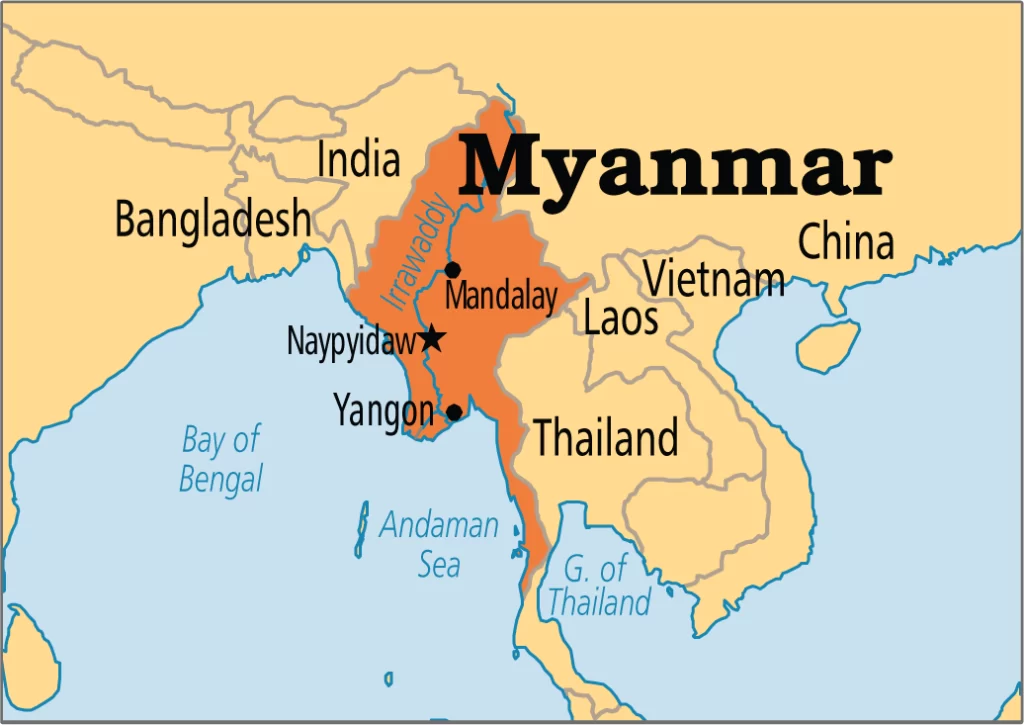
(Asian independent) India that shares 1643 kilometers of porous land border with Myanmar (earlier known as Burma and Brahmadesh) keenly observes the ongoing national elections in the military-ruled southeast Asian nation but with a timid hope that the Buddhist majority country of nearly 55 million people will have a stable regime in Naypyitaw. Amid the global denouncement against the military staged polling, the country’s northeastern region, which is adjacent to northern Myanmar, hope that an unchecked flow of illicit drugs and arms from its neighbour will be minimized after the polls. Moreover, the covert ties between the Myanmar military junta and some northeastern insurgents may also need to be addressed in addition to returning back all Myanmarese refugees to the trouble-torn country as early as possible.
Meanwhile the poverty-stricken nation conducted the two phases of general election on 28 December and 11 January last amid a civil war like situation showing a low voter turnout. The electoral exercises covered altogether 202 (100 plus 102) townships (loosely termed for constituencies) out of 330, even though many localities evaded the voting as those were not under the control of the military regime led by Min Aung Hlaing. The anti-military ethnic groups, people’s defence forces and other armed resistance outfits, which currently rule over one-third of Myanmar territories, strongly opposed the polls. The third phase of voting is scheduled for 25 January covering only 63 townships. The final outcome from electronic voting machines (used for the first time in Myanmar) are expected by end of this month.
Mentionable is that the Land of Golden Pagodas witnessed a military coup on 1 February 2021 overthrowing the democratically elected government of the National League for Democracy (NLD) led by Nobel laureate Aung San Suu Kyi in Naypyitaw. Since then former State Counsellor Suu Kyi (facing 27 years of imprisonment), President U Win Myint (sentenced to 12 years) and thousands of NLD leader-workers along with civilians including media professionals remain inside the jails. The absence of the NLD, which won landslide victories in 2015 and 2020 national polls has already dwindled the credibility of polls. The pro-democracy activists around the world termed the Myanmar electoral process as a sham election.
The junta-appointed Union Election Commission (UEC) planned the polling exercises for 274 townships, while the rest have been declared as disturbed and unstable (precisely under Rakhine, Sagaing and Shan provinces). The voting began at 6 am on both the days under heavy security arrangements and continued till 4 pm. The peaceful polling witnessed mostly elderly voters, who came out to vote with no hope but to get rid of threatening actions by the armed forces (popularly known as Tatmadaw). The young voters, who are not hailing from the military families, largely boycotted the election. The pro-military party Union Solidarity and Development Party (USDP) is already declared winner in most of the constituencies for the Pyithu Hluttaw (lower house of Myanmar Parliament).
The UEC had earlier canceled the registration of a number of mainstream political parties citing various reasons. Over 40 political parties, including NLD, did not re-register with the electoral authority. Only six political parties namely the USDP, National Unity Party, People’s Pioneer Party, Myanmar Farmers Development Party, Shan & Nationalities Democratic Party, and People’s Party were allowed to field candidates nationwide, where 51 smaller parties are entitled to take part in regional assemblies. Over 4,850 candidates representing various political parties (and also as independents) remain in the fray.
In the post-2021 coup, Myanmar recorded over 7,500 casualties in the series of violent political protests, where 3.6 million people have been displaced and currently over 20 million people live in desperate need of humanitarian assistance. The government forces still continue the crackdowns with indiscriminate airstrikes on crowded places, hospitals and even schools. Over 22,000 political prisoners remain under detention and a large number of pro-democracy leaders had left for the neighbouring countries like Thailand, China, Bangladesh and India to escape the military atrocities. The military dictator Hlaing and his associates have however tried their best to showcase the election as a successful venture in front of the global community (but with an inherent agenda to acquire legitimacy for their unlawful power capture).
The United Nations has already condemned the polls as a sham, as UN special rapporteur (on the situation of human rights in Myanmar) Tom Andrews cited political repression, imprisonment of over 22,000 political detainees and deaths of over 7,600 civilians since the 2021 coup as evidence to assert that this ‘not a free, fair or legitimate election’. As predicted by strategic observers, soon after the polls, military chief Hlaing may emerge as the new President of Myanmar and he would appoint someone from his trusted followers as the top military commander. At the same time, the lawmakers (under the military-drafted 2008 Constitution reserving space for 25% members in the Parliament and key ministries to the defence personnel) will probably function as mute spectators while dealing with any military-interested developments.
Myanmar’s neighboring countries including India expressed their concern over the continued instability on border localities and also unchecked influx of Myanmarese nationals to their territories. With the major investment in Kaladan multi-modal transit transport project (waiting for official commissioning soon) and putting hope for Act East Policy-inspired India-Myanmar-Thailand trilateral highway, New Delhi waits for an India-friendly administration in the neighborhood. The presence of 1.2 million Rohingya people (thrown out of Myanmar’s Arakan region) in Bangladesh and a suspected anti-India conspiracy from the foreign land to pump armed Rohingya militants into the eastern Indian localities may make the situation volatile once again.