By: Surjit Singh Flora

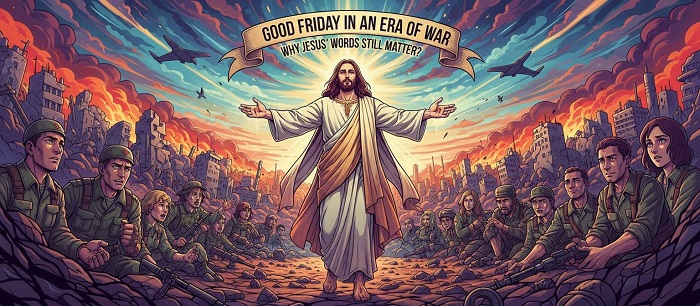
(Asian independent) April 2026 carries a heavy sound, sirens, grief, and the fear of what comes next. Fighting involving Israel, the United States, and Iran remains active, while the Russia-Ukraine war has dragged on for more than four years. In Afghanistan and Pakistan, many families face hunger, displacement, and armed violence instead of peace and growth. Against that darkness stands a startling contrast. Human beings keep returning to revenge, yet Jesus answered cruelty with mercy. From the same broad region now marked by conflict came these words from the cross:
“Father, forgive them, for they do not know what they are doing.”
Those words still speak because war keeps proving how little rage can heal.
As of April 2026, the conflict involving Israel, the United States, and Iran is still ongoing. Recent strikes and retaliation have killed many people and pushed large numbers from their homes. At the same time, the war between Russia and Ukraine continues with no clear end, after more than four years of loss, blackouts, shelling, and shattered cities.
The same pattern appears elsewhere, though with less global attention. In Afghanistan, millions face serious hunger, and fresh fighting has forced many to flee again. Border violence and militant attacks tied to Afghanistan and Pakistan have also brought more fear to daily life. When aid slows, prices rise, and roads close, ordinary people pay the price first.
War often gets told through maps, leaders, and weapons. Real life looks different. It looks like a mother searching for medicine, a father unable to buy flour, or a child waking to the sound of aircraft.
Civilians carry the deepest burden. They bury the dead, treat the wounded, and try to comfort children who no longer trust the night. Homes are damaged, schools are closed, and food becomes harder to afford. Trauma settles in quietly, then stays for years.
Actually, force can change borders, remove leaders, or block attacks. It can’t cure pride, hatred, or the memory of humiliation. Armies may stop one assault, yet they rarely mend the human heart.
That is why moral teaching still matters. Nations need truth, restraint, and justice. People also need repentance, mercy, and the courage to see the enemy as human. Without that change, pain keeps returning in a new uniform.
Jesus was born in Bethlehem and lived as a Jew among his own people under hard political rule. He walked through towns and villages, not palaces. He met the sick, the poor, the lonely, and the ashamed. His teaching stayed close to daily pain, because he spoke to people who knew hunger, debt, fear, and exclusion.
He taught forgiveness, holiness, sharing, and neighbour-love. He lifted the worth of every person, not only the respected. He welcomed children and placed them near the centre of God’s concern. In his life, love was not soft sentiment. It was a public stand against cruelty, hypocrisy, and contempt.
One clear example appears in the story of the woman accused of adultery. A crowd wanted to stone her. The scene carried both fury and theatre, because public shame can make angry people feel righteous.
Jesus stopped the rush to punish. He said that the one without sin should throw the first stone. One by one, the accusers left. He did not call evil good, yet he refused mob justice. He protected her dignity, exposed hypocrisy, and told her to leave her old life behind. Mercy and truth stood together.
Public leaders should face moral scrutiny when their words or actions cause harm, especially when innocent people suffer in war. Still, serious claims such as murder or sexual abuse must rest on verified facts, not anger or rumour. Good Friday and Easter call people to humility, repentance, and mercy, so no leader, including Donald Trump, should act as if he’s above sin or beyond judgment. In that spirit, believers can ask Jesus and the Father in heaven for forgiveness, for peace, and for hearts that reject pride, violence, and greed.
Jesus also confronted empty religion. He opposed the show of holiness without compassion. He rebuked leaders who placed heavy burdens on others while guarding their own status. His words cut through class pride, social contempt, and the use of faith as control.
He lived among ordinary people and moved toward those pushed aside by the upper class. Tax collectors, labourers, women with bad reputations, the sick, and children all found room near him. His teaching pointed toward equality, brotherhood, harmony, and shared responsibility. He refused the cold idea that only one group matters.
That is why some powerful figures felt threatened. Some religious leaders and political rulers saw his human-centred teaching as a danger. Judas Iscariot betrayed him for money, traditionally remembered as 30 silver coins. Under public pressure, the Roman governor declared him innocent yet still allowed the sentence to go forward.
Before the crucifixion, Jesus suffered mockery, beating, and public humiliation. He carried the cross through the city, weakened and bleeding. The crowd saw a condemned man. Christians see the innocent one bearing human hatred without returning it.
His prayer from the cross gives this story its moral centre.
He did not bless the violence, but he refused to become its mirror.
That matters because forgiveness did not come from comfort. It came from pain. Peter’s failure, Judas’s betrayal, the rulers’ fear, and the crowd’s cruelty all meet at the cross. Yet Jesus answered with mercy.
Forgiveness does not mean forgetting the dead or excusing evil. It does not ask the weak to accept abuse. Rather, it refuses to let hatred become the final ruler of the heart. That message speaks to homes, streets, communities, and nations.
Peace still needs truth, accountability, and protection for the innocent. A mother who loses a child needs more than slogans. A bombed city needs more than sentiment. Justice has a place.
Yet without forgiveness, grief passes like an inheritance. One wound feeds the next. One revenge invites another. In March 2026, Israeli and Palestinian mothers walked barefoot in Rome to protest the killing of innocents. Their act showed a different path, grief that resists the pride of “I alone am right.”
In Canada, Easter 2026 falls on 5 April, with Good Friday on 3 April. Churches mark Holy Week with prayer, worship, and reflection. Families also meet in other ways, through meals, school events, chocolate eggs, and neighbourhood gatherings. The public season carries both faith and familiar custom.
The lands now scarred by war once heard words of forgiveness from a wooden cross. That contrast should unsettle every proud heart. People can build weapons faster than trust, but peace still begins the old way, with truth, repentance, and mercy.
No war serves ordinary families. They want bread, safety, and a future for their children. If homes, streets, and nations are to change, forgiveness can’t stay a sermon line. It has to become a lived refusal to hate.
The world has heard enough threats. It still needs the harder work, “Father, forgive them.”