
The SC/ST (Prevention of Atrocities) Act Judgment and the 2 April 2018 Protests
SR Darapuri, National President, All India Peplos Front
Introduction

(Asian independent) The relationship between law, caste, and state power in India has always been deeply contested. While the Indian Constitution promises equality and justice, the persistence of caste-based oppression continues to challenge these ideals. The Scheduled Castes and Scheduled Tribes (Prevention of Atrocities) Act, 1989 (PoA Act) was enacted as a corrective legal mechanism to address systemic caste violence. However, the Supreme Court’s 2018 judgment in Subhash Kashinath Mahajan v. State of Maharashtra triggered widespread controversy and resistance among Dalit communities.
The nationwide protests on 2 April 2018, often referred to as the Bharat Bandh, were not merely reactions to a judicial decision but expressions of accumulated grievances against structural inequality. The violent state response to these protests further intensified debates about constitutional morality, democratic rights, and the nature of state power.
This essay examines the Dalit opposition to the Supreme Court judgment and critically analyzes the events of 2 April 2018 as a moment of both democratic assertion and state repression.
The PoA Act and the Historical Context of Caste Violence
Caste-based violence in India cannot be understood as isolated incidents; rather, it is embedded in a long history of social exclusion, economic exploitation, and cultural domination. Scholars such as Gail Omvedt (1994) and Gopal Guru (2011) have emphasized that caste oppression operates through everyday practices of humiliation and structural inequality.
The PoA Act, enacted in 1989, was a response to the inadequacy of general criminal law in addressing caste-specific crimes. It recognized that Dalits and Adivasis face unique vulnerabilities due to entrenched social hierarchies. The Act introduced stringent provisions, including immediate arrest of the accused, special courts, and enhanced punishments.
Data from the National Crime Records Bureau consistently show a high incidence of reported atrocities against Scheduled Castes and Scheduled Tribes (NCRB 2017; 2018). These figures likely underrepresent the actual scale of violence due to underreporting, fear of retaliation, and institutional barriers.
Anand Teltumbde (2010) argues that caste violence must be understood within the broader framework of power relations, where dominant castes maintain control over resources and social status. In this context, the PoA Act functions not merely as a legal instrument but as a symbolic assertion of Dalit rights.
The Supreme Court Judgment of 2018
On 20 March 2018, the Supreme Court of India delivered its judgment in Subhash Kashinath Mahajan v. State of Maharashtra. The Court introduced procedural safeguards aimed at preventing alleged misuse of the PoA Act.
These included:
- A preliminary inquiry before the registration of a First Information Report (FIR)
- Prior approval for the arrest of public servants
- The allowance of anticipatory bail
The Court justified these measures by citing concerns about false cases and the need to protect innocent individuals from arbitrary arrest.
From a doctrinal perspective, the judgment reflects a liberal legal emphasis on due process and individual rights. However, critics argue that such an approach abstracts legal reasoning from social realities. Upendra Baxi (2018) contends that the judgment exemplifies a “context-blind jurisprudence” that fails to account for the structural nature of caste oppression.
Dalit Opposition: A Structural Critique
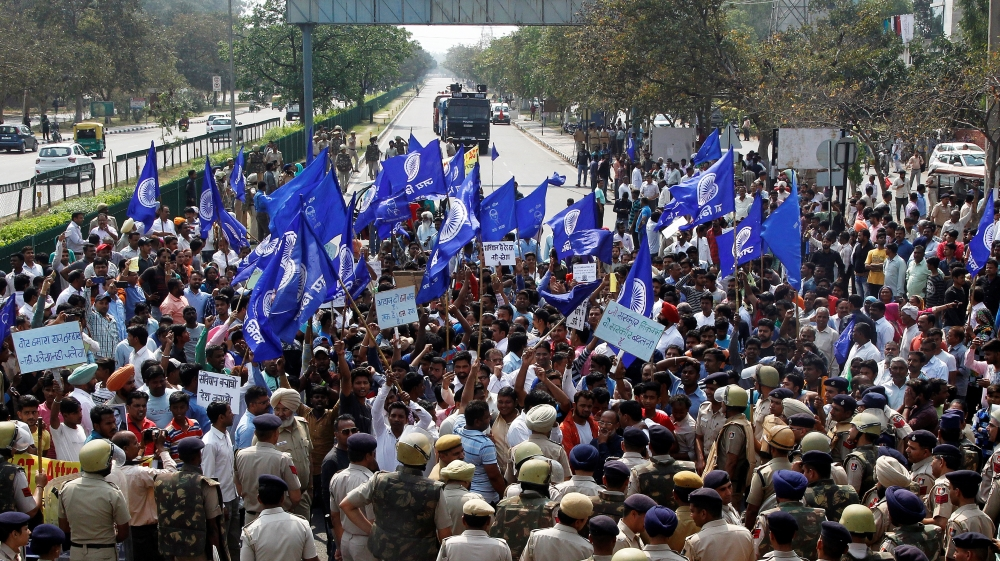
The Dalit response to the judgment was immediate and widespread. Protests erupted across the country, culminating in the nationwide bandh on 2 April 2018. The opposition was rooted in a deep skepticism of the Court’s reasoning and its implications.
Structural Nature of Oppression
Drawing on the thought of B. R. Ambedkar, Dalit activists argued that caste is a system of graded inequality that cannot be addressed through neutral legal principles alone (Ambedkar 1936). The requirement of a preliminary inquiry before FIR registration was seen as a barrier to justice in a system where victims already face significant obstacles.
The “Misuse” Narrative
One of the central justifications for the judgment was the alleged misuse of the PoA Act. However, empirical research suggests that false cases are not a significant issue. Instead, low conviction rates are often due to poor investigation and hostile social environments (Shah et al. 2006).
The emphasis on misuse is therefore seen as reflecting dominant caste anxieties rather than empirical reality.
Weakening Deterrence
The provision for immediate arrest under the original Act served as a deterrent against caste violence. By introducing procedural delays, the judgment was perceived as weakening this deterrence and emboldening perpetrators.
Judicial Overreach
Critics also argued that the Court had effectively amended the law, encroaching upon the legislative domain. This raised broader concerns about the balance of power between the judiciary and Parliament.
The 2 April 2018 Protests: Dalit Assertion
The protests on 2 April 2018 represented one of the largest mobilizations of Dalits in recent history. They were characterized by decentralized organization, with significant participation from rural and urban areas alike.
Christophe Jaffrelot (2019) interprets these protests as part of a broader transformation in Dalit politics, where new forms of mobilization are emerging outside traditional party structures. Social media played a crucial role in coordinating actions and disseminating information.
The protests were not merely reactive but constituted a form of political assertion. They reflected a collective demand for dignity, recognition, and protection under the law.
Violence and State Response
The protests were accompanied by widespread violence and a strong state response. Reports indicated that more than a dozen people were killed, and thousands were arrested.
Civil liberties organizations such as the People’s Union for Civil Liberties documented instances of: Police firing on protestors, Arbitrary arrests and detentions and Excessive use of force
In several regions, Dalit communities reported retaliatory violence by dominant caste groups and inadequate police protection.
State Action as Structural Oppression
The characterization of the state’s response as oppressive is supported by several factors.
First, the use of disproportionate force against largely marginalized protestors raises questions about the state’s commitment to democratic rights. While maintaining law and order is a legitimate function, the scale and intensity of repression suggest a deeper bias.
Second, the criminalization of protest reflects a broader trend in which dissenting voices are framed as threats to public order. This is particularly significant in the case of Dalit movements, which challenge entrenched social hierarchies.
Third, the failure to protect Dalit communities from retaliatory violence indicates a structural bias within state institutions. As Gopal Guru (2011) argues, the state often reproduces existing social inequalities rather than challenging them.
From an Ambedkarite perspective, such actions represent a violation of constitutional morality, which requires the state to actively protect the rights of marginalized groups.
Media and Public Discourse
The representation of the protests in mainstream media often emphasized violence and disruption, framing the events as a law-and-order problem. This narrative tended to obscure the underlying grievances and structural issues.
In contrast, alternative media and Dalit scholars highlighted the legitimacy of the protests and the historical context of caste oppression. Anand Teltumbde (2018) describes this divergence as a form of epistemic marginalization, where dominant narratives exclude subaltern perspectives.
Legislative Response and Aftermath
The scale of the protests compelled the government to act. Parliament passed the SC/ST (Prevention of Atrocities) Amendment Act, 2018, which effectively nullified the Supreme Court’s directives and restored the original provisions of the law.
This legislative response demonstrates the power of collective mobilization in shaping public policy. It also underscores the continuing importance of the PoA Act as a tool for social justice.
Theoretical Implications
The events of 2018 highlight several broader theoretical issues.
Formal vs Substantive Equality
The tension between formal legal principles and substantive social justice is central to this episode. While the Court emphasized due process, Dalit movements emphasized the need for context-sensitive protections.
Law as a Site of Struggle
The controversy illustrates that law is not a neutral instrument but a site of contestation shaped by competing interests and power relations.
Democracy and Marginalized Voices
The protests underscore the importance of collective action in a democracy. They reveal both the possibilities and limitations of institutional mechanisms in addressing social injustice.
Conclusion
The Supreme Court’s 2018 judgment on the PoA Act and the subsequent protests of 2 April represent a critical moment in India’s socio-legal history. The Dalit opposition to the judgment was rooted in a deep understanding of caste as a structural phenomenon, one that cannot be adequately addressed through formal legalism alone.
The state’s response to the protests raises serious questions about the nature of democratic governance and the protection of marginalized communities. While the legislative reversal of the judgment reflects the success of popular mobilization, the underlying issues remain unresolved.
Ultimately, the episode reaffirms the continuing relevance of Ambedkar’s vision of social democracy, in which legal equality must be accompanied by substantive justice.
References
Ambedkar, B. R. 1936. Annihilation of Caste.
Baxi, Upendra. 2018. “The Supreme Court and the SC/ST Act Judgment.”
Guru, Gopal. 2011. Humiliation: Claims and Context.
Jaffrelot, Christophe. 2019. India’s Silent Revolution.
Omvedt, Gail. 1994. Dalits and the Democratic Revolution.
Shah, Ghanshyam et al. 2006. Untouchability in Rural India.
Teltumbde, Anand. 2010. The Persistence of Caste.
Teltumbde, Anand. 2018. “The SC/ST Act Judgment and Its Implications.”
National Crime Records Bureau. 2017, 2018. Crime in India Reports.
People’s Union for Civil Liberties. 2018. Fact-finding reports on April 2 protests.