By: Surjit Singh Flora
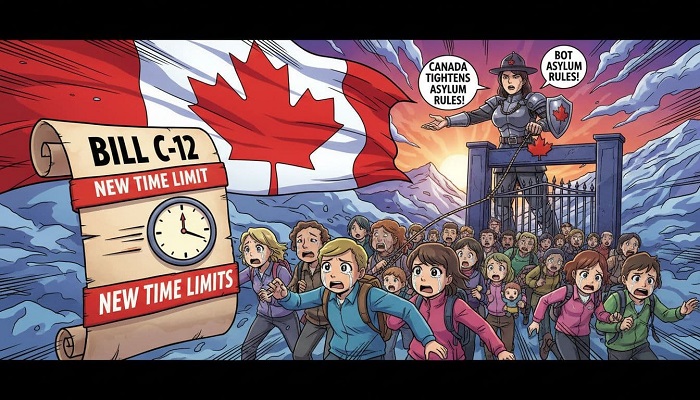
Canada has made a sharp change to its asylum system. Bill C-12, the Strengthening Canada’s Immigration System and Borders Act, received royal assent on March 26, 2026, and is now in force.

(Asian independent) The biggest shift is about timing. Some people who wait too long to claim asylum may no longer get a full hearing before the Immigration and Refugee Board, or IRB. The law also has four wider parts, stricter claim rules, a faster process, broader information sharing, and more federal power over visas and other immigration documents. The issue matters now because claim volumes have surged, and pressure on the system has grown, especially with a high number of claims from India.
In simple terms, asylum means asking Canada for protection from persecution, torture, or other serious harm. The IRB is the independent tribunal that decides many refugee cases. A referral is the step that sends a claim to the IRB for a full hearing.
Under Bill C-12, the key changes apply to asylum claims made on or after June 3, 2025. Ottawa says the goal is to reduce strain on the system, secure the border, and stop misuse, while still protecting people who face real danger. A detailed summary of Canada’s new asylum claim time limits has drawn national attention because the new deadlines can decide whether a claimant gets a full hearing or not at all.
The biggest practical change is simple: missing a deadline can now block a full refugee hearing.
The takeaway is hard to miss. Timing now matters almost as much as the claim itself.
This is one of the law’s toughest changes. If a person first entered Canada on or after June 24, 2020, and then makes an asylum claim more than one year later, that claim will generally not be referred to the IRB for a full hearing.
The rule turns on the first entry date. If that person later leaves Canada and comes back, the clock does not reset. In other words, re-entry does not create a new one-year window.
That point matters because many people may assume a later return changes the timeline. Under the new law, it does not. For many claimants, the first date of arrival now carries long-term legal weight.
The 14-day limit also targets some people crossing from the United States
Bill C-12 also creates a shorter deadline for some people who enter Canada irregularly from the United States, which means crossing between official border points. If that person waits more than 14 days to claim asylum, the claim will generally not go to the IRB for a full hearing.
The rule is narrow in one sense, because it targets a specific type of entry. Still, its effect can be severe. A two-week delay may now shut the door on an independent refugee hearing.
Why Ottawa says tougher asylum rules are needed right now
The political pressure behind Bill C-12 did not appear out of nowhere. Canada’s asylum system has faced a steep rise in claims, and the backlog has grown with it.
By the end of 2025, the IRB backlog had reached about 299,614 pending cases. That number helps explain why the government moved from slower fixes to hard legal deadlines.
Rising claim numbers, especially from India, helped drive the debate
Available 2025 data show the scale of the pressure. In the first six months of that year, Canada received 57,440 asylum claims in total. Of those, 9,770 came from India, the highest number from any country.
Public discussion has often pointed to claims linked to concerns in Punjab, including political tension, security fears, and economic strain. At the same time, critics of the current system have argued that some claims may be used as another way to remain in Canada after entry on a visa or permit.
That debate has been heated because it sits between two competing concerns. On one side, people may face real risk. On the other, a strained system can slow down valid claims and weaken public trust.
The government says the law will protect the system, not end refugee protection
Ottawa says Bill C-12 is meant to reduce abuse, manage sudden spikes in claims, secure borders, and support action against organized crime, including fentanyl smuggling. Public Safety Canada has also said the law gives police stronger tools to address illegal activity at the border.
At the same time, the government argues that refugee protection remains in place. People who do not get a full IRB hearing may still receive a pre-removal risk assessment, or PRRA. That process looks at whether a person would face danger if removed from Canada.
Still, a PRRA is not the same as a full refugee hearing. It is narrower, faster, and far less open than a full case before the IRB.
What else the law changes, and why critics are alarmed
Bill C-12 reaches beyond asylum deadlines. It also changes how cases move through the system, how governments share personal data, and how Ottawa can manage visas and permits.
Supporters say those powers can help the government react faster. Critics say the same powers are too broad.
Faster processing and wider data sharing could reshape how claims are handled
The law is meant to speed up and simplify asylum handling in the months ahead. It also allows federal, provincial, and territorial governments to share more personal information for investigations and case coordination.
Supporters say that can help enforcement, spot fraud sooner, and reduce duplication. Yet broader data sharing also raises privacy concerns, because more agencies may now handle sensitive personal details.
New powers over visas and permits raise fairness concerns
Bill C-12 gives the minister broader power, when the government says it is in the public interest, to cancel, suspend, or change visas, work permits, study permits, and other immigration documents.
The law also allows Ottawa to pause the acceptance or processing of some new applications in certain categories. That is a major shift because it gives the federal government more control over large groups of applicants at once, not only single cases.
Critics say that could affect temporary residents already in Canada and leave people facing sudden changes with little warning.
Refugee and rights groups warn that fewer hearings could put people at risk
Groups such as the Canadian Council for Refugees and the Canadian Civil Liberties Association have strongly criticized the law. Their central argument is clear: fewer full IRB hearings could mean more people are removed without an independent review of their refugee claim.
They also say the law may clash with the Charter and with Canada’s international refugee duties. In their view, a fast-tracked PRRA before removal does not provide the same level of fairness or protection as a full hearing.
That concern sits at the heart of the fight over Bill C-12. Is a quicker system a stronger system, or a weaker one?
Bill C-12 is not a small paperwork update. It changes who can reach a full refugee hearing, based on strict time limits, and it gives Ottawa broader control across the immigration system.
The people most affected are those who delayed claiming asylum after first entering Canada, and some who crossed from the United States between official border points and waited too long to file. For them, the calendar now carries far more weight than it did before, and that may shape the next legal battle over refugee rights in Canada.