THE ASIAN INDEPENDENT UK

Bal Ram Sampla
Geopolitics
When Canadian Prime Minister Mark Carney stepped off a plane in Mumbai on February 27, 2026, it was more than just a diplomatic trip. The fact that it happened at all was remarkable. Just two years earlier, Canada and India were barely on speaking terms.
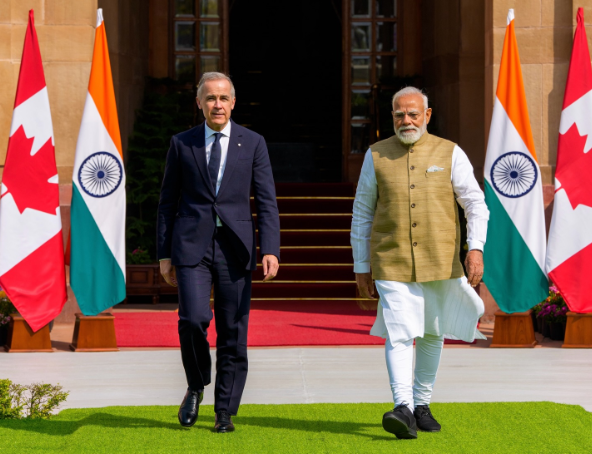
By the time Carney sat down with Prime Minister Narendra Modi at the historic Hyderabad House in New Delhi on March 2, something had clearly shifted. The two leaders announced billions of dollars in new deals, pledged to double trade by 2030, and set a target of signing a full free trade agreement before the year’s end. For two democracies with deep people-to-people ties and much to offer each other, it felt like a long-overdue reunion.
How It All Fell Apart
To understand why this visit mattered so much, you have to go back to the summer of 2023. In June of that year, Hardeep Singh Nijjar — a Sikh activist and Canadian citizen who supported the idea of an independent Khalistan homeland — was shot and killed outside a temple in Surrey, British Columbia. It was a brazen act of violence on Canadian soil.
Then-Prime Minister Justin Trudeau stood up in Parliament that September and declared that Canadian intelligence had credible evidence linking Indian government agents to the killing. India flatly denied any involvement and called the accusation absurd. What followed was a cascade of anger: diplomats were expelled from both sides, free trade talks were frozen, and the relationship went into a deep freeze. Canada’s large and politically influential Sikh diaspora demanded accountability. India accused Canada of sheltering what it called terrorists. The bitterness ran deep.
The friction did not end there. Canada’s national police force, the RCMP, later alleged that there was evidence of a broader Indian campaign of intimidation and violence on Canadian soil — a serious charge that made any diplomatic recovery seem nearly impossible.
A New Leader, A New Approach
The turning point came with leadership change. When Mark Carney replaced Trudeau as Prime Minister in early 2025, he brought a quieter, more pragmatic style to the file. Where Trudeau had made the Nijjar affair a central and public confrontation, Carney chose to treat it as a law enforcement and security matter — something to be handled through proper channels, not megaphone diplomacy. This subtle but important shift opened a door.
One of Carney’s early moves was to invite Modi to the G7 Summit that Canada hosted in June 2025. The two leaders met, and by all accounts the conversation was positive. A new security framework was quietly established — a channel between national security advisors — that would allow difficult issues like foreign interference to be handled separately from trade and diplomatic relations. The idea was simple but smart: don’t let one unresolved problem poison everything else.
The results were striking. By the time Carney made his New Delhi trip, his office could say that Canada and India had engaged more in the past year than in any two decades combined. Modi, for his part, was generous in acknowledging the change. “I give the entire credit for this increasing momentum to my friend, Prime Minister Carney,” Modi said through a translator at their joint press statement.
What Was Signed
The deals announced on March 2 were substantial. The headline agreement was a $2.6 billion contract for Canadian uranium giant Cameco to supply roughly 22 million pounds of uranium to India between 2027 and 2035 — fuel for India’s rapidly growing nuclear energy sector.
Five memorandums of understanding covering energy, critical minerals, artificial intelligence, technology, talent, culture, and defence were signed, totalling $5.5 billion in value.
Private sector deals piled up alongside the government agreements. An Indian pharmaceutical company pledged $155 million to triple production at a Quebec plant. A Canadian coal firm signed a deal worth hundreds of millions to supply India. A food company committed $135 million to expand a potato processing plant in Gujarat.
Perhaps most significant for the long term is the commitment to negotiate a Comprehensive Economic Partnership Agreement — a full free trade deal — with a potential signing date at the G20 Summit in Miami in December 2026. The two countries also set a target of doubling two-way trade from roughly $30 billion today to $70 billion a year by 2030.
Diversifying trade
Timing matters in diplomacy. This reset did not happen in a vacuum. Canada is navigating an increasingly complicated relationship with the United States under President Trump, who has imposed aggressive tariffs that are squeezing Canadian exporters. Diversifying trade relationships has become a national priority — and India, the world’s most populous country and fastest-growing major economy, is an obvious destination.
India, meanwhile, is hungry for energy — particularly uranium to fuel its nuclear power ambitions — and eager to attract the kind of stable, long-term investment that Canadian pension funds and resource companies can provide. Both countries need each other more than they might have admitted just a few years ago. Geopolitics has a way of focusing minds.
Unfinished Business
It would be wrong to pretend the slate is entirely clean. The investigation into Nijjar’s killing is ongoing. Canadian Foreign Minister Anita Anand made clear that concerns about transnational repression remain “at the forefront” of Canada’s thinking. Carney’s office noted that he raised the issue of foreign interference directly with Modi. These issues have not disappeared — they have simply been managed more carefully.
The Khalistan question — India’s deep sensitivity about Sikh separatist activism on Canadian soil — also did not vanish. Carney notably avoided making a high-profile visit to Punjab, a deliberate choice to sidestep one of the raw nerves that had inflamed tensions under his predecessor. Diplomacy is often about what you do not say or do, as much as what you do.
Conclusion
This visit deserves more attention than it received. Buried under the noise of an Iran crisis and regional conflict, a genuinely historic diplomatic achievement passed largely unnoticed. Two countries that had expelled each other’s diplomats, frozen cooperation, and traded accusations across international forums found a way back to the table — and not just back, but forward, to a more ambitious partnership than they had before the falling out.
“This is not merely the renewal of a relationship,” Carney told reporters in New Delhi. “It is the expansion of a valued partnership with new ambition.” Canada and India share democratic values, a massive and deeply connected diaspora, and enormous complementary economic interests.
References
1.https://www.cbc.ca/news/politics/carney-modi-canada-india-deal-9.7110805
2.https://www.pm.gc.ca/en/news/statements/2026/03/02/joint-statement-prime-minister-carney-and-prime-minister-modi
3.https://kpiasacademy.com/india-canada-mended-frayed-ties/
4.https://www.aljazeera.com/news/2026/2/27/canadas-pm-carney-in-india-to-bolster-trade-and-mend-ties
5.https://www.upi.com/Top_News/World-News/2026/03/02/india-canada-agreements/1301772467613/