THE ASIAN INDEPENDENT UK
 Ramesh Chander
The writer is A Retired Career Diplomat.
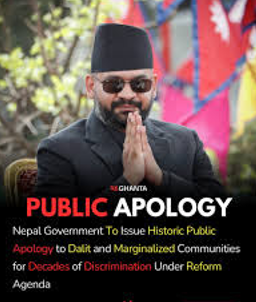
Nepal’s new government under the leadership of young leader, Balendra Shah which came into power after the Gen – Z Revolution, has decided to tender official apology to Dalits of the country who were made to suffer discrimination and ill-treatment in the caste ridden social setup for centuries. The decision of Nepal has triggered a debate in India and other countries of South Asia as to why the governments in these countries should not follow suit to assuage the pent-up feelings of the so called Dalits – scheduled castes, socially marginalized sections of the society. Nepal’s decision to offer an official apology to Dalits has prompted similar calls from India, where the community faces similar, if not worse, discrimination. Alisha Rahaman Sarkar has reported in the Telegraph. My motivation to write on the subject arose from a suggestion of one of friends and social activist, Advocate Satpal Virdi. I will try to study and analysis the issue, not as an expert but as a layman, with regard to India that is Bharat, my motherland which is the biggest country in the region with about 20% Dalit population who suffered from the obnoxious caste system of the Hindu hierarchy for many long centuries together. I have taken cue from the article of Alisha Rahaman Sarkar referred to above to make this narrative.
 With the decision, the government of Nepal will “formally acknowledge the injustice, discrimination and deprivation of opportunities inflicted on Dalits and historically marginalized communities by the state, society and policy structures”. The government said the proposed apology will be followed by measures on social justice, inclusive restoration, and historical reconciliation. Rights activists have welcomed the apology and the historic acknowledgment of generations of caste-based discrimination and exclusion. The Dalit community, which sits at the bottom of the rigid social stratification system, has faced centuries-long severe discrimination across South Asia despite constitutional guarantees. The ground situation is that Dalits live in poverty, with lower literacy rate and persistently low representation in key institutions,
Indian Ambedkarite MP, Chandrashekhar Azad speaking in the Lok Sabha on the subject asked to take moral responsibility for the historical injustice, drawing a comparison with Nepal’s commitment in this regard. “When will this parliament apologies to those discriminated for thousands of years and even today face discrimination and are forced to fight for basic necessities, such as food, clothing and shelter,” he said. The caste system in India dates back thousands of years and is still critical in Indian life and politics, with those at the bottom rung routinely discriminated against. The Indian constitution banned caste-based discrimination in 1950, and successive governments have implemented policies to encourage greater social mobility for the “lower” castes. But across India, particularly outside big cities, the system persists to varying degrees.
 With the constitution of India, caste based discrimination has been eradicated and abolished but the system of the laws of Manu remains as we say in Hindi – Jatti Hai Ki Jatti Hi Nahin (Caste does not go). The affirmative actions to empower Dalits – socially marginalized sections of the society in the form of reservations and other actions have helped in the process to lessen the adverse and ill effects of the caste system but these provisions have not delivered in full measure as expected. The main stream of the society who still professes the old and obnoxious rules of the society with regard to caste should come forward and fight the menace head-on from the front, if we intend to save Bharat. The gesture of apology is just a way or means to add to the sense of empowerment of Dalits with a view to integrate them in the process of bringing about Vikshit Bharat as visualized by our leadership headed by PM Narendra Modi. Nepal has taken the lead and rightly so. There is no harm to be magnanimous in the run up to safeguard preserve humanity. Many Chandrasekharas are sitting on the fence to jump to fight for the human-dignity as enshrined, thoughtfully, in our constitution given by our forefathers headed by Babasaheb Ambedkar. I am reminded of a couplet of Allma Iqbal –
Sun Ae Ghafil Sada Meri, Ye Aesi Cheez Hai Jis Ko
Wazifa Jaan Kar Perhte Hain Taair Bostanon Mein
(Listen to my call, O imprudent one! This is something which
The birds in gardens are reciting like the daily prayers)