

By: Surjit Singh Flora

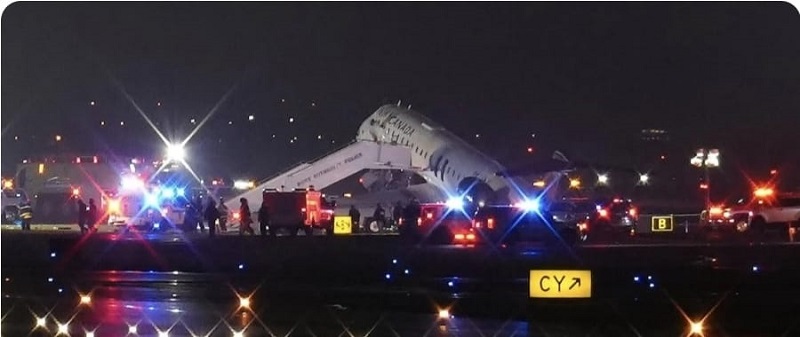
(Asian independent) In the wake of a devastating runway collision that claimed the lives of two pilots and injured several passengers, Air Canada CEO Michael Rousseau has issued an apology after facing significant backlash for delivering his condolence message solely in English. The incident, which involved an Air Canada aircraft operated by Jazz Aviation and a fire truck at LaGuardia Airport, has reignited discussions about language representation and sensitivity in a bilingual nation.
On the day of the tragedy, which killed pilots Antoine Forest and Mackenzie Gunther, Rousseau released a video message expressing condolences and sorrow for the victims’ families but failed to provide a French version, sparking outrage among political leaders and language advocates. Critics emphasized that as the head of one of Canada’s key airlines, Rousseau’s English-only message was not just a gaffe, but a breach of the bilingual obligations set forth in Canada’s Official Languages Act.
In a written statement issued in both English and French, Rousseau expressed deep remorse that his limited proficiency in French detracted from the focus on the grieving families and the airline staff affected by this tragedy. “I am profoundly saddened that my inability to communicate effectively in French has shifted attention away from the victims and their loved ones,” Rousseau stated. “Despite my commitment and efforts to improve my language skills over the years, I recognize that I still struggle to express myself adequately.”
The collision occurred shortly after the Air Canada flight, which had departed from Montreal, landed at LaGuardia. Investigations have revealed that both the aircraft and the fire truck had been cleared to cross the runway moments before the incident. The collision resulted in the tragic loss of two lives and left several passengers injured, with four individuals still hospitalized days after the event.
Prime Minister Mark Carney, who has been vocal about the incident, criticized Rousseau’s English-only message as lacking compassion. “In times of tragedy, we must come together as a nation and communicate with empathy. An absence of a bilingual message in such a significant moment is a failure to recognize the diversity that defines our country,” Carney remarked at a recent press conference.
Quebec Premier François Legault went a step further, suggesting that Rousseau should consider stepping down if he is unable to meet the bilingual expectations of his position. “As the CEO of a major Canadian airline, it is imperative that he represents both official languages. If he cannot do so, perhaps it is time for new leadership,” Legault stated.
The incident has also drawn the concern of Canada’s parliamentary Committee on Official Languages, which has called upon Rousseau to appear before Members of Parliament to explain why his initial video message was not delivered in both official languages. “This situation raises serious questions about the commitment to bilingualism within our national institutions,” said committee chair, MP Julie Dabrusin.
Despite being privatized in 1988, Air Canada is still subject to the country’s bilingual obligations, routinely providing onboard announcements in English and French. While Rousseau has faced criticism for his French language skills since taking over as CEO in 2021, the recent events have escalated the scrutiny surrounding his leadership and communication abilities.
As investigations into the collision continue, with early details from cockpit recordings suggesting a miscommunication in runway clearance, Rousseau’s apology has brought neither comfort nor resolution to the families affected by this tragedy. Airport operations were temporarily halted following the incident, and authorities are working diligently to ensure the affected runway is reopened safely.
In conclusion, the collision at LaGuardia Airport and the subsequent fallout from Rousseau’s English-only condolence message have sparked a broader conversation about bilingualism in Canada. As the nation grapples with the implications of language in leadership, the focus remains on the victims and their families, whose grief has been overshadowed by the controversy. Rousseau’s commitment to improve his French skills may be a step forward, but for many Canadians, the incident raises critical questions about accountability and sensitivity in a diverse society.