

DR RAMJILAL, Social Scientist Former Principal, Dyal Singh College,
Karnal (Haryana, India).
Email [email protected]

(Asian independent) Abstract: This is an important topic because Haryana’s contribution to India’s freedom struggle has not received the proper attention it deserves in many mainstream histories of the national movement. At that time, Haryana was not a separate state; most of its present territory was part of the former Punjab province, while districts and places that now fall within Haryana have been identified.
The article is not merely a chronological account of prominent figures but a historical and analytical study from a Marxist perspective. It brings together the participation of rulers, nawabs, soldiers, peasants, labourers, women, political activists, and revolutionaries.
The history of India’s freedom movement is incomplete without a proper account of the contributions of the people of present-day Haryana. Situated between Delhi and Punjab, Haryana was a key strategic, agricultural, and military hub during the British Raj. Its people participated in the 1857 Revolt, peasant protests, revolutionary activities, and the national movement led by the Indian National Congress and the Indian National Army (INA). Yet, the contributions of this region, especially its peasants and the general rural population, have not received much attention in mainstream history.
Between 1857 and 1947, Haryana was not a separate administrative state. Its current territory was divided into British-administered districts and princely states. After the rebellion was suppressed, much of this region was incorporated into Punjab in 1858. This administrative change also reflects the British colonial government’s attempt to consolidate its control over the region whose people participated in the rebellion.
The movement was not socially or politically homogeneous. It included peasants, soldiers, labourers, rulers, nawabs, landowners, the educated middle class, women, and revolutionary nationalists. Their objectives sometimes coincided with those against British imperialism, but they differed on questions of property, power, and social reform. Understanding these contradictions is essential to writing a people’s history of Haryana’s contribution to independence.
Expansion:
1. Before the 1857 People’s Revolution: Farmers’ Movement
In fact, before 1857, the flames of the movement were flaring due to anger and discontent among the people against the rule of the British East India Company. From 1760 to 1857, tribal peasants and agricultural labourers, as well as peasants and farm labourers living in the plains, staged numerous violent armed and nonviolent revolts against the British East India Company, British imperialism, and the Indian nawabs, kings, landlords, princely states, and principalities they protected.
Kisan movements in Haryana before 1857:
Before the People’s Revolution of 1857, there were numerous Kisan movements throughout Haryana. These include Jind (June 1814-January 1815), Chhachhrauli (1818), Rania (1818), Kisan Andolan (1824), Kaithal (March-April 1843), Ladwa (1845-1846), and the Kisan Revolt in Karnal (1846-1847). Rising poverty, hunger, and revenue rates were the primary drivers behind these Kisan movements.
In June 1857, the British official Andrews wrote to the Government of India, ‘I find the country considerably disorganised; the revenue and police officers are in a state of fight, and many Zamindars and big villages are quite refractory. ’In fact, before 1857, the flames of people’s revolution were raging due to popular anger and discontent with the British East India Company’s rule.
2.1857: Military rebellion and popular resistance
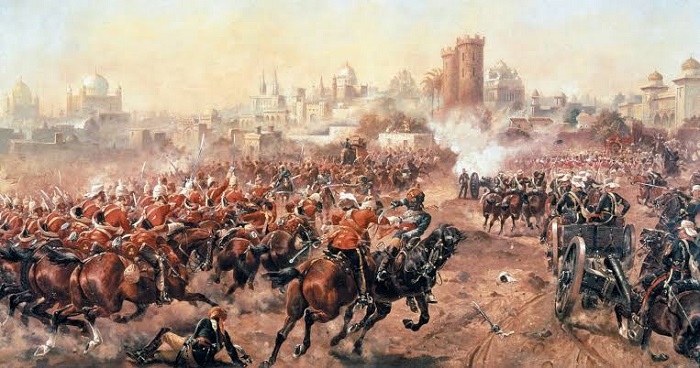
The Revolt of 1857 was a decisive episode in Haryana’s history. Ambala Cantonment witnessed an open military uprising at approximately 9 a.m. on 10 May 1857, followed by the revolt of the 5th Native Infantry around noon. This was several hours before the better-known uprising at Meerut that evening. Historian K. C. Yadav has examined the possibility of a coordinated plan among soldiers at Ambala and Meerut.
The rebellion arose from several interconnected grievances. The introduction of the Enfield rifle cartridges became an immediate military trigger, but the deeper causes included racial discrimination, the erosion of traditional military privileges, colonial annexations, economic exploitation and political interference.
3. MainYears ago, the British Epicentres:
The primary epicentres of the uprising were Ambala, the Ahirwal region (including Rewari), Nasibpur (Narnaul), Mewat, Jhajjar, Ballabhgarh, Farrukhnagar, Hansi, Hissar, Thanesar, and Karnal.
4. The Rulers, Nawabs, and Popular Resistance:
The political situation in Haryana in 1857 was complex, as the region consisted of several princely states, jagirs, and territories directly governed by the British. Local rulers and chiefs made decisions based on their political interests, territorial disputes, and relationships with the colonial administration.
Prominent leaders who resisted British authority included Rao Tula Ram of Rewari, Nawab Abdur Rahman Khan of Jhajjar, Raja Nahar Singh of Ballabhgarh, Nawab Ahmad Ali Khan of Farrukhnagar, and Rao Krishan Gopal. Their participation highlighted that resistance was not limited to one community or social group.
A. Rao Tula Ram:
Rao Tula Ram emerged as one of the most crucial military and political leaders of the rebellion in the Ahirwal region. He organised resistance in and around Rewari and Nasibpur, where a significant battle was fought against British forces in November 1857. His efforts to seek support beyond India also illustrated the broader political ambitions of the rebellion.
B. Raja Nahar Singh:
Raja Nahar Singh of Ballabhgarh supported the rebels and maintained connections with revolutionary forces operating around Delhi.
C. Nawab Abdur Rahman Khan and Nawab Ahmad Ali Khan:
Nawab Abdur Rahman Khan of Jhajjar and Nawab Ahmad Ali Khan of Farrukhnagar were also involved in the resistance. Following the suppression of the revolt, the British punished several of these rulers, confiscating territories and executing key participants. Raja Nahar Singh, Nawab Abdur Rahman Khan, and Nawab Ahmad Ali Khan were captured and hanged by the British at Chandni Chowk in Delhi. Rao Tula Ram, meanwhile, died in exile while trying to secure foreign support for the revolution.
5. The Outbreak and Liberation of Hisar:
According to historical accounts, the revolt in Hisar began on May 29, 1857. Soldiers from the Haryana Light Infantry and Dadri Cavalry, involved in the uprising at Hansi, rose against British authority. Contemporary and later accounts describe attacks on British officials and government establishments, the opening of the prison, and the seizure of the treasury. The rebel flag was reportedly raised near Nagori Gate. Hisar remained outside effective British control for approximately 83 days.
The uprising extended beyond Hisar, with participation from Jats, Ranghars, Rajputs, Bishnois, and Bhattis. Villages around Hisar became key centres for mobilisation and support. This wide participation indicates that the revolt had a substantial rural and agrarian character, although the motivations of different groups were not necessarily the same.
6.Leadership and Hindu-Muslim Cooperation in Hisar:
An important figure in the uprising was Muhammad Azim, a jagirdar from Bhattu, who emerged as a leader of the rebellion and claimed authority in the name of Mughal Emperor Bahadur Shah Zafar. Other accounts mention Shah Nur Khan and Rajeb Beg in relation to the military revolt, alongside Sahbaz Beg in the organisation of resources. Local leaders such as Hukam Chand Jain, Faqir Chand Jain, and Muneer Beg also played roles in the resistance and its organisation.
This cooperation between Hindu and Muslim participants is historically significant, showcasing that opposition to colonial rule could unite people across religious boundaries. The rebellion did not present a uniform agenda; rather, it was a coalition of soldiers, local notables, and rural communities with overlapping but sometimes divergent objectives.
7. British Reconquest and Repression:
In response to the uprising, the British organised a military campaign to reclaim Hisar and Hansi. General Van Cortlandt advanced with reinforcements, including forces backed by princely states. On August 19, 1857, British forces recaptured Hisar, and the reprisals were severe. Historian Mahender Singh cites reports indicating that 435 people were killed near Nagori Gate and 123 crushed under a road roller. Other accounts suggest even higher death tolls throughout the town. These figures should be regarded as historical estimates rather than an exact count.
Punishment did not cease with the recapture of the town. Villages suspected of supporting the uprising faced executions, confiscations, and economic penalties. The reported auctioning of land in villages such as Hazimpur, Jamalpur, Mangali, Puthi Mangal Khan, and Rohnat illustrates how colonial repression extended beyond military defeat to economically weaken rural society
7. A Marxist Interpretation of the Hisar uprising:
From a Marxist historical perspective, the Hisar uprising should be understood as a combination of military rebellion and popular resistance against colonial dominance. British rule was not merely a shift in political authority; it involved revenue extraction, interference in local power structures, economic pressure on cultivators, and the consolidation of colonial administrative control.
The involvement of rural communities indicates that the revolt was linked to broader agrarian grievances. However, it would be historically inaccurate to claim that every participant shared the same class interests or a unified modern political agenda. Local chiefs, soldiers, prosperous cultivators, small peasants, and other rural groups may have opposed British rule for different reasons. Their temporary unity was directed against colonial authority.
The British reprisals also had a class dimension; the confiscation and auction of village lands could punish not only individuals who fought but entire rural communities suspected of supporting the rebellion. Thus, the suppression of 1857 involved both military violence and the reorganisation of property and political authority.
8. Place in the History of Haryana of the revolt in Hisar:
The revolt in Hisar must be studied alongside the uprisings in Hansi, Sirsa, Rohnat, and other surrounding villages. The official Haryana State Gazetteer records that the troops stationed at Hisar, Hansi, and Sirsa helped initiate the rebellion in the last week of May 1857, which was quickly followed by a response from the civilian population. The account also identifies Muhammad Azim and the Hansi leaders Hukam Chand Jain, Faqir Chand, and Meena Beg.
Hisar thus deserves a prominent place in the history of 1857 in Haryana—not only because British authority was challenged there but also because the resistance involved soldiers, civilians, rural communities, and leaders from various religious backgrounds. This history reminds us that the struggle for political independence was intertwined with questions of land, livelihood, and social power.
8.Different political and social interests to British domination:
However, not all princely rulers supported the rebellion. The rulers of Patiala and Jind, as well as the Nawabs of Karnal and Kunjpura, among others, assisted the British in maintaining control. Their roles illustrate the divisions within the ruling classes and highlight the importance of examining the political and economic interests behind their decisions.
The participation of these rulers reflected the opposition of different political and social interests to British domination. However, their resistance should not be automatically equated with the interests of the peasantry. The rulers and landed elites sought to defend political authority, territory, and property, while ordinary cultivators faced agrarian exploitation and colonial revenue demands.
Thus, the revolt represented a broad but internally differentiated alliance against colonial power. Its multi-community character also challenges interpretations of 1857 through the lens of communal divisions.
The participation of Hindu rulers, Muslim nawabs, Sikh chiefs, soldiers, and ordinary villagers give the Revolt of 1857 in Haryana a distinctly popular and multi-community character. Its history should therefore be understood through political alliances and popular resistance rather than communal classifications.
9. Popular Resistance in the Old Karnal District: Gharaunda, Ballah, and Asandh
The contribution of the old Karnal district deserves special attention because the revolt of 1857 was not merely a military rebellion. It developed into a popular uprising involving peasants, village communities, and local social groups. The disturbances affected Karnal, Gharaunda, Ballah, Assandh, Kaithal, Jalwana, Kurukshetra, Shahabad, Ladwa, Kalsaura, and surrounding areas.
The participation of the rural population was particularly significant. Peasants opposed colonial revenue demands, oppressive administrative practices, and the authority of officials representing British rule. In several areas, the revenue and police administration became ineffective as villagers refused to cooperate and challenged the colonial authorities.
The old Karnal district, particularly Gharaunda, Balla, and Asandh, was an epicentre of popular resistance.
To suppress the uprising, two hundred and fifty soldiers from the Punjab First Cavalry, led by Captain Hughes, were dispatched from Karnal on July 13, 1857. The British clashed with 900 Indian soldiers from Balla village, and Captain Hughes eventually fled. This victory boosted the morale of the people. Three hundred British soldiers later joined the Indian People’s Army. Utilising guerrilla tactics, the Indian soldiers attacked at night and hid in the forests during the day.
However, on July 14, 1857, just as Captain Hughes faced complete defeat, troops from Maharaja Patiala arrived to assist the British. Balla village was subsequently destroyed, and the people faced horrific torture beyond expression. The immense Peepal tree that still stands near the Johad (Pond) serves as a reminder of these atrocities.
The massive peepal tree near the pond in Balla village stands as a testament to the village’s dark history. Countless individuals—men, young men, women, and young women—were hanged from this tree. According to legend, these individuals were forced to lie on the ground and were trampled by rollers. Homes and properties were looted, burnt, and crops destroyed.
After the revolutionary movement ended, the people of Balla village faced a heavy land tax. When a moneylender paid the entire village’s taxes, the British government withdrew its army but did not remove the increased land tax. Unfortunately, this elevated land revenue persisted for 30 years after India’s independence on August 15, 1947. When the issue was brought to the attention of the people’s leader, Tau Devilal, he repealed the tax in 1977 during his tenure as Chief Minister.
In Asandh, the Muslim Kamboj (Kamboh) zamindars (landowners) provided supplies, protection, and shelter to rebel freedom fighters, known as the Azadi ke Sipahi. During the Siege of Delhi, amidst an uprising led by Bahadur Shah Zafar, British military records referred to the “Kamboj Irregular Cavalry” in relation to the Muslim Kambojs of Panipat.
The actions of Allah Dad Khan Kamboh, a Muslim Lambardar (village headman) from Asandh, became known during the 1857 Karnal uprising, where he was accused of supplying horses to the rebels. As a result of his actions, authorities confiscated his 400 bighas of land. Additionally, Six Kamboh families in the Guhla-Cheeka area of Haryana were labelled as “traitorous zamindars” for sheltering a supporter of Nana Rao Peshwa.
To comprehend the sacrifices of village communities and the colonial punishments they faced, it is essential to reconstruct their history using district gazetteers, contemporary records, oral traditions, and research on Karnal.
Ultimately, the revolutionaries of Karnal district were crushed under the leadership of Pearson and Captain Maclean, resulting in the failure of the uprising. The fundamental reasons for this failure included a lack of effective leadership, modern weapons, and trained soldiers compared to the European and Indian armies of Maharaja Jind, Maharaja Patiala, the Nawabs of Kunjpura, and Karnal. The movement was brutally suppressed; armies from both European countries and Indian Nawabs committed heinous atrocities against the people, leading to the deaths of thousands—men, young men, women, young women, and children. Villages were burned, properties were destroyed, and many areas saw houses set ablaze, all while revenue demands increased in countless villages. These atrocities weakened the population and hindered their participation in future movements. Although the popular uprising ended, the wounds remained fresh, and the pain continued to burn in the hearts of the people.
The British response to the revolt extended beyond military action. Punitive measures, fines, confiscations, and alterations in local administrative arrangements significantly impacted rural society. These policies were part of a broader colonial strategy to weaken opposition and empower loyal intermediaries.
The participation of Hindu rulers, Muslim nawabs, Sikh Chiefs, soldiers, and ordinary villagers give the Revolt of 1857 in Haryana a distinctly popular and multi-community character. Therefore, its history should be understood through political alliances and popular resistance rather than through communal classifications.
10.A Marxist Interpretation of the Revolution of 1857 in Haryana:
The Revolution of 1857 in Haryana should be viewed not merely as a military rebellion or a struggle led by dispossessed rulers, but as a broad resistance to British colonial dominance. Its social composition included soldiers, peasants, local chiefs, artisans, and other sections of society. Although their immediate grievances and political objectives differed, they were united by their opposition to foreign rule.
From a Marxist perspective, the economic foundations of colonialism are central to understanding this uprising. The colonial system aimed to extract agricultural surplus through land revenue, transform traditional property and administrative relations, and strengthen its control over local resources. These policies placed considerable pressure on cultivators and rural communities. Thus, the participation of peasants and villagers in the revolt reflected not only political discontent but also deeper economic and social grievances.
The involvement of rulers such as Rao Tula Ram, Raja Nahar Singh, and other local chiefs highlighted the loss of political authority and erosion of their traditional positions under British expansion. Simultaneously, the participation of ordinary people gave the revolt a broader social character. Resistance in Hisar, Hansi, Karnal, Rewari, Ballabhgarh, and other centers demonstrated that the uprising extended beyond military establishments and princely leadership into rural society.
The cooperation between Hindus and Muslims was another significant aspect of this upheaval. It demonstrated a united front against colonial oppression, emphasising that the struggle transcended religious boundaries and drew upon a collective desire for freedom. Thus, the Revolution of 1857 in Haryana was a significant episode in the history of anti-colonial resistance. Its legacy must be assessed not only through the sacrifices of rulers and soldiers, but also through the participation and suffering of peasants and ordinary people. It laid an important foundation for the subsequent freedom movement, while reminding us that political independence and social-economic emancipation are related but distinct historical struggles.
11. The Legacies of the Revolution of 1857 in Haryana:
The Revolution of 1857 left a lasting legacy in the political and social history of Haryana. Although the uprising was ultimately suppressed, it demonstrated that British authority could be challenged through collective resistance involving soldiers, peasants, local leaders, and ordinary villagers. The sacrifices of figures such as Rao Tula Ram, Raja Nahar Singh, Hukam Chand Jain, Faqir Chand, and many lesser-known participants have become an integral part of the region’s historical memory.
One of the most significant legacy of the uprising was the spirit of cooperation between Hindus and Muslims. Individuals from different religious communities came together to resist colonial rule, illustrating that a common struggle for freedom could transcend religious divisions. This involvement of rural communities also established an important tradition of popular resistance in the region.
The British response to the revolt—marked by executions, property confiscation, punitive taxation, and the repression of villages—highlighted the close connection between political dominance and economic control. The memory of these oppressive measures continued to shape popular perceptions of colonial rule.
From a Marxist perspective, the legacy of 1857 lies in its demonstration that national liberation was intricately linked to issues of land, livelihood, economic exploitation, and social power. While the uprising did not produce a unified programme for agrarian or social transformation, it exposed the contradictions of colonial rule and unified diverse sections of society in common resistance. The Revolution of 1857 did not mark the end of Haryana’s struggle against colonialism; instead, it signalled an important beginning in the region’s modern history of resistance. The spirit of sacrifice, popular participation, and collective action during this period established a historical foundation for the movements that arose between 1885 and 1947.
12. Conclusion:
The Revolution of 1857 holds a significant place in Haryana’s history of resistance to British colonial rule. Despite being suppressed, it showcased the courage and collective strength of soldiers, peasants, local rulers, and ordinary citizens. The participation of both Hindus and Muslims reflected a spirit of unity against foreign dominance, while the widespread involvement of rural communities revealed the deeper social and economic grievances that underpinned the uprising.
From a Marxist perspective, the revolt represented not only a resistance to political subjugation but also a challenge to colonial exploitation and the disruption of existing agrarian and social structures. Although it lacked a cohesive national and socio-economic programme, its sacrifices and popular character left an enduring legacy. The Revolution of 1857 was not the culmination of Haryana’s freedom struggle; rather, it was a crucial foundation upon which subsequent generations would build their fight for national independence.
(Note: Co-authors: Harish Chandra Mittal and Ramjilal Kamboj (now Dr RAMJILAL), Haryana: Then and Now, Kurukshetra, 1967).
References:
1.Government of Haryana. (n.d.). Haryana State Gazetteer, Volume I. Government of Haryana. Read the Gazetteer chapter on the 1857 uprising.
2.Yadav, K. C. (1977). The revolt of 1857 in Haryana. Manohar Book Service.
3.Sheoran, C. B. Singh. (2019). Gallant Haryana: The first and crucial battlefield of AD 1857. Routledge. Publisher’s book details.
4.Deswal, D. (2024, August 22). This day 167 years ago, British killed almost 800 people in Hisar. The Tribune. Read the report.
5.Deswal, D. (2025, August 5). When Hisar raised banner of revolt and was ‘free’ for 83 days in 1857. The Tribune. Read the report.
6.Haryana State Archives. (n.d.). Record holdings. Archives Department, Haryana
7. Bhardwaj, S. B. (2017). Economic transformations and their socio-political impact in colonial Haryana, 1857–1947. International Journal of Reviews and Research in Social Sciences, 5(2), 121–131. https://doi.org/10.5958/2454-
8. Government of Haryana. (n.d.). History of Haryana. https://www.haryana.gov.in/
9.. Government of Haryana. (n.d.). History of Ambala. https://ambala.gov.in/history/
10. Government of India, Ministry of Culture. (n.d.). Dictionary of martyrs: India’s freedom struggle, 1857–1947. https://www.culture.gov.in/
11. Yadav, A. (2019). Socio-economic discontent among the peasants and the uprising of 1857: A case study of Haryana. Academic Discourse, 8(2), 8–17.
12. Yadav, K. C. (2022). 1857 uprising: ‘The outburst’ in Haryana. Indian Historical Review, 49(1_suppl), S69–S80. https://doi.org/10.1177/
13. Yadav, K. C., & Dass, R. (1994). Rebels against the Raj: Who’s who of freedom fighters in Haryana, 1885–1947 (Vols. 1–2). Mounto Publishing House.
14. Singh, P., & Shukla, S. P. (1985). Freedom struggle in Haryana and the Indian National Congress, 1885–1985.
15. Karnal District Gazetteer. (1976). Government of Haryana.
16. मित्तल, चंद्र, हरीश तथा कंबोज, लाल, रामजी. (अब डॉ रामजीलाल) (1967). हरियाणा :तब और अब , शिक्षा विस्तार विभाग,कॉलेज आफ एजुकेशन, कुरुक्षेत्र.
17.Lal, Ramji, Dr. (25/08/2025). The role of Karnal district in the Indian Independence Movement from 1857 to 1947: A Reviewhttps://samajweekly.com/
18. Lal, Ramji, Dr. ,भारतीय स्वतंत्रता आंदोलन में सन् 1857 से सन् 1947 तक करनाल जिले की भूमिका : एक पुनर्विलोकन
https://samajweekly.com/1857-
19.Lal, Ramji, Dr. (13 मई 2020). ब्रिटिश हुकूमत में महामारी की याद दिलाता है करनाल का ग्रेव्यार्ड, अमर उजाला, करनाल, 13 मई 2020
https:// www. amarujala .com/ Haryana/ Karnal/ the –graveyard- of -Karnal -reminds -me -of –the- epidemic –in- British- rule-ka>
20. Lal, Ramji, Dr. (17 अगस्त 2022).कर्ण वीरों की भूमि :आजादी के हर संग्राम का अहम किरदार रहा करनाल ’,दैनिक ट्रिब्यून, 17 अगस्त 2022, पृ. 6
21.Lal, Ramji, Dr. (16 जनवरी 2025). प्रथम स्वतंत्रता संग्राम में ब्रिटिश सेना के छुड़ा दिए थे छक्के,करनाल केसरी,करनाल,16 जनवरी 2025,पृ.4
22 Lal, Ramji, Dr.,हरियाणा के प्रसिद्ध क्रांतिकारी बल्ला गांव की सन् 1857 की जनक्रांति में कुर्बानियों की रौंगटे खडी करने वाली दास्तान: एक ऐतिहासिक पुनर्मूल्यांकन
https://samajweekly.com/
23. Lal, Ramji, Dr., From the window of History :Hair-raising sacrifices of Balla village of Haryana in the people’s revolution of 1857—Re-evaluating history
24. Lal, Ramji, Dr.,https://samajweekly.com/
25. Lal, Ramji, Dr. ,Haryana in the people’s revolution of 1857—Re-evaluating historyhttps://theasianindepen
26.Lal, Ramji, Dr., https://pratibimbmedia.com/
27. Lal, Ramji, Dr. , From the window of history: Hair-raising sacrifices of Balla village of Haryana in the people’s revolution of 1857 – a historical re-evaluation
https://hastaks hep.com/aapki-najar/hair-
28. Lal, Ramji, Dr. (12 अगस्त 2025). प्रथम स्वतंत्रता संग्राम को दबाने के लिए बेरहमी से मारे गए थे क्रांतिकारी, करनाल केसरी,करनाल,12 अगस्त 2025,पृ.1
29. Lal, Ramji, Dr. (1 7 अगस्त 2025 ).1857 की जनक्रांति और बल्ला गांव की कुर्बानियां, जगमार्ग,चंडीगढ़,1 7 अगस्त 2025, पृ.6
30. Lal, Ramji, Dr. (17 अगस्त2025).इतिहास के झरोखे से–हरियाणा के प्रसिद्ध क्रांतिकारी बल्ला गांव की सन् 1857 की जन क्रांति में कुर्बानियों की रौगटे खडी करने वाली दास्तान एक ऐतिहासिक पूर्नमूल्यांकन,सत्य केसरी,करनाल,17 अगस्त2025,पृ.6
31.Lal, Ramji, Dr.,1857 ਦੀ ਲੋਕ ਕ੍ਰਾਂਤੀ ਵਿੱਚ ਹਰਿਆਣਾ ਦੇ ਮਸ਼ਹੂਰ ਇਨਕਲਾਬੀ ਬੱਲਾ ਪਿੰਡ ਦੀਆਂ ਕੁਰਬਾਨੀਆਂ ਦੀ ਰੌਂਗਟੇ ਖੜ੍ਹੇ ਕਰਨ ਵਾਲੀ ਕਹਾਣੀ: ਇੱਕ ਇਤਿਹਾਸਕ ਪੁਨਰ–ਮੁਲਾਂਕਣ
https://samajweekly.com/in-
32. Lal, Ramji, Dr. (18 अगस्त 2025).विद्रोह का प्रतीक पिंड बल्ला, दैनिक जागरण पंजाबी, जालंधर ,18 अगस्त 2025