THE ASIAN INDEPENDENT UK
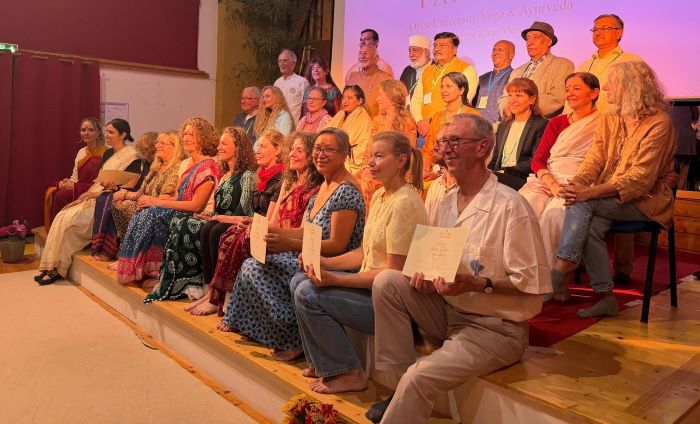
“22nd Ayurveda & Yoga International Symposium France
Tapovan is a prominent Yoga and Ayurveda education and holistic health centre operating in dual hubs at Paris and Normandy in France. Founded in 1982 by Vaidya Kiran Vyas considered a pioneer and reference point for traditional Indian medicine in France.
Kiran Vyas is originally from Lakhtar, Gujarat, in India, and was deeply influenced by Gandhi and Sri Aurobindo.
For over four decades, Kiran Vyas has been the quiet architect of Ayurveda’s presence on this continent — introducing it to France when it was still entirely unknown, building Tapovan into an Open University of Yoga and Ayurveda. His contribution has been formally recognised by the Government of India itself, with the conferral of the Padma Shri in 2024.”
The All-Party Parliamentary Group – Indian Traditional Sciences
Presentation by Amarjeet S. Bhamra
Before setting out our purpose, it would be remiss not to acknowledge our host and the spirit of this gathering. It is a privilege to address this assembly under the roof of Tapovan, France — founded in 1982 by Vaidya Kiran Vyas, and rightly recognised as one of the oldest and most authentic centres of Yoga and Ayurveda in Europe. It is fitting that a movement calling for the amalgamation of Indian Traditional Sciences into European Integrative Healthcare should gather under the very roof where that journey in Europe began.

The All-Party Parliamentary Group Indian Traditional Sciences was established in the UK Parliament in 2014.
The purpose was to provide a platform for a unified voice calling for a Disease-Free Society — a purpose that speaks as directly to Europe as it does to Britain.
This initiative was an imperative, given the support of a million UK signatures nationwide in 2010, for my petition in favour of Herbal, Traditional, Complementary & Integrative Healthcare. That same petition stood in direct response to the European Union’s Traditional Herbal Medicinal Products Directive (THMPD) — meaning this movement has, from its very origin, been a European story as much as a British one.
A UK government Report on 26 March 2015 advised establishing a statutory regulatory framework for herbal practitioners, including those practising Ayurveda, to enhance public safety, quality control, and training standards, and to bring practitioners under a unified regulatory body. The same UK government at the time did not find in favour of the Report’s recommendations — yet the underlying question it posed remains unresolved across the whole of Europe: how should our health systems safely and formally integrate traditional, complementary, and evidence-based practices that hundreds of millions of Europeans already use?
Lord King, the first Chairman and myself as the founder of the All-Party Parliamentary Group Indian Traditional Sciences, made an earlier call to the competent and willing — and it is a call that all parliamentary members of this Group have been organising and delivering Ayurveda and Yoga into a pluralistic model of Integrative Healthcare across the Houses of Parliament in London and the European Parliament in Brussels.
A Shared European Moment
Today, together, we have a great opportunity before us. In July 2025, the UK Government published its “Fit for the Future” 10-year Plan for the National Health Service (NHS) in England. Now is the time for us to contribute: to build “Health” into British and European health and social care policy, based on prevention-oriented, evidence-based, person-centred, holistic healthcare.
 The NHS Plan states: “We will achieve our goals by harnessing a huge cross-societal energy on prevention. We will work with businesses, employers, investors, local authorities and mayors to create a healthier country together.” The rationale given is that this will boost health, ensure the future sustainability of the NHS, and support economic growth.
This is not a uniquely British ambition. Across the European Union, the same reckoning is underway. The Commission’s State of Health in the EU: 2025 Synthesis Report identifies the same four interlocking challenges facing all 27 member States: preventing non-communicable diseases, strengthening primary care, accelerating digital health transformation, and ensuring affordable access to medicines. And under the EU4Health Programme — the EU’s principal health fund, worth €4.4 billion — Member States committed that at least 20% of the budget be directed to health promotion and disease prevention. That target has, to date, not been met. The gap between prevention rhetoric and prevention funding is, it seems, a European problem, not merely a British one.
To those of us with a TCIH background, both the UK Plan and the EU’s own health strategy read more like a wish-list than a roadmap — neither yet sets out how to create “Health,” nor how to prevent “Ill Health,” in practice. This is the standpoint of a rapidly advancing, but relatively young, field of modern medical science — a science and technology to which many of us may owe our lives, through the crisis-management skill of our heroic allopathic medical professionals. And yet the escalating burden of chronic disease, and its accompanying cost, continues to present an existential crisis to every health system in Europe alike.
Friends — across Europe — there has never been a time so rich as this: a moment for us to stand united in our cause, and to support our shared heritage as we collaborate in the implementation of Integrative Healthcare within the health architecture of our continent.
The Scale of the Challenge, Across Europe — and Britain’s Place Within It
Rising costs – Health-related benefit spending is rising across the whole of the developed world, not just in Britain. According to Organisation for Economic Co-operation and Development (OECD) based in Paris, social expenditure data, the OECD average for cash spending on working-age health-related benefits stands at around 1.6% of GDP — rising to 2.0% of GDP once in-kind support is included.
Britain’s own trajectory illustrates the pattern starkly: UK spending on these benefits has grown from 1.3% of GDP in 2019/20 (£36 billion) to 1.7% of GDP in 2023/24 (£48 billion), with official forecasts projecting a rise to 2.1% of GDP (£63 billion) by 2028/29 — an all-time high, and now above the current OECD average. Within this, UK disability benefit spending alone has grown by 45% in real terms since 2019/20, and incapacity benefit spending by 26%.
The same underlying pressure is visible in the EU’s own figures. EU-27 expenditure on mental-health-related disability benefits alone rose from €49.1 billion in 2019 to €54.4 billion in 2020 — a 10.8% single-year jump during the pandemic — and, critically, has not receded since, reaching an estimated €65.5 billion by 2023. Germany’s mental health disability expenditure alone rose from €13.0 billion in 2012 to €24.2 billion in 2023; France’s from €8.1 billion to €13.2 billion; Belgium’s more than doubled, from €1.36 billion to €2.73 billion. Mental disorders now account for around 37% of all disability benefit expenditure across the OECD — a share that has roughly doubled over the past two decades, as musculo-skeletal conditions give way to psychiatric and stress-related conditions as the leading driver of permanent work incapacity.
Rising demand
Britain’s own projections — a 37% rise in major illness by 2040, nine times the growth rate of the working-age population — are not an isolated national trend. They are one national data point within a much larger European story: an ageing population, rising chronic and mental-health-related illness, and mounting pressure on health and social support systems, being recorded in strikingly similar terms from Berlin to Paris to Brussels.
The policy response
Britain’s 10-year NHS Plan aims to shift focus from treating illness to preventing it, from analogue to digital services, and from hospital-based care to community-based support. The European Union’s own strategy — through EU4Health and the State of Health in the EU initiative — points in the same direction: prevention, primary care, and person-centred reform. Both systems are, in their own way, still struggling to convert that ambition into delivery — which is precisely the opening for Integrative Healthcare to make its case, on both sides of the Channel.
Integrative Healthcare: Traditional, Complementary, Integrative Medicine, and Millennia of “Safe Use”
88% of World Health Organisation (WHO) Member States acknowledge their population’s use of TCIH, and have formally developed policies, laws, regulations, programmes, and offices to govern these practices. According to the WHO, TCIH plays an important role in supporting population health needs and addressing many of the unique global health challenges of the 21st century — a finding as relevant to Warsaw, Paris, and Berlin as it is to London.
A Shared Platform, A Shared Purpose
I deeply appreciate the opportunity to present our objectives to this great assembly at Tapovan, France, and across our European neighbours — to represent our shared heritage of traditional knowledge, alongside our deep respect for modern medicine’s extraordinary crisis-management capability. May we resolve to act together, at this crucial time we are all experiencing, which can only be described as a phase transition in the collective consciousness of our world — a time when only the evolutionary power of Nature can recreate accord between nations, and world peace.
May I express, on behalf of us all, the intention that this assembly is significant in its unity of purpose, and that together our platform — spanning Westminster and Brussels, and every Ayurveda family across Europe — presents the capacity for change we have all worked for, for so long.
——- The Symposium was chaired by Vaidya Kiran Vyas with the following speakers Priya Vyas, Dr Bruno Suarez, Dr Sylvie Schafer, Danielle Soret, Dr Dominique Leyronnas, Dr Raimundo Alviz Gonzalez, Dr Florine Boukhobza (France), Jan Vancura, Dr Santos Rajpoot, Tomas Pfeiffer (Czech Republic), Dr Mrunmayee Thombare, Prof Anup Thakar, Dr Bhargav Jetegaonkar (India), Dr RaghuNandan Sharma, Avtar Singh, Dr Venkata N Joshi (UK), Oksana Mishkina (Ukraine), Dr Bhaswati Bhattacharya (USA).
The administration was run extremely effectively by the efforts of: Falguni Vyas, Sandrine Lemasson, Jeevana Gogula, Shubham Saini, Sarvagya Pandey, Helene Piednoir, Hajar El Arja, Caroline Kaiser, Marie-Laure Potel, and the rest of the Tapovan family. Finally, the ambrosial food to satisfy all the taste buds was masterfully prepared by master chef Hari Ram Palival and his team, with organic vegetables and herbs from the beautiful Tapovan Gardens.