

Nava Thakuria

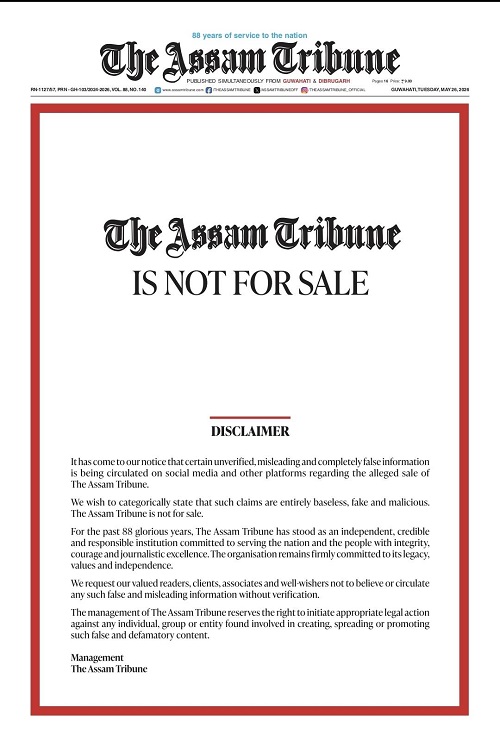 (Asian independent) The readers of a venerated newspaper from Guwahati noticed an unusual full front-page advertisement on 26 May 2026 stating that the English daily was not for sale. Grabbing the most important space for hard news (meant for valued readers who buy the newspapers every morning), the arrogant management did not hesitate to use the front page for an issue that could have been dealt otherwise. But the question remains, why the Assam Tribune management propagated the advertisement asserting that the acclaimed daily is not being sold to anyone. Refuting rumours on social media, the managerial authority took the unusual step that was read by the media observers not as a clarification, but overreaction to something appearing in the alternate media.
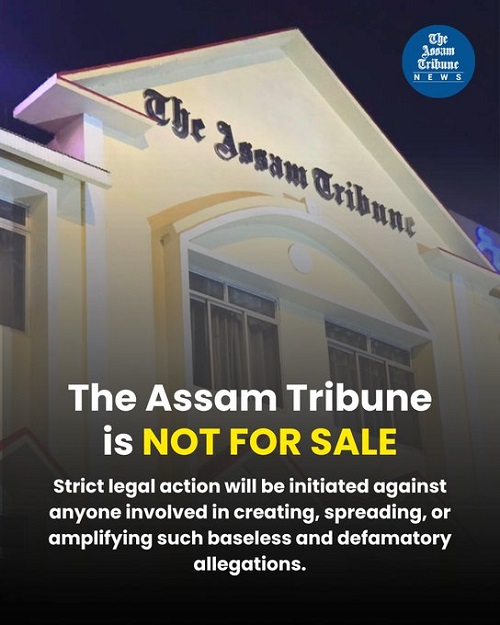
The strongly worded disclaimer/ statement with the sturdy line THE ASSAM TRIBUNE IS NOT FOR SALE claimed that the widespread speculation on social media regarding its alleged sale is unjustified. “For the past 88 glorious years, The Assam Tribune has stood as an independent, credible and responsible institution committed to serve the nation and the people with integrity, courage and journalistic excellence,” read the advertisement, adding that the management reserves the right to initiate appropriate legal action against any individual, group entity found involved in creating, spreading or promoting such baseless and defamatory content.
Earlier in its verified social media account, the newspaper pointed out that the rumour was amplified by prominent personalities and even media outlets, many of whom apparently felt verification was an unnecessary formality. No official confirmation. No credible source. No due diligence. Just pure confidence and a share button, it added. “For nearly nine decades, The Assam Tribune has remained committed to preserving the trust of its readers, and it will continue to do so in the years ahead. In an era where everyone claims to value journalism and fact-checking, it’s fascinating to see how quickly baseless speculation can be repackaged as ‘news’ simply because it trends online,” stated the newspaper.
The issue got momentum, when many Assamese social media users in the fourth week of May apprehended that the prestigious newspaper was already sold to industrialist Gautam Adani (Chairman of Adani Group) for around Rs 421 crore. It was later amplified by many prominent personalities, who also claimed that the management failed to pay the Assam Tribune employees for months and over 75 ex-workers were yet to get their legal financial dues which compelled them to approach the competent court. Needless to mention that, the social media respondents genuinely expressed their concern at the pathetic financial condition of the media house.
The history of newspapers in Assam of northeast India began as the first issue of Arunodoi (Sunrise) hit the market in January 1846. Published from Sibsagar in eastern Assam by the American Baptist Missionaries, the monthly publication in Assamese language continued its presence till 1879. The second Assamese monthly news magazine named Asam Bilasini started its publication in 1871 from Majuli river island by Deva Dutta Goswami and its journey continued till 1883. Several newspapers and magazines in Assamese later followed the footsteps where Dainik Batori emerged as the first daily published in 1935 by tea-planter Siva Prasad Baruah.
Eminent Assamese entrepreneur Radha Govinda Baruah founded the Assam Tribune group in 1939 and added a few other publications in Assamese language. First published as a weekly newspaper from Dibrugarh, it was brought to Guwahati and transformed into a daily in 1946. The diamond jubilee celebration of The Assam Tribune was graced by the then Prime Minister Atal Behari Vajpayee on 7 December 1999. On the other hand, its platinum jubilee was attended by PM Narendra Modi on 29 November 2014, where he highlighted the strength of media and the positive role it could play in transforming a society.
Lately, the oldest media group in northeast India faced a financial crisis and it was reflected in the official statements of Assam Tribune Employees’ Union, where it alleged delays in regular salaries and other due post-retirement benefits to the employees. The union organized a series of demonstrations at the office premise and even addressed a press conference claiming that a huge amount of money (advertisement revenues) was pending at Assam government’s information and public relations department. The management also echoed similar versions stating that it was expecting those pending millions of rupees urgently.
Amid all disturbing developments, the management handed over the responsibility of Dainik Asom, a sister publication, to a separate media house owner. The new owner, while taking leadership of the six-decade old daily on 17 September 2025, denied taking liability of over 75 employees (who were associated with Dainik Asom). The old management was supposed to clear all the dues for the ousted employees at the earliest, but it did not happen. Finally they knocked on the doors of the legal fraternity and the court had recently asked the Tribune management to pay them off.
The Guwahati-based media house was recognized as an honest news entrepreneur across the region. The Tribune group implemented the recommendations of the Majithia Wage Board in 2010 for the first time in the country. Just before evading the responsibility of Dainik Asom, the current batch of owners silently put their seven-decade-old tabloid Asom Bani to die silently. The mainstream weekly was merged with Dainik Asom as a Sunday supplement. However, the buyer didn’t own the weekly and thus it faced an unceremonious death. Asom Bani was last published on 12 September last year as a supplement, but the Tribune management did not issue any statement over its closure.
The media group, which witnessed and reported various important socio-political developments of the trouble-torn region like the medium school instruction movement, anti-influx agitation, sudden rise of separatist militancy, common social unrest, emergence of regional politics, etc with commitment to the indigenous population. Soon after the Covid-19 pandemic all newspapers in Assam faced existential crisis because of drastic fall of circulations and revenues. Media observers note that the Tribune house historically maintained credibility in disseminating information, editorials, and articles, but in recent years, these principles were largely compromised.
The Assam Tribune extensively covered the anti-citizenship act movement in 2019, providing significant space to public protests against the Union government’s initiative to politically support persecuted Hindu, Sikh, Buddhist, and Christian families from Muslim majority Pakistan, Bangladesh and Afghanistan. The coverage fuelled weeks of unrest in Assam’s Brahmaputra valley, with the narrative suggesting that the new citizenship law would undermine the Assam accord which was signed in 1985 to culminate the six years long anti-foreigner agitation.
Moreover, the people of Assam remember a series of biased media reports prepared for the English newspaper on the eve of a city press club election in 2020. Those low-credible reports were full of personal attacks against the then secretary of Guwahati Press Club, which ultimately put its hard-earned reputation at stake. Later when the particular scribe won an international award from Geneva-based Press Emblem Campaign in 2021, the editorial desk denied space to it.
While the current financial status of Assam Tribune is dire, it was seemingly not created by the pandemic alone, but the habit of exercising editorial liberties without accountability by some of its ill motive news-desk workers, who made the situation worse. Those media professionals even after enjoying all benefits fomented disorder inside the institution inviting colossal troubles, when the management too remained a mute spectator, reasons best known to them only, which finally invited the disaster.