THE ASIAN INDEPENDENT UK

Bal Ram Sampla
Geopolitics
When Chief Justice Surya Kant of India’s Supreme Court compared unemployed young people to cockroaches, he likely expected outrage. What he got instead was a phenomenon, millions of young Indians gleefully adopting the slur, turning it into a flag, and marching under it.
The Cockroach Janta Party (CJP) was born not from a political manifesto but from the raw energy of a generation that has simply had enough.
In the space of less than a month, the CJP amassed over 22 million Instagram followers, more than the ruling BJP and the Indian National Congress combined. It was created on May 16th by Abhijeet Dipke, a political communications strategist, and immediately struck a nerve that decades of formal opposition politics had failed to touch.
The name itself is a deliberate satirical twist: swap “Bharatiya” for “Cockroach” and Modi’s own party acronym becomes the butt of the joke. For a generation raised on memes, the symbolism was instant and electric.
But to dismiss this as mere internet theatre would be a serious mistake. Beneath the cockroach mascots and viral jokes lies a catalogue of very real grievances. India’s under-30 population, more than half of the country’s 1.4 billion people. Faces staggering unemployment, corruption, rising fuel prices, exam paper leaks that have sabotaged the futures of millions of students, and an inflation crisis made sharper.
The CJP gave a voice that felt authentic and unafraid, something the opposition has struggled to achieve. Its is calling for cancelling the broadcasting licenses of media outlets owned by billionaires close to the government. Its founder announced plans to return to India to demand the resignation of the education minister.
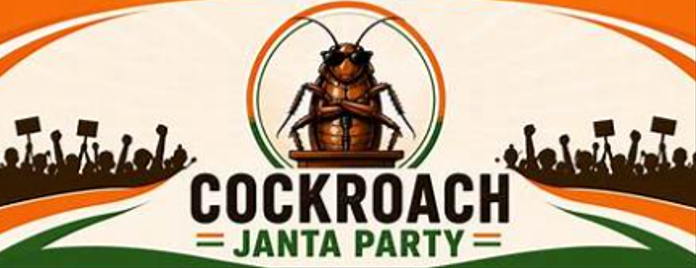
The government’s response only accelerated the movement’s momentum. When the CJP’s X account was blocked in India under a “legal demand,” the party simply re-emerged minutes later under a new handle. Posting an image of a cockroach at a podium, fist raised, with the caption: “You thought you could get rid of us? Lol.” It was the perfect metaphor for the movement itself.
The attempted suppression handed the CJP exactly the narrative it needed: that the establishment is afraid.
For Narendra Modi, this is a genuinely uncomfortable moment, perhaps more unsettling than any formal electoral challenge in recent years. Modi has built his political brand over 12 years on strength, national hindutva pride, decisive leadership, and the projection of India as a rising power on the world stage.
That image depends heavily on the consent and enthusiasm of young India. Gen Z was never supposed to be the opposition. They were supposed to be the future he was building for. A youth movement that mocks the government with memes, that grows faster than the ruling party’s own social media presence, and that threatens to take its energy from Instagram to the streets of Delhi — this is an attack on the very narrative of Modi’s legacy.
There is also a regional context that no serious observer can ignore. In the past two years, youth-led movements have toppled governments in Bangladesh and Nepal. In each case, the uprisings began online, fed on humour and defiance, and were repeatedly underestimated by those in power. India’s establishment is acutely aware of these precedents, which may explain why the response to the CJP has oscillated awkwardly between crackdown and silence, neither fully suppressing nor engaging with what the movement is saying.
Whether the Cockroach Janta Party translates its online mass into sustained street power remains to be seen. Founder Dipke himself has been careful to distance the movement from calls for violent protest, insisting it will operate peacefully within the bounds of the Indian Constitution. The real test is not whether millions will click “follow” — they already have, but whether they will show up, stay organised, and maintain pressure when the news cycle moves on.
In a democracy as vast and complex as India, the moment young people stop being cynical and disengaged and start being creative in their dissent, building satirical parties, writing manifestos, designing cockroach logos, and flooding the streets. The political mathematics changes in ways that are difficult to predict and very hard to reverse. Modi has weathered many challenges in 12 years. But he has rarely faced one that laughs this loudly.
The Other Casualty: Rahul Gandhi and the Failure of Opposition
The CJP did not just embarrass Modi. It held up a mirror to everyone in Indian politics and no reflection is less flattering than Rahul Gandhi’s.
The Cockroach Party’s success is in many ways a direct and damning measure of his failure. The issues the CJP is raising, unemployment, exam corruption, media capture, crony capitalism , are almost identical to the issues Rahul Gandhi has been talking about for years. The raw material was always there. The youth frustration was always there. He simply never found the language, the energy, or the format that made young Indians feel it belonged to them. A 26-year-old with a laptop and an Instagram account did in two weeks what the Indian National Congress could not do in a decade.
Rahul Gandhi has become something of a political paradox , a man who occasionally lands a genuinely sharp line, who can draw a crowd on a march, and who clearly understands that something is wrong with India, but consistently fails to demonstrate that he knows what to do about it. His soundbites are often good. “Suit-boot ki sarkar” — dismissing Modi as a government for the wealthy elite — was memorable. His parliamentary speeches attacking the Adani-government relationship showed flashes of real political courage. But a soundbite is a moment. Opposition leadership is a sustained, grinding, strategic enterprise. And that is precisely where he repeatedly falls short.
The core problem is that he is not consistent. He will land a powerful blow in parliament, then disappear. He will generate momentum with a yatra, then fail to convert it into electoral organisation. He treats politics like a series of individual performances rather than a continuous “war of attrition that requires presence, coalition-building, and relentless pressure:. Modi, whatever his faults, is never absent. Rahul Gandhi frequently is.
There is also something deeper and more uncomfortable at work. Rahul Gandhi may not actually want power in the way that effective opposition leaders must hunger for it. He has stepped back before. He seems genuinely ambivalent about the role at times. And a leader who is ambivalent communicates that ambivalence, young people especially can sense it immediately. The CJP’s founder projected more conviction and urgency in two weeks than Rahul has managed in two decades.
The CJP is filling a vacuum that Rahul created. Many within Congress quietly believe he should have already reconsider his position. The party has talented regional leaders who connect with voters far more. The problem is that the Congress’s entire identity has become so entangled with the Gandhi family dynasty that stepping back feels, to many insiders, like dissolving the party itself. That is perhaps the biggest structural failure of all, an opposition so dependent on one surname that it cannot reinvent itself even when the evidence demands it.
The Cockroach Party is, at heart, still a protest movement rather than a political force. Protest movements are brilliant at articulating anger; they are historically poor at sustaining organisation, contesting elections, and governing. But that offers Rahul Gandhi little comfort. The movement didn’t create the frustration. It simply harvested it. And the harvest that should have been his, built over years of speeches and marches and carefully crafted soundbites, went instead to a cockroach with a raised fist.
That is not just a political failure. At this point, it is a generational one — and Indian democracy will have to reckon with what comes next.
References
1.https://aje.news/jw9srn
2. https://www.britannica.com/topic/What-Is-the-Cockroach-Janta-Party
3.https://kathmandupost.com/world/2026/06/01/india-s-viral-cockroach-youth-group-plans-street-protest-in-challenge-to-modi
4.https://edition.cnn.com/2026/05/22/india/india-cockroach-janta-party-gen-z-intl-hnk
5.https://www.cnbc.com/2026/06/04/indias-cockroach-cjp-party-what-investors-need-to-know.html
6.https://www.rt.com/india/640745-cockroach-party-india-modi/
7.https://en.wikipedia.org/wiki/Cockroach_Students%27_Union_of_India
8.https://m.thewire.in/article/economy/who-are-the-parasites-in-india