THE ASIAN INDEPENDENT UK

Dr. Ramjilal, Social Scientist,
Former Principal,Dyal Singh College,
Karnal (Haryana – India)
Email: [email protected]
Brief
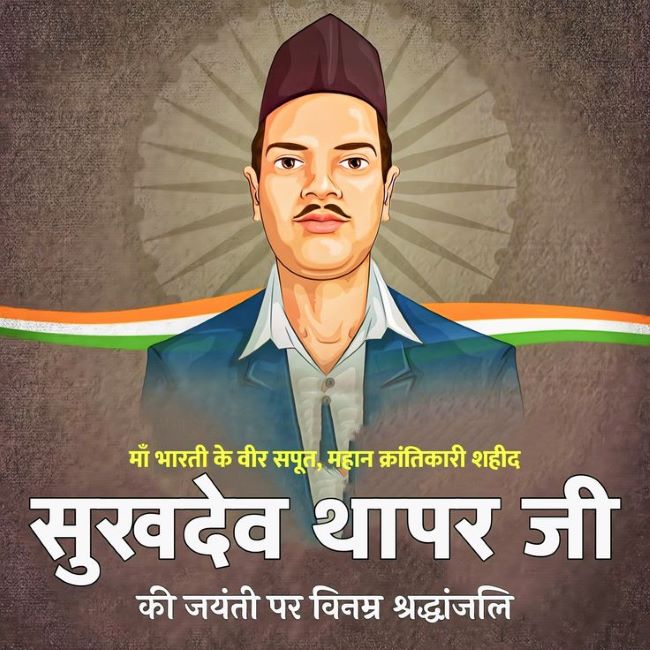
Three great socialist revolutionaries of India – Sukhdev (full name: Sukhdev Thapar – born May 15, 1907 – Ludhiana, Punjab – Martyrdom Day: March 23, 1931 – age 23), Bhagat Singh (born September 28, 1907 – Martyrdom Day: March 23, 1931 – village Banga – now Pakistan – 23 years ), and Rajguru (born August 24, 1908 – Martyrdom Day: March 23, 1931 – full name: Shivraj Hari Rajguru – birthplace: Khed village, Maharashtra – Marathi, age 22) were hanged on March 23, 1931. All three martyrs were under 25 years of age. Immortal Martyr Sukhdev was a great socialist thinker, secularist, and nationalist revolutionary. He is a glorious golden chapter of the Indian socialist revolutionary movement.
Early Life and Education:
Sukhdev (full name: Sukhdev Thapar – born May 15, 1907, Ludhiana, Punjab – martyrdom day: March 23, 1931) was born on May 15, 1907, in the Naughara locality of Ludhiana, a famous city in Punjab, to Mrs. Ralli Devi and Mr. Ramlal Thapar (Arya Samaji). According to N.N. Vohra, former Governor of Jammu and Kashmir and currently Chairman of the Tribune Trust, Chandigarh, Sukhdev was “my maternal uncle, my mother’s cousin, because his mother died very early.” After his parents’ death, he was raised in Lyallpur (now in Pakistan) under the care of Sukhdev’s maternal uncle and N.N. Vohra’s maternal grandfather, Lala Achint Ram Thapar. Sukhdev received his early education at Shri Sanatan Dharma School, Lyallpur (now in Pakistan) and for higher studies he joined National College, Lahore. As a student in the school he refused to salute the visiting officer. It was a spirit of resistance of the child even in the early age.
Personal Qualities
Sukhdev was a studious, profound intellectual, thinker, unwaveringly courageous and patient, a freedom fighter, a nationalist revolutionary, a committed socialist thinker and professional revolutionary, an excellent guide, a skilled organiser, an effective organizer, a secular patriot, a fiery orator, an excellent debater, a supreme self-sacrificer, and an exceptionally intelligent young man. As a skilled political strategist, he along with his comrades, orchestrated numerous revolutionary activities and conspiracies, including the Kakori Conspiracy, the Central Assembly Bombing Conspiracy( April 8, 1929), and, most notably, the Lahore Conspiracy.
Pseudonyms: Sukhdev’s revolutionary circle had many pseudonyms—”Grameen,” “Kisan,” “Gwar,” “Swami,” and “Dyal.” Sukhdev never cared about his attire and possessed a simple personality. He is, in fact, the catalyst and a glorious golden chapter of the Indian socialist revolutionary movement.
Sukhdev stands as a pivotal figure in the Indian socialist revolutionary movement, profoundly influenced by the stark socio-economic realities of his time—inequality, poverty, and rampant British imperialism. Renowned for his diligence and steadfast courage, he emerged as an exceptional thinker, a passionate freedom fighter, and a dedicated socialist revolutionary.
His journey was notably shaped by Lala Achint Ram, a courageous freedom fighter who resisted British rule and endured 19 years of imprisonment for his beliefs. From a young age, Sukhdev exhibited a bold spirit of defiance, refusing to salute a British officer , and feeling deeply affected by the tragic events of the Jallianwala Bagh massacre. During his college years, Sukhdev immersed himself in discussions surrounding global revolutions. Inspired by Pierre-Joseph Proudhon (Father of Anarchism),and SohanSingh Josh(Indian Freedom Fighter and Communist),Mikhail Bakunin(Russian Revolutionary), and Marxism-Leninism, he ardently aspired to establish a “socialist republic” in India .
As a leading strategist within the Hindustan Socialist Republican Association (HSRA), he dismissed the notion of relying on terrorist or anarchist tactics, instead emphasising that the fight against capitalism and imperialism was crucial to their mission. His commitment to socialism resonated deeply with his peers, many of whom acknowledged his intense engagement with the ideology, particularly alongside the remarkable Bhagat Singh. According to Sukhdev’s friend, Shiv Verma, “After Bhagat Singh, if any comrade read and contemplated the most on socialism, it was Sukhdev.”
Skilled Organiser: The Naujwan Bharat Sabha and The Hindustan Socialist Republican Association:
The Naujwan Sabha was founded by Bhagat Singh in March 1926. Sukhdev was among the leading members of the Naujwan Sabha. His fluent, passionate, and fiery speeches instilled a new consciousness and awareness among the youth of the then undivided Punjab and other areas of northern India. As a result, the spark of the revolutionary freedom struggle ignited in undivided Punjab.
A secret meeting was held on September 8-9, 1928, at the Feroz Shah Kotla grounds in Delhi. At this meeting, Sukhdev and Bhagat Singh passed a resolution to change the name of the Hindustan Republican Association (HRA) to the Hindustan Socialist Republican Association (HSRA) and add the word “socialism” to the name. The main objective of the Hindustan Socialist Republican Association was to achieve “independence from British imperialism” and establish a “United Socialist Republic of India,” with “universal suffrage” under the “dictatorship of the proletariat” and the elimination of parasites from the seat of power, where “man by man is not exploited.”
Sukhdev was a staunch socialist and a skilled organizer. Consequently, he was entrusted with the responsibility of secretary of the Punjab unit of this newly formed organization. Consequently, he played a crucial and decisive role in formulating and implementing the policies, movement strategies, and plans of the Hindustan Socialist Republican Association (HSRA). Like Lenin, Sukhdev believed that revolution could only be brought about by “trained professional revolutionaries” armed with revolutionary ideology and determination.
Sukhdev: Avenging Lala Lajpat Rai’s Death and the Murder of John Saunders (December 17, 1928)
On October 30, 1928, when the Simon Commission arrived at Lahore Railway Station, a large crowd of peaceful protesters, led by Lala Lajpat Rai, shouted “Simon Commission go back!” in opposition to the commission. Lahore’s Superintendent of Police, James A. Scott, ordered a lathi charge to disperse the non-violent crowd. Police Superintendent Stock personally attacked Lala Lajpat Rai, seriously injuring him. The Tribune (Lahore) criticized the police’s actions in a headline that read, “Cowardly Attack on Peaceful Procession.” Dr. B.R. Ambedkar also condemned this brutal police assault. Lala Lajpat Rai died on November 17, 1928, at the age of 63. In response to his death, revolutionaries including Sukhdev, Bhagat Singh, Shivaram Rajguru, and Chandrashekhar Azad sought revenge.
Although Sukhdev did not support violence, he justified the murder of J.P. Saunders in a letter to his colleagues dated October 7, 1930, stating, “Take the example of the Saunders murder. When Lala was beaten with sticks, unrest spread throughout the country. This was a good opportunity to draw public attention to our cause. The murder was planned intentionally. We did not plan to flee after the act; we wanted to convey to the people that this was a political murder committed by revolutionaries. Our actions responded to the grievances of the public. We aimed to inspire revolutionary ideals, and such ideals sound more glorious from the mouth of someone who has been hanged for their cause.”
Central Assembly Bombing Incident: April 8, 1929
In April 1929, the Central Government introduced the Public Safety Bill and the Trade Union Bill in the Central Legislative Assembly (now the old Parliament – Constituent Assembly). These bills allowed the government to arrest individuals without reason, which was viewed as a conspiracy to control nationalist agitation. The Central Committee of the Hindustan Socialist Republican Association (HSRA) devised a plan to oppose these bills. Although Sukhdev was not present at the meeting where the decision was made to throw a bomb in the Assembly, he opposed this plan. He believed that Bhagat Singh would be better able to articulate the HSRA’s objectives. His influence led the committee to select Bhagat Singh to carry out the act.
On April 8, 1929, during the debate on the Public Safety Bill at 12:30 PM, Bhagat Singh and his companion B.K. Dutt detonated two low-intensity bombs and threw pamphlets in the Central Legislative Assembly. They chanted slogans such as “Inquilab Zindabad,” “Down with British Imperialism,” and “Workers of the World Unite.” It is believed that Sukhdev acted as a catalyst for Bhagat Singh during this incident.
Lahore Conspiracy Case: Crown (Complainant) vs. Sukhdev and Others:
Sukhdev emerged as the mastermind behind the Lahore Conspiracy Case, which is why the case was titled “Crown (Complainant) vs. Sukhdev and Others.” In April 1929, Senior Superintendent of Police Hamilton Hardy filed a First Information Report (FIR) against 27 accused individuals in the special court of Magistrate R.S. Pandit. Sukhdev was listed first in the FIR, with Bhagat Singh at twelfth and Rajguru at twentieth. Kuldip Nayar, in his book “Without Fear: The Life and Trial of Bhagat Singh,” recounts that when the executioner asked who would go first, Sukhdev replied, “I will go first.” The executioner pulled the noose three times, one after the other, and the bodies of all three men hung from the gallows for an extended period.
On October 7, 1930, the tribunal set the execution date for the three revolutionaries—Sukhdev, Bhagat Singh, and Rajguru—for March 24, 1931. However, due to public outrage, their executions were advanced by 11 hours and were carried out on March 23, 1931, at 7:30 PM after breaking through the rear wall of Lahore jail.
The bodies of Sukhdev, Bhagat Singh, and Shivraj Hari Rajguru were taken out of the jail, and that same night, they were transported to the banks of the Sutlej River at the Hussainiwala border near Ferozepur. A mass pyre was constructed, and kerosene oil was poured over them before they were cremated. Their partially burned remains were discarded into the Sutlej River. However, before dawn, local villagers retrieved the bodies from the river and performed the last rites.
On March 25, 1931, The Tribune (Lahore) reported the incident on its front page with the headline “Bhagat, Rajguru, and Sukhdev Executed.” This caused public outrage to reach a boiling point, resulting in massive protests in Mumbai, Madras, Bengal, Punjab, and Uttar Pradesh. This was the first time since 1857 that such a fierce confrontation between the public and the authorities occurred.. As a result, 141 Indians were martyred, 586 were injured, and 341 were arrested in this struggle. In short, their martyrdom created a new revolutionary fervour and wave among the people.
I pay my Tribute to the Invincible Martyrs of India on supreme sacrifice day in Indian revolutionary history.
(Note: Dr. Ramjilal is the author of Political India 1935-42: Anatomy of Indian Politics (Ajanta Publications, Delhi, 1986).)