

THE ASIAN INDEPENDENT UK
A Review of a Unique Rajbanshi Literature Book
The Prelude
A good literature creates a universal effect and the language cannot limit it. A good literature appeals to any literature-lover person crossing the boundaries of languages. It is believed that each literature is beautiful and every literature bears some valuable element in it to contribute to or to enrich the human society. That is the reason the United Nations’ Organization (UNO) has made provisions of granting opportunity to each and every individual to use his or her language and practice his or her culture. So much so, the UNO has made it compulsory for all member-nations of UNO to support the cause of language and literature within their jurisdictions. In this context, we must remember that the UNESO, its cultural wing, has made a declaration – ‘we must see that no language is left out’. This declaration has a very wide implication to mean that every person of the globe has the responsibility to work for uplifting an endangered language and its literature so that we do not lose any more languages.
 Release of a Rajbanshi Literature Book
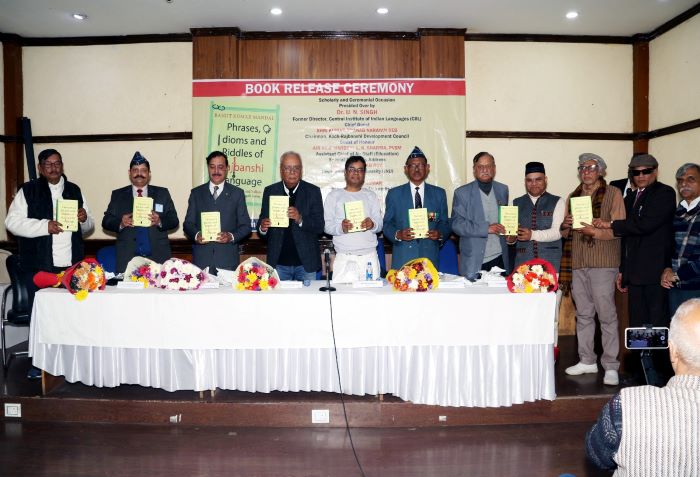
I feel extremely delighted to make it known that one member of our organization residing in Siliguri has a brough out a Rajbanshi literature book recently. The title of the book is – Phrases, Idioms and Riddles of Rajbanshi Language: Rajbanshi Chilkas and Solloks in English and Bengali Verses. The author of the book is Wing Commander Dr. Ranjit Kumar Mandal (Retd), a renowned writer and a social thinker. The release ceremony of the book was held in the Press Club of India, New Delhi on 19 December 2025. The chief guest of the ceremony was Dr. U.N. Singh, the former Director, Central Institute of Indian Languages (CIIL), Mysore. This tri-lingual book was brought out by a renowned publisher – Rupa Publications India Limited, New Delhi.
The Special Feature of the Book
This first-of-its-kind book has been a book of collection of 2500 pieces of gems i.e., phrases and idioms (Chilkas and Solloks), gathered by the author painstakingly from the almost extinct language. The veteran author being a native speaker this language, could present the Chilkas and Solloks as he found them in their use personally since the fifth decade of the previous century.
Foreword of the Book
As the tradition goes, the book begins with forewords. The book has been foreworded by three eminent literatures namely Dr. Dipak Kumar Roy, the Vice Chancellor, Raigunj University, Dr, Sreenivasa Rao, Secretary, Sahitya Academy and Prof Bhogirath Das, an eminent writer and a professor of Rajbanshi language, teaching Rajbanshi language in the Panchanan University, Cooch Behar. All three of them have hailed the book to be as an extraordinary and pioneering work. They have even put on record that this book shall make enormous contributions in the linguistic diversity besides being a resource for the social science researchers and the lovers of literature. They have hailed the book to be able to cross the linguistic barriers due to its three-language presentation.
 Introductory Chapter of the Book
The 19-page Introduction of the book lays down the history of the Rajbanshi community, Rajbanshi language, grandeur of the Rajbanshi literature and the significance of the Chilkas and Solloks in the Rajbanshi literature. The Introduction of this book makes it known that the Rajbanshi language has been one of oldest languages of the country and which has been in existence in India since the 10th century BC. This chapter brings out that the Rajbanshi language is in use currently in India, Bangladesh, Nepal and Bhutan, as the Rajbanshi language speakers currently live in these countries. It was amazingly described that the Rajbanshi language speakers live in a vast area in India, such as in West Bengal, Assam, Bihar, Meghalaya and Tripura. It was most fascinating to know that this language was the sole language of a ruling dynasty called the Koch Dynasty that ruled in the eastern and the north eastern part in India with its last palace being available even today in the Cooch Beahr town in West Bengal. It was brought out there that though the Rajbanshi language has not yet been placed in the 8th scheduled in the constitution of India, but the Sahitya Academy has recognized this language; and has awarded ‘The Bhasha Samman: 2010’ to one of the literatures of this language. Over and above that, some of the artisans of Rajbanshi culture have been awarded with Padmashree, honorary doctorate and D.Lit degrees. Meanwhile, one Rajbanshi feature film has bagged an international award too. Currently, about 8 universities, located in Assam and West Bengal, are teaching this language through their Certificate and Diploma programmes. In Nepal, this language is a recognized language.
Literary Significance of Rajbanshi Chilkas and Solloks
The Rajbanshi language Chilkas and Solloks are the synonyms of the phrases and idioms of the English language. The book presents 2500 Chilkas and Solloks in six chapters which reflect the vivid and complete picture of the society, life-stye and nature of the people living in the Eastern and the North-Eastern India. Generally, the Chilkas and Solloks deal with human values like necessitates to be hard working, living honest life, necessity of helping others, having self-confidence, having high level of professional skills as the means of leading healthy and happy life etc. This book thus could be called as the book of language, literature, culture, anthropology and social history of Eastern and the North Eastern India.
Kabir’s Dohas and the Rajbanshi Chilkas and Solloks
Who does not know Dohas of Hindi literature? By virtue of the literary values, Dohas have been providing moral teachings to its readers as their basic features. The Dohas, as a literary genre, are the soothing rhythmic verses or couplets which are not only the pleasing literary pieces but they guard against the evils to crop in in the society. This particular Rajbanshi literature book of Chilkas and Solloks too brings somewhat the same kind of elements as the precious Dohas do.
Some Extracts of Chilkas and Solloks from the Book
Some Chilkas and Solloks that provide guidance to the people and stand as the pieces of literary excellence are placed below:-
(a) Advice for maintaining good health by Early Rising and Exercises:
Sakāl baikāl māṭhat jāẏ.
Tār kaṛi baidya nā pāēẏ.
Word Meanings: ‘Sākāl baikāl’: morning and evening; ‘Māṭhat jāẏ’: goes to the ground; ‘Tār kaṛi’: his money; ‘Baidya nā pāēẏ’: does not go to any physician.
Contextual Meaning: This phrase signifies that the regular physical exercises in the morning and in the evening can keep a youth and adolescent healthy.
‘One who walks on the ground in the morning and in the evening later,
They need not pay their money to any doctor.’
(b) Guidance for Maintaining Personal Hygiene:
Sakāl sandhāẏ snān,
Jam rājā pālē jān.
Word Meanings: ‘Sakālē sandhāẏ snān’: bathing in the morning and in the evening; ‘Jam rājā’: makes the king of death; ‘Pālē jān’: run away.
Contextual Meaning: A hygienic lifestyle, of a youth and adolescent in their growing age cam keep them healthy and live longer.
‘One who is habituated in bathing daily twice,
They will be blessed with happiness and a long life.’
(c) Necessity of having Nutritious Food:
Māṁsat māṁsa bāṛē, ghi’uē bāṛē bal
Dudhōtē bīrjya bāṛē, ār śāgōt bāṛē mal.
Dudhōtē bīrjya bāṛē, ār śāgōt bāṛē mal.
Word Meanings: ‘Māṁsat māṁsa bāṛē’: through consumption of meat, one gets muscles; ‘Ghi’uē bāṛē bal’: through consumption of clarified butter; ‘Bāṛē bal’: one increases their strength; ‘Dudhōtē bīrjya bāṛē’: through consumption of milk, one increases their vitality; ‘Ār śāgōt bāṛē mal’: through consumption of leafy vegetables, one has a clear bowel movement.

Contextual Meaning: The consumption of meat, clarified butter, milk and leafy vegetables is good for health.
‘Eating of meat creates muscles,
Clarified butter gives one strength.
Milk increases one’s vitality,
Leafy vegetables clear bowel activities.’
(d) Necessity of having Varieties of Fruits:
Asāl ām kāṭōl,
Ghittur ḍhak jamburā;
Gackumārī pāniāl,
Kucli thākā ha’iḍḍā
Word Meanings: ‘Asāl ām kāṭōl’: juicy mangoes and jackfruits; ‘Ghittur ḍhak jamburā’: a pumpkin-sized grapefruit; ‘Gackumārī pāniāl’: a tree-ripe panial (plum); ‘Kucli thākā ha’iḍḍā’: trees laden with soap seed.
Contextual Meaning: Households prosper if the housing complex has healthy living conditions and is surrounded by plenty of fruit-bearing trees for regular consummation by the family members.
‘A household prospers if the complex has fruit-bearing trees,
If mango, jackfruit, plum and berries are among these.’
(e) Necessity of Having Good Feel of a Green Housing Complex:
Bāṛir śubhaṅkar kalāgāchi, nāirkol,
Cālir śōbhā hō’il jhāri;
Nārīr śubhaṅkar sōẏāmī paradhan,
Bichnār śōbhā nārī.
Word Meanings: ‘Bāṛir śubhaṅkar kalāgāchi, nāirkol’: a house looks beautiful if surrounded by banana and coconut trees; ‘Cālir śōbhā hō’il jhāri’: the veranda of the house looks proper if there is a water vessel meant for hand-wash; ‘Nārīr śubhaṅkar sōẏāmī paradhan’: a married woman looks beautiful with her husband; ‘Bichnār śōbhā nārī’: the bed is complete with the presence of the wife.
Contextual Meaning: A house looks pleasant with greenery around and certain accessories decorating inside. Likewise, a happy married life is when the husband and the wife share a loving bond, and the bed becomes beautiful with the presence of the charming wife.
‘Houses look grand with tall trees around,
Veranda looks nice if a water pot is found.
Women look pretty in company of their husbands,
A bed receives added grace if the wife is present.’
(f) Guidance for Right Food Habit:
Dudē nuṇē khābu nā,
Asātalē jābu nā.
Word Meanings: ‘Dudē nuṇē’: milk and salt; ‘Khābu nā’: not to be consumed together; ‘Asātalē jābu nā’: one should not spoil their health by doing so.
Contextual Meaning: Consumption of milk and salt together is hazardous to one’s health.
‘Avoid consuming milk and salt together,
By that, you will remain healthy forever.’
(g) Necessity of Prioritizing Hygienic in Food:
Dhāgrīr hātē khā’i,
Tēm̐’ō gēdrīr hātē nā khā’.
Word Meanings: ‘Dhāgrīr’: a woman of doubtful character (maintains illicit relationships); ‘Hātē khā’i’: can be permitted to cook and serve you food; ‘Tēm̐’ō’: but; ‘Gēdrīr’: a person who lives an unhygienic life; ‘Hātē nā khā’i’: should not be permitted to do so.
Contextual Meaning: It is very essential to ensure that the woman who cooks and serves food lives a hygienic life; it does not matter what her personal life is like (even if she has a questionable character in the prevailing social sense).
‘Cleanliness is godliness—this is taken as the truth,
A cook should live a hygienic life to serve you food.’
(h) Necessity of Remaining Away from Substance Abuse:
Gām̐jāẏ khāẏ māñjā,
Āphiṁē khāẏ kāẏā,
Word Meanings: ‘Gām̐jāẏ’: a narcotic called the hussies; ‘Khāẏ māñjā’: takes away the inner strength of a person; ‘Āphiṁē’: the opium; ‘Khāẏ kāẏā’: spoils the physical appearance of a person.
Contextual Meaning: Substance abuse harms a person in one way or the other.
‘Hussies ruin the health of a man,
(i) Necessity of Keeping Good Company:
Sat saṅgē swarga bās,
A-sat saṅgē sarbōnāś.
Word Meanings: ‘Sat saṅgē’: good company; ‘Swarga bās’: takes one to heaven; ‘A-sat saṅgē’: bad company; ‘Sarbōnāś’: ruins everything.
Contextual Meaning: While good company brings one joy, bad company ruins the mental peace. This Chilkā issues a kind of advisory that one should maintain a desirable company for one’s benefit and for the general well-being of society.
‘In good company, one acquires positive traits,
In bad company, one lowers one’s image.’
(j) Leading lives with Honesty:
Tu’m̐i bāchā satyāt thāk,
Andhār rātit milibē bhāt.
Word Meanings: ‘Tu’m̐i bāchā satyāt thāk’: you stay in the path of truth; ‘Andhār rātit milibē bhāt’: you will be able to manage your affairs even in the toughest situation.
Contextual Meaning: This Chilkā conveys a great moral value that if one remains in the path of truth, one will be able to manage their affairs without any difficulty.
‘Stick to the path of honesty and truth,
Your life shall always be safe and smooth.’
(k) Following the Principle of ‘Service Before Self’:
Dharmērṭā āg nijērṭā pāch
Word Meanings: ‘Dharmērṭā āg’: others’ benefit comes first; ‘Nijērṭā pāch’: own benefit comes later.
Contextual Meaning: It is a great human virtue to think of others’ needs before one’s own.
English Sentence: The benefit of others remains the first concern for the kind-hearted—their own requirements come later.
(l) Following the Right Vastu Norms:
Pubē hās, paścimē bāś,
Uttarē guā, dakṣhiṇē dhuā.
Word Meanings: ‘Pubē hās’: pond in the east; ‘Paścimē bāś’: bamboo grove in the west; ‘Uttarē guā’: betel nut orchard in the north; ‘Dakṣhiṇē dhuā’: open in the south.
Special Note: This is the traditional way which was followed in designing a housing complex in Northeastern India. It is believed that this design makes living healthy.
Contextual Meaning: In the ideal planning of a housing -complex, it is suggested that the pond should be located in the east, the bamboo grove in the west, the betel plantation in the north, and the southern side should be kept open.
‘If you wish to build a healthy abode,
There is a need to plan for that.
(m) Educating People in a Humours ways through Satire:
Tōr ṭikāt chyāndā.
Cā’ilōn kaẏ Bindik,
Word Meanings: ‘Cā’ilōn kaẏ’: the sew says; ‘Bindik’: to the needle; ‘Tōr ṭikāt’: you have at your buttock; ‘Chyāndā’: a hole.
Special Note: Here, a sew which has multiple holes in it is pointing its finger to the needle which has a hole at the tip. The hole, hereby, is being considered a defect.
Contextual Meaning: It is ironic that a person who is guilty of multiple shortcomings sets out to find flaws in others.
‘A sew criticizes a needle for having a hole on its tip,
The same sew bears multiple holes—how about it?’
Easy Readability of the Book:
The book has been written in a very lucid way and the other important factor of the book is that the Chilkas and Solloks being written with their serial number of each item, the book is easily readable in a random manner.
A Recommendation:
I have no reservation to say that this book is going to be interesting to devour and I recommend a wide reading of this book. This book deserves to be included in the inventories educational institutions and personal libraries.