THE ASIAN INDEPENDENT UK

Dr. Ramjilal, Social Scientist,
Former Principal,Dyal Singh College,
Karnal (Haryana – India)
Email: [email protected]
Abstract:
The Kambojas stand out prominently in ancient Indian history as a formidable tribe and a significant Mahajanapada. From the Rigvedic period to Southeast Cambodia, Kamboja women played an essential role in administration and combat. The Rigveda categorically describes the Kambojas as a warrior-loving people unafraid of challenge. In the context of Vedic society, women possessed the right to engage in assembly and warfare, marking a progressive stance for their time. Kamboja women were not only skilled but also highly trained in horsemanship, archery, and martial arts. Vedic hymns vividly illustrate women fighting side by side with men on horseback, asserting their equal role in battle. In comparison to other contemporary republics, Kamboja women enjoyed a far greater engagement in public and military domains. When their husbands fell in battle, Kamboja queens decisively took command of the army, leading their warriors into combat. Located near Gandhara, the Kamboja region valued women’s education and independence, establishing a clear model of empowerment. The tradition of women in public and military roles within the Kamboja Mahajanapada significantly influenced queens from various dynasties in later periods, promoting the concept of women warriors rather than accepting subjugation.
Details:
1. Kamboja Rishis and Rishikas in Vedic and Ancient Times: Among the notable sages and scholars of the Kamboja dynasty are Sage Kamboja Aupamanyava (mentioned in the Vamsa Brahmana of the Samaveda), Sage Upmanyu (cited in the Rigveda), and Kambu Svayambhuva Kamboja (featured in the Vamsa Brahmana list). While the Rigveda refers to Sage Apala as the daughter of Sage Atri, historians and literary figures from the Kamboja community rightfully present Sage Apala as a Kamboja sage due to her roots in the Kamboja region.
2. Kamboja Queens during the Mahabharata Period: The Kamboja Mahajanapada commands attention in the Mahabharata. Bhanumati, the daughter of Kamboja King Chitrang Kamboja and Queen Chandera Mudra Kamboja, is highlighted as a central figure. She was the sister of Maharaja Sudarshan Kamboja and married to Duryodhana, reflecting strategic marriage diplomacy between the Kamboja and Kaurava dynasties. This alliance strengthened their political ties. Maharaja Sudakshina Kamboja valiantly sided with the Kauravas—Jayadratha and Duryodhana—in the battle against the Pandavas. His decision to join the Kauravas stemmed from his commitment to honor and protect his sister Bhanumati, Duryodhana’s queen. He commanded a powerful army equipped with horsemen, golden chariots, and white horses, engaging fiercely against the Pandavas and Arjuna on the battlefield of Kurukshetra, where he ultimately achieved martyrdom. Following his death, Maharani Sudarshana Kamboja, his powerful mother, stepped in to rule the Kamboja Mahajanapada with strength. Bhanumati demonstrated remarkable intellect and formidable diplomatic skills, serving as a trusted advisor to her mother-in-law, Gandhari. She played a pivotal role in maintaining the unity of the Kaurava clan, encapsulated in the enduring proverb: “Bricks from here, stones from there, Bhanumati united the clan.”
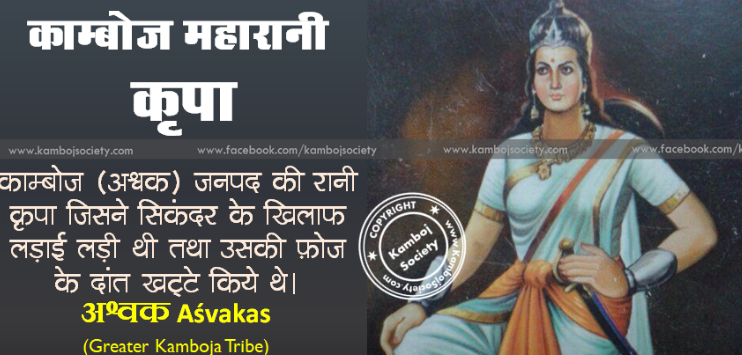
 3. Kripa Kamboja:An Undeniable Force in Ancient India: Queen Kripa Kamboja, as documented by the Greek historian Cleophis and Persian sources, is a key figure during Alexander’s invasion of India in 327-326 BCE. She was the reigning monarch of the Kamboja Mahajanapada, located in the strategic regions of Swat, Kunar, and the Pujankora Valley in contemporary Afghanistan-Pakistan. After successfully conquering Persia and Bactria, Alexander’s forces faced robust resistance in India. Following the loss of her husband and son in battle, the queen of Massaga Fort courageously took command of her army, engaging Alexander for several weeks and inflicting considerable losses on both sides. This fierce resistance compelled a treaty. The historian Curtius did not shy away from lauding the bravery of Queen Kripa Kamboja. She emerged as India’s first female commander, the first female ruler, the pioneer of a female army, and the first woman to compel Alexander to enter negotiations. Queen Kripa Kamboja stands as an enduring symbol of resistance and diplomatic prowess, not only within the Kamboja community but also throughout the history of India.
4. Ayasi Kambojika: Ayasi Kambojika (Sanskrit: आयसी कम्बोजिका) was a notable queen and princess of the Kamboja dynasty during the Indo-Scythian period in Mathura, known for her influential role in the region during the first century. She was married to Mahakshatrapa Rajuvula Kamboja, the ruler of Mathura. Inscriptions from this era highlight her strength as a queen, particularly through her strategic marriage alliances. A Kharosthi inscription discovered at the Saptarishi mound in Mathura acknowledges her significant contributions to Buddhism, including the commissioning of a stupa and a cave monastery along the banks of the Yamuna River. Furthermore, the inscriptions indicate that Kamboja queens were vital within the royal family and took an active role in supporting ,and donating to religious institutions, particularly as Buddhist monasteries emerged as social and religious centres for Kamboja women.
5. Queen Bhagya Devi Kamboja: Queen Bhagya Devi is recognised as a prominent queen of the Kamboja dynasty during the 10th and 11th centuries in Bengal, a period marked by the decline of the Pala dynasty. As the mother of Nayapala Kamboja and the wife of Kamboja Rajyapala, she played an important role in regional governance. Queen Bhagya Devi was also known for her involvement in religious activities, contributing to Buddhist monasteries and temples. Her legacy primarily survives through references in copper plates and genealogical texts.
 6. Queen Didda: The ‘Catherine’ of Kashmir**: Queen Didda (reign: 980-1003 AD) stands out as a significant ruler of Kashmir, with links to the Kamboja dynasty. She was born in 924 AD, the daughter of King Singharaja of the Lohara Dynasty, and the grand-daughter of the renowned Hindu Shahi king, Bhimdev Shahi. Following her husband King Kshemagupta’s death, she ruled Kashmir as both regent and later as an independent monarch for 30 years. Celebrated for her administrative abilities and military strategy, Didda famously defeated the invading Mahmud Ghaznavi’s forces twice, overcoming a much larger army with a small contingent. Known as the “Catherine of Kashmir,” she was an effective and formidable leader, dedicated to reforming her kingdom and maintaining stability, even deposing her own grandson when necessary. Despite being physically disabled from birth, she demonstrated exceptional leadership and military skills.
7. Queen Kambuja Rajalakshmi: Kambuja Rajalakshmi (Khmer: កម្លូបសៀរាជលក្ខ្មេី) is a semi-legendary and semi-mythical queen of Chenla, Cambodia, who ruled during 575-580 AD. She was the daughter of King Shrestha Varman and the grand-daughter of the oldest line of the Chenla royal dynasty. After the death of King Veera Shrestha Varman, she ascended the throne and ruled alongside her husband, Bhava Varman.
8. Assakenin Queen Tummey/Tumiris: Historical sources and interpretations by Kamboja scholars identify Queen Tummey, also known as Tomiris, as a heroic figure from ancient times who led her army in battle, underscoring the martial prowess often attributed to Kamboja queens.
In conclusion, while Kamboja queens may not be as widely documented as other prominent female figures like Rani Durgavati and Rani Lakshmi Bai, historical evidence reveals their significant-martial leadership roles within the Kamboja dynasty. These queens were influential in tribal politics, often blending military responsibilities with governance. The limited evidence of their lives highlights the diverse historical narrative of India, illustrating the queens’ roles in patronising religions and contributing to the development of Buddhist and Jain institutions. The Kamboja Mahajanapada’s strategic location between Central Asia and India enabled these queens to forge critical diplomatic ties that fostered cultural and religious integration. Many Kamboja queens, while being Buddhists, supported Vedic scholars and embraced a variety of cultural practices, showcasing their vision as leaders who united diverse beliefs and traditions. The unification of diverse historical narratives has become an increasingly vital pursuit in contemporary India. In recent discussions, scholars and intellectuals are advocating for the incorporation of the remarkable contributions of the Kamboja Queens into educational curricula at both school and university levels. This initiative seeks to immerse students in the rich tapestry of history, shedding light on the influential roles these extraordinary women played in shaping the nation’s past. By integrating their stories and achievements into the educational framework, the aim is to deepen students’ appreciation and understanding of India’s cultural heritage, fostering a sense of pride and connection to history that is often overlooked.