THE ASIAN INDEPENDENT UK

Bal Ram Sampla
Geopolitics
A Political Analysis
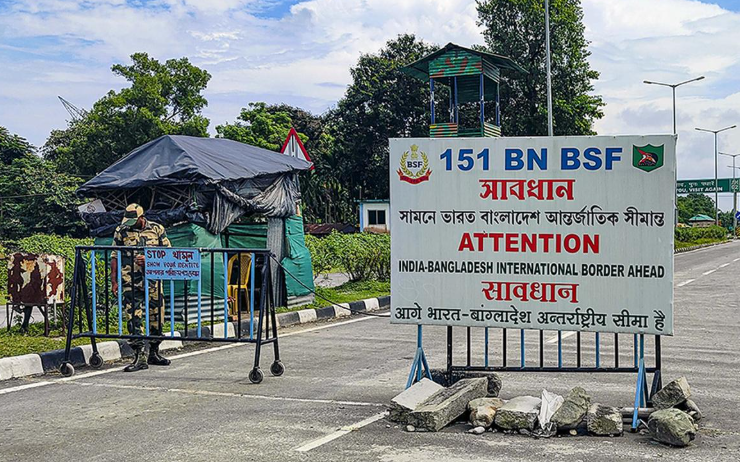
For more than fifty years, India has struggled with one of the world’s longest and most porous borders. The 4,096-kilometre boundary that India shares with Bangladesh cuts through rivers, marshlands, hills, and densely populated villages. It is not just a line on a map — it is a living, breathing challenge that has shaped the politics, demographics, and security policies of both nations.
The problem of illegal crossings began in earnest during the 1971 Bangladesh Liberation War, when an estimated ten million people fled into India. Many never went back. In the decades that followed, poverty, flooding, and political instability in Bangladesh kept the flow of people moving westward. Today, official census figures suggest around three million Bangladeshi nationals live in India, though some Indian officials put the unofficial number far higher — as many as twenty million. For a country that is already one of the most populous on earth, this has created deep anxieties about resources, employment, and national identity.
The Fence: India’s First Line of Defence
The most visible step India has taken is the construction of a border fence. Work began as far back as 1986, and successive governments have pushed to complete it. The fence is made of barbed wire and, in some areas, is equipped with floodlights to deter crossings at night.
However, nature has made this effort enormously difficult. The border crosses fifty-four rivers, including stretches of the Ganges and Brahmaputra. Low-lying areas flood regularly, and in some places, the terrain simply makes construction impossible. As of today, around 850 kilometres of the border remains unfenced, with roughly 175 kilometres considered virtually impossible to fence due to water. These gaps are precisely where smugglers and illegal migrants tend to cross.
The Border Security Force
Patrolling this vast frontier is the job of India’s Border Security Force, or BSF. The BSF deploys hundreds of thousands of personnel along the eastern border, conducting patrols day and night. They have long had a controversial shoot-on-sight policy for those caught crossing illegally, which has led to the deaths of many Bangladeshi civilians over the years and has repeatedly strained relations between the two countries.
Despite the risks, crossings have continued. Where there is poverty and desperation, people find a way through.
Modern Technology
Recognising that manpower alone is not enough, India has increasingly turned to technology. The BSF now uses drones to monitor remote stretches of the border from the air. Infrared cameras and night-vision equipment allow guards to spot crossings in the dark. Sniffer dogs are deployed to detect people hiding in vegetation.
These tools have improved detection rates, but they cannot cover every kilometre of a border this vast and this difficult.
Unconventional Ideas: Bees, Crocodiles and Snakes
In recent months, India has floated some highly unusual proposals. One idea already being implemented in some areas is the installation of beehives along the fence line. The logic is simple — bees are a natural deterrent that neither humans nor animals want to cross. It is low-cost, environmentally friendly, and surprisingly effective in some locations.
Far more controversial is a plan, reportedly ordered by Home Minister Amit Shah, to release crocodiles and venomous snakes into riverine sections of the border where fencing is impossible. An internal memo from BSF headquarters, dated March 2026, asked field officers to assess the “operational feasibility” of this idea. The plan has drawn widespread alarm from wildlife experts, human rights groups, and even some security analysts, who point out that the animals cannot tell the difference between a Bangladeshi migrant and an Indian villager. Wildlife experts have also noted that the crocodiles being considered are not native to those river stretches and may not even survive if released there.
Political Pressure and Domestic Politics
It is impossible to separate India’s border policies from its domestic politics. The ruling Bharatiya Janata Party (BJP) has made illegal immigration a central campaign issue for over a decade. Senior BJP figures have labelled undocumented Bangladeshis — who are mostly Muslim — as “infiltrators” who threaten India’s Hindu-majority identity. This political framing has pushed border policy in an increasingly hard-line direction.
Relations between India and Bangladesh worsened after the fall of the Awami League government in Bangladesh in August 2024, after which anti-India sentiment surged in the country. Only recently have the two sides begun tentative steps to reset their relationship.
The Human Cost
Behind the politics and the policy debates are real human beings. The people crossing this border are often desperately poor, fleeing floods or joblessness, looking for a better life. The BSF’s shoot-on-sight policy has claimed many innocent lives, including that of fifteen-year-old Felani Khatun, who was shot dead in 2011 after getting caught in the border wire. Her death became a symbol of the brutal human cost of border enforcement.
If the crocodile and snake plan were ever implemented, critics argue, the human cost would rise even further — and would not be limited to those crossing illegally.
Conclusion
India’s struggle to secure its border with Bangladesh is one of the longest-running and most complex border management challenges in the world. Fencing, armed patrols, drones, and even unconventional ideas like bees and reptiles reflect the sheer scale of the problem. Yet experts broadly agree that no physical barrier, however extreme, will fully stop migration driven by poverty and desperation.
Reference
1.https://brusselssignal.eu/2026/04/india-considers-use-of-snakes-and-crocodiles-to-fight-illegal-migration-from-bangladesh/
2.https://www.gbnews.com/news/world/migrant-crisis-india-snakes-crocodiles-border-immigration-bangladesh
3.https://www.gbnews.com/news/world/migrant-crisis-india-snakes-crocodiles-border-immigration-bangladesh
4.https://thediplomat.com/2026/04/india-mulls-deployment-of-crocodiles-and-snakes-at-border-with-bangladesh/