Dr Baba Saheb Ambedkar: “I measure the progress of a community by the degree of progress which women have achieved.”
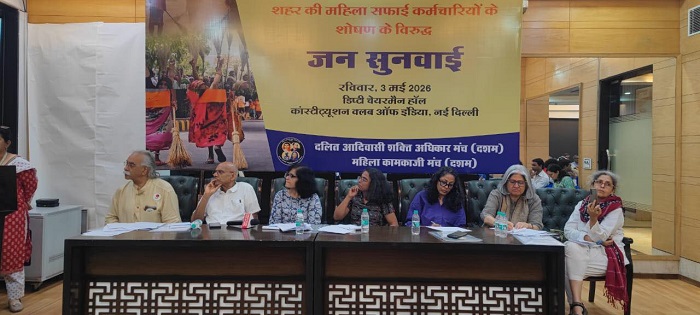
 New Delhi (Asian independent) On Sunday, May 3, 2026, the Dalit Adivasi Shakti Adhikar Manch (DASAM), along with its women’s wing, Mahila Kaamkaji Manch (MKM), organised a public hearing titled “Labour Without Security, Lives Without Dignity: Confronting Structural Exploitation and Reclaiming Entitlements”. The event marked a significant milestone in an ongoing grassroots process that has unfolded over several months across the city of Delhi.
The hearing emerged from DASAM’s and MKM’s sustained initiative, “Sunday Campaign with Women Workers”, through which Dalit women sanitation workers across multiple slum clusters have been engaged in weekly dialogues. Over time, what began as informal conversations evolved into structured spaces of trust and collective reflection. Women who were often excluded from formal platforms began articulating their lived realities, transforming silence into shared understanding and individual struggles into collective awareness of systemic injustice.
 Through these engagements, recurring issues surfaced: delayed wages, arbitrary dismissals, unsafe working conditions, harassment, and a lack of recognition. As these patterns became clearer, the idea of a public hearing took shape, an effort to shift from private suffering to public testimony and accountability.
The hearing brought together hundreds of Dalit women workers, particularly from the Valmiki community, who are employed as sanitation workers, housekeeping staff, domestic workers, and daily wagers across schools, malls, offices, metro systems, hospitals, and major public institutions, including the MCD, NDMC, DDA, and DCB. Journalists, civil society members, researchers, academicians, and legal experts were also present to ensure that these testimonies were not only heard but documented and engaged with.
The event opened with the introduction of an eminent jury panel comprising leading voices in law, human rights, gender justice, and labour rights, underscoring the seriousness of the process and its connection to broader legal and policy frameworks. The panel included:
- Vrinda Grover, Senior Advocate, Supreme Court of India, and Commissioner, UN Independent International Commission of Inquiry on Ukraine
- Colin Gonsalves, Senior Advocate, Supreme Court of India, and Founder, Human Rights Law Network
- Prof. Reetika Khera, Department of Economics, IIT Delhi

- Purnima Gupta, feminist educator and founding member of Sahjani Shiksha Kendra and Nazariya Foundation
- Manjula Pradeep, human rights defender and National Convenor, National Campaign on Dalit Women’s Leadership (NCWL)
- Indu Prakash Singh, social activist, author, and educator
- Prof. Sophy K. J., Associate Professor, National Law University Delhi, and Director, Centre for Labour Law Research and Advocacy
At the heart of the hearing were testimonies from women workers that revealed the depth and persistence of structural injustice.
Laali, a former sanitation worker with NDMC, described working under continuously renewed informal contracts without written documentation. She recounted paying large sums to secure and retain her job, only to be defrauded and denied recognition for years of service due to systemic manipulation.
Geeta, a Valmiki woman and sole breadwinner, shared a story marked by profound loss. In 2018, her husband, a contractual sewer worker, died from illness caused by prolonged exposure to hazardous conditions. Soon after, her son, who had taken up sanitation work, died of dengue. Despite repeated appeals, she has received no adequate compensation or support and continues to struggle for survival.
Anita, employed in a private school, highlighted the precarity of her work: low and delayed wages, no leave, and constant fear of dismissal. Though hired as a caretaker, she is required to perform multiple roles, including sanitation work, without formal protections.
Similarly, Neetu Singh, a sanitation worker in a private school, highlighted an excessive and exploitative workload. Beyond cleaning duties, she is required to move furniture, carry exam materials, perform domestic work for the principal, and even clean a church on Sundays. Alongside this, she faces caste-based discrimination and physical abuse.
During the public hearing, a broader structural pattern became evident as the testimonies unfolded. Workers’ experiences are shaped by a labour system increasingly defined by outsourcing and contractualisation. Employment through contractors allows both public and private institutions to evade responsibility, rendering workers invisible within formal systems despite their essential roles. Contracts are short-term, often arbitrarily renewed, and in many cases, workers are forced to pay bribes to secure re-employment, creating a cycle in which labour is continuously extracted while accountability is systematically avoided. Informal labour broking and coercive payment structures further deepen exploitation, pushing workers into cycles of debt and dependency.
The hearing also highlighted the stark gap between labour and livelihood. Workers reported earning between Rs 8,000 and Rs 16,000 per month, with wages frequently delayed, reduced, or withheld. Working conditions remain unsafe and largely unregulated, with daily exposure to waste, toxic substances, and physically demanding labour leading to chronic health issues. Access to protective equipment, healthcare, and compensation is minimal or absent.
Beyond the workplace, these women shoulder the responsibility of sustaining entire households. As primary earners, they navigate rising living costs, debt, and uncertainty. The consequences are severe—children dropping out of school, untreated illnesses, and the intergenerational normalisation of economic insecurity.
The hearing underscored that these conditions are not incidental but rooted in intersecting systems of inequality.
Caste continues to determine occupational roles, with sanitation work disproportionately assigned to Dalit communities, reinforcing stigma and everyday discrimination. Gender further intensifies vulnerability, as women balance paid labour with unpaid domestic work while facing harassment, wage manipulation, and a lack of protection. Political marginalisation compounds this invisibility—despite reserved constituencies, Dalit women sanitation workers remain excluded from decision-making spaces, and their concerns rarely shape policy. The absence of unionisation leaves workers isolated, limiting their capacity to negotiate or resist exploitation.
In this context, the public hearing functioned as a critical intervention and moved beyond documentation to create a space of recognition and collective accountability. By bringing together workers, legal experts, researchers, and civil society actors, the hearing transformed individual narratives into collective testimony and evidence, while opening space to critically examine the role of state institutions, private contractors, and existing labour frameworks.
This was among the first public hearings in Delhi to centre the structural realities of Dalit women sanitation workers within outsourced labour systems.
 Importantly, the hearing is not an isolated event but part of an ongoing process of organising, documenting, and demanding justice. DASAM and MKM remain committed to building collective leadership among marginalised women workers and ensuring that their voices lead to concrete action.
Dalit women sanitation workers are indispensable to the functioning of the city, yet their lives continue to be marked by invisibility and injustice. This public hearing represents a step toward changing that reality toward recognising them not as passive recipients of policy, but as active agents asserting their rights to dignity, security, and just livelihoods.
Meanwhile, the jury members suggested the following recommendations:
- Health and Medical Camps: Organise regular health and medical camps in collaboration with government hospitals to address chronic illnesses, reduced life expectancy, and occupational health risks faced by sanitation workers. These camps should ensure continuous monitoring, early diagnosis, and access to treatment, especially in the absence of adequate social security and healthcare resources.
- Capacity and Leadership Building
Conduct community-based capacity and leadership development programmes, with a focus on youth and women from Valmiki communities, aiming to build leadership skills, foster collective consciousness, and encourage assertion of rights, and special emphasis should be placed on labour rights education and community mobilisation. - Research and Documentation for Legal Action
Systematically collect and document data on violations of labour laws, institutional safeguards, and human rights. This evidence will support future legal interventions, including petitions and public interest litigation, to secure entitlements and accountability. - Social Media Advocacy Campaigns

Launch strategic social media campaigns highlighting not only workplace issues but also living conditions, including access to housing, sanitation, and water. Use video documentation (with consent and options for anonymity) to amplify voices and hold authorities accountable. - Resource and Network Building
Develop a network of professionals—lawyers, journalists, researchers, and activists—who are committed to sanitation workers’ rights. This ecosystem can provide legal aid, media visibility, and technical expertise to strengthen the movement. - Accessible Audio-Visual Rights Education
Develop simple, accessible audio-visual materials to educate workers about their legal rights and entitlements under relevant labour laws. This includes awareness of health cards, insurance, the provident fund, occupational safety standards, wage rights, and access to protective equipment. - Union Mobilisation and Solidarity
Strengthen engagement with existing trade unions and labour organisations to build solidarity, access leadership, and advocate for social security benefits. Collaboration can amplify collective bargaining power and policy influence. - Digital Documentation of Wage Practices
Establish systems to track and document wage payments digitally. This will help identify patterns of wage theft, salary deductions, and irregular payments, providing evidence for legal claims in labour courts and other forums. - Tailored Strategies for Worker Categories

Recognise the diversity among sanitation workers—contractual, permanent, and informal—and develop differentiated legal and advocacy strategies. A one-size-fits-all approach is inadequate given varying employment conditions and vulnerabilities. - Understanding Contractual Labour Systems
Study the political economy of contractual labour, particularly under privatised governance models. Research should focus on relationships between workers, contractors, and state agencies to inform policy critique and legal strategies. - Documentation of ‘Break in Service’ Practices
Record instances where artificial breaks in employment are used to deny regularisation and benefits. Collect employment records and testimonies to challenge such exploitative practices legally. - Challenging Privatisation and Contractor Exploitation
Investigate and expose exploitative practices by private contractors, including wage theft, bribery, and denial of legal entitlements. Verify licensing, regulatory compliance, and accountability mechanisms. Mobilise resistance against unchecked privatisation and advocate for stronger regulation and transparency. - Addressing Sexual Harassment for Women Workers
Ensure awareness and access to grievance redressal mechanisms under the POSH framework. Explore the role of local committees in supporting unorganised women workers, enabling them to report harassment without institutional barriers.