THE ASIAN INDEPENDENT UK

Bal Ram Sampla
Geopolitics
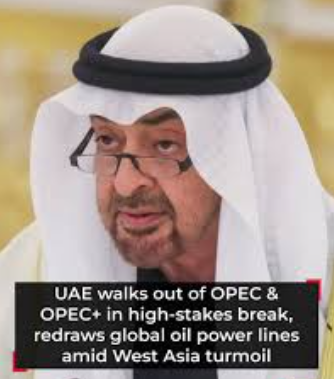
For over fifty years, the UAE sat quietly at the OPEC table, pumped oil within the limits it was assigned, and followed the rules set mostly by its powerful neighbour, Saudi Arabia. That changed on April 28, 2026. In a move that shocked the oil world, the UAE announced it was leaving OPEC — effective May 1. No warning. No consultation with Riyadh. Just a clean exit, dressed up in polite diplomatic language about “national interests” and “long-term vision.”
To understand why this matters, we need to understand what OPEC actually does. Think of it as a club for oil-producing countries. The club’s main job is to decide how much oil each member can sell to the world. When they sell less, prices go up. When they sell more, prices fall. For decades, this gave OPEC enormous power over the global economy. A handful of countries in the Middle East could, quite literally, decide how expensive it was to fill your car.
“The UAE has the capacity to produce 4.85 million barrels of oil a day. Under OPEC’s rules, it was being held to barely 70% of that — leaving billions of dollars sitting in the ground.”
Why the UAE Really Left
The official reason was strategy and vision. The real reason was money — and a broken relationship with Saudi Arabia.
The UAE has spent $150 billion upgrading its oil fields through its national oil company, ADNOC. It has the capacity to produce 4.85 million barrels of oil every day. Under OPEC’s quota system, it was allowed to produce significantly less. Every day it stuck to those limits was a day it was leaving enormous revenue on the table. With global oil demand expected to peak sometime this decade, the UAE made a cold calculation: if we are going to sell oil, we need to sell as much as we can, right now, not when Saudi Arabia gives us permission.
Then came the Iran factor. When the US-Israel war on Iran broke out, Iran — a fellow OPEC member — attacked UAE ships and disrupted exports through the Strait of Hormuz. Sitting in a cartel alongside a country actively attacking your oil tankers became politically impossible. The war gave the UAE the perfect moment, and the perfect excuse, to leave.
Beneath all of this is a quiet but real falling-out between Abu Dhabi and Riyadh. The two nations once moved in lockstep. Today they compete economically, back opposing sides in regional conflicts, and clearly no longer trust each other. The UAE did not even bother to phone Saudi Arabia before making the announcement.
Where India Fits In
India is the world’s third largest consumer of oil. It imports roughly 85% of what it needs. Every time oil prices rise, India’s import bill swells, the rupee weakens, and inflation creeps up for ordinary people. Every time oil prices fall or India secures a better deal, it gets breathing room to grow.
The UAE is already one of India’s most important energy partners. It is India’s fourth largest source of crude oil and second largest supplier of natural gas. And the relationship goes far beyond oil — the UAE is India’s third largest trading partner overall, home to 3.5 million Indian citizens, and increasingly a strategic ally in a turbulent region.
The Numbers at a Glance
(1) $100 billion+ — India-UAE bilateral trade in 2024–25
(2) $200 billion — target set jointly by Modi and MBZ for 2032
(3) $3 billion LNG deal — ADNOC to supply India’s HPCL for 10 years from 2028
(4) 3.5 million — Indian diaspora living in the UAE
(5) 4.85 million bpd — UAE’s oil production capacity, previously capped by OPEC
The Good News for India
A UAE outside OPEC is a UAE that can pump as much oil as it wants. And because India is the UAE’s single most important buyer, that extra oil will very likely flow toward Indian refineries — at competitive prices negotiated directly between the two governments, not through a cartel’s pricing mechanism.
This is already happening. In January 2026, just three months before the OPEC exit, Prime Minister Modi and UAE President Sheikh Mohamed bin Zayed signed a landmark $3 billion gas supply deal and pledged to double bilateral trade to $200 billion by 2032. India’s National Security Advisor Ajit Doval met with MBZ in Abu Dhabi just one day before the OPEC announcement — a conversation centred specifically on energy security. It is hard to believe these were coincidences.
India and the UAE have also begun settling some oil trades in Indian rupees and UAE dirhams — cutting out the US dollar as the middleman. For India, which spends enormous amounts of foreign exchange buying oil in dollars, this is significant. A post-OPEC UAE, free from cartel rules, makes direct rupee-dirham oil deals even easier and more attractive.
“India is perfectly positioned — large enough to matter as a buyer, non-aligned enough to deal with everyone. In the new oil order, that makes India the most strategically valuable customer in the world.”
The Risks India Cannot Ignore
Not everything is rosy. The Strait of Hormuz — the narrow sea passage between Iran and Oman through which a fifth of the world’s oil normally flows — remains partially closed because of the Iran war. The UAE’s oil production has already dropped sharply because of this, from 3.4 million barrels a day to under 2 million. All the deals in the world mean nothing if the oil cannot reach India’s shores.
A weakened OPEC also means more unpredictable oil prices. The cartel, for all its faults, acted as a stabiliser. When it loses members and influence, oil prices can swing wildly — which is a headache for any country that imports as much as India does.
India also needs to be careful with Saudi Arabia. The Saudis are unhappy, and India imports heavily from them too. New Delhi will need its characteristic diplomatic skill — maintaining warm ties with both Abu Dhabi and Riyadh, without being seen as taking sides in their growing rivalry.
The Bigger Picture
What is unfolding is not just an oil story. It is the rewriting of a fifty-year-old global order. OPEC was built in a world where a small group of oil nations could hold the global economy hostage. That world is ending — because of American shale oil, because of the energy transition, because of wars and rivalries within the cartel itself.
For India, this is a rare window. As the UAE moves away from its dependence on a cartel and seeks reliable, long-term partners, India — with its massive energy needs, its growing economy, and its 3.5 million citizens living in the UAE — is the natural choice. The relationship is transforming from a simple buyer-seller arrangement into something much deeper: a strategic partnership built on energy, investment, defence, and people.
The UAE did not just leave OPEC. It chose a new direction. And India, quietly and carefully, is helping to build the road.
References
1https://www.cnbc.com/2026/01/20/india-signs-3-billion-lng-agreement-uae-vows-double-trade-us-deal-remains-elusive.html
2.https://www.thenationalnews.com/business/energy/2026/04/28/uae-announces-it-will-leave-opec/
3.https://www.aljazeera.com/news/2026/4/28/uae-leaves-opec-and-opec
4.https://gulfnews.com/uae/government/uae-president-meets-indias-nsa-ajit-doval-in-abu-dhabi-1.500519292
5.https://www.aa.com.tr/en/energy/oil/uae-and-india-sign-historic-oil-agreement-/18799
6.https://www.india-briefing.com/doing-business-guide/india/trade-relationships/india-uae-commence-crude-oil-trade-using-local-currency-settlement-lcs-framework