

by Dinkar Kapoor is State General Secretary, All India People’s Front, Uttar Pradesh
(Asian independent) In the coming days, workers across the country will celebrate May Day. Its origins trace back to the 1886 Haymarket workers’ movement in Chicago, USA. In her courtroom statement, Lucy Parsons, wife of the martyred labor leader Albert Parsons, said: “Judge Altgeld, will you deny that your prisons are filled with the children of the poor and not the rich? Will you deny that a person steals because his stomach is empty? Do you dare say that the ‘fallen women’ you speak of feel happy sleeping with ten to twenty men in a single night and burning their insides?” Even today, in the context of historic May Day, these questions reflect capitalist devastation, plunder, repression, and the exploitation of workers.
In today’s era, working people—especially the working class—are being pushed toward a modern form of bonded labor. With the help of the government, a handful of corporate houses have led to the closure or sale of public sector industries. Permanent jobs in these industries and government departments have been eliminated, and contract systems have forced workers to work their entire lives for extremely low wages. Private companies, following the government’s example, are moving in the same direction. To understand the gravity of the situation: in Gautam Adani’s business empire worth ₹16 lakh crore, there are only about 32,000 permanent employees; the rest are contract workers. On India’s e-Shram portal, nearly 320 million registered workers exist, and 92% of them earn less than ₹10,000 per month.
Working conditions have deteriorated drastically. Hard-won labor rights have been taken away. During the COVID period, the Modi government introduced Labor Codes and, under pressure from deals with the US and Europe, implemented them from November 24, 2025, effectively legalizing modern slavery. Working hours were increased from 8 to 12 hours. The floor wage weakened the right to minimum wages. Fixed-term employment took away even the limited social security rights that contract workers had gained.
For years, both state and central governments failed to revise minimum wages. In Uttar Pradesh, there was no wage revision since 2014. The state government eventually acknowledged this and issued a notification for a 21% wage increase. The central government has not revised minimum wages since 2022, despite the Minimum Wages Act of 1948 requiring revisions every five years. Accordingly, wages in the state should have been ₹26,000 per month and ₹32,000 per month at the national level.
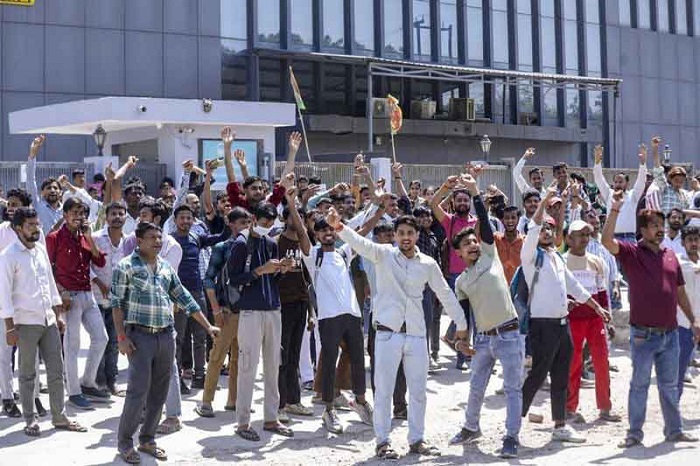
Conditions have worsened so much that workers are denied weekly holidays, double overtime pay, bonuses, and gratuity. Employers even refuse restroom breaks during work. Labor laws are being openly violated. The Deputy Labor Commissioner in Noida admitted that hundreds of contractors violated workers’ rights and even looted their ESI and EPF contributions. The recent US-Israel attack on Iran has worsened the situation: rising gas prices, closure of small and medium industries, job losses, inflation, and massive unemployment have stirred workers across the country. Against this backdrop, workers in Noida and the NCR rose in protest against these conditions of modern slavery.
Instead of seeking a democratic solution to the issues raised by this movement, the Yogi government responded with brutal repression in line with its authoritarian character. It has waged war against its own citizens. Under labels such as “Pakistani connection” and “Urban Naxal,” intellectuals have been arrested and jailed. Satyam Verma, son of renowned historian Professor Lal Bahadur Verma and a senior journalist formerly with UNI, was abducted by Noida police for two days and then imprisoned. Hundreds of workers, including women and minors, are in jail under serious charges. Opposition leaders, human rights organizations, and even lawyers have been prevented from meeting them.
The government alleges that organizations like Mazdoor Bigul and Disha created WhatsApp groups and wrote pro-worker articles in the registered newspaper Mazdoor Bigul. However, under Article 19 of the Indian Constitution, freedom of expression is a fundamental right, and this is not illegal. Everyone knows that the RSS and BJP operate countless toolkits, WhatsApp groups, and social media handles spreading propaganda daily. Even the Prime Minister’s image relies on such teams. The RSS publishes newspapers like Panchjanya and Organizer, filled with praise for the US and big corporate houses and divisive political content. In this context, the allegations against worker leaders and intellectual supporters are baseless attempts to defame them—something society will not accept.
On April 24, at the national conference organized by the Employment and Social Rights Campaign at Rajendra Bhavan in Delhi, democratic forces from across the country resolved to stand in support of the Noida movement and organize a nationwide protest against repression.