THE ASIAN INDEPENDENT UK

Bal Ram Sampla
Geopolitics
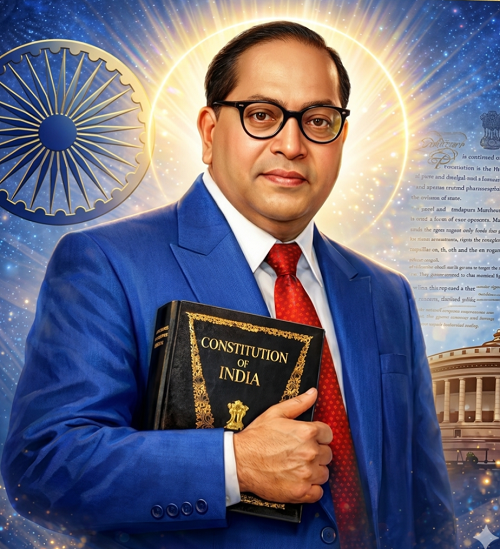
“Today we celebrate Dr. Ambedkar’s birthday as Equality Day. And equality is exactly the right word — because Ambedkar spent his entire life fighting for the rights of the oppressed.
In 2023, Parliament passed the Women’s Reservation Bill — 33% of seats in Parliament and state assemblies reserved for women. Historic, we were told. But there was a condition. It will not come into effect until something called delimitation is completed. That could mean 2034. Or later.
So what is delimitation?
Every country needs to divide its territory into constituencies — areas that elect one representative each. As populations shift and grow, those boundaries need to be redrawn so that each constituency represents roughly equal numbers of people. That redrawing is called delimitation. In India, it is a constitutional requirement.
On paper, it sounds fair. Equal
population, equal representation.
But here is where it gets political. And here is where Ambedkar’s thinking becomes essential.
Delimitation is not just a map-drawing exercise. It decides who gets power and who loses it.
Constituencies can be drawn to cluster communities together or to split them apart. Constituency boundaries have often been drawn to dilute Dalit and OBC votes — spreading a large Dalit population across multiple constituencies so they cannot determine the outcome in any single one. This is not accidental. It is a structural tool.
The current delimitation debate has another dimension. Southern states — Tamil Nadu, Kerala, Karnataka, Telangana — followed family planning policies.
Their populations grew slowly. Northern states — Uttar Pradesh, Bihar, Madhya Pradesh — did not. Delimitation based on today’s population will shift seats northward.
The South gets fewer seats. The North gets more.
This penalises states that did the right thing. And it concentrates political power in the Hindi heartland — which also happens to be the BJP’s strongest electoral base. So the party in power benefits directly from a delimitation it controls the timeline of.
And they have tied women’s reservation to that same timeline.
Dr. Ambedkar would have called this by its correct name — the constitutional machinery being used to serve majoritarian power.
But Dr. Ambedkar would not stop there. He would turn the argument around and ask the South — and ask all of us — a harder question.
Your anger about losing seats is legitimate. But whose seats are you protecting? Look at your own assemblies. Look at your own party lists. How many Dalit women are there? How many OBC women? How many adivasi women?
The Women’s Reservation Bill itself — the one we are celebrating — has no sub-reservation for the most marginalised women within that 33%. So the seats reserved for women will most likely go to women who are already privileged — upper caste, educated, connected to political families.
This is what Ambedkar called formal equality. Same rule for everyone. But when people do not start from the same place, the same rule produces the same old hierarchy.
He knew this pattern intimately. He tried to introduce birth control legislation in the Bombay Legislative Assembly — a progressive measure for women’s autonomy that the establishment resisted.
He drafted the Hindu Code Bill to give women inheritance rights and the right to divorce. Parliament diluted it beyond recognition. He resigned as Law Minister in 1951 in protest. He understood that systems are very good at absorbing the language of equality while blocking its substance.
Delimitation is that same system, in a new form.
Dr. Ambedkar did not just diagnose India’s illness. He prescribed its cure. He wrote it into Constitution — equality not as a gift from the powerful, but as a right belonging to every person, regardless of caste, gender or region.
He was born into a society that told him he did not matter. He died having written the document that said every Indian does.
That Constitution is now being tested. Delimitation, reservation, representation — these are not technical questions. They are questions about whether we mean what that document says.
On this Equality Day, let us make a simple commitment. Not to Dr. Ambedkar the statue. Not to Dr. Ambedkar the symbol. But to Dr. Ambedkar the thinker — who asked us to keep asking, keep pushing, keep demanding that equality reaches the last person.
That work is unfinished. And it belongs to us.”