Dr. Ramjilal, Social Scientist, Former Principal, Dyal Singh College, Karnal (Haryana, India).
Email: [email protected]

(Asian independent Baisakhi is not just a festival;it is a significant religious celebration observed during the month of Vaishakh (Baisakh) and marks the first day of the solar month. The act of bathing in the Ganges River on this day is of great importance, and massive fairs are held in Haridwar and Rishikesh to commemorate the occasion. Vaisakhi coincides with the Sun transit into the constellation Aries, which is why it is also referred to as Mesha Sankranti or the Equinox. This day heralds the Solar New Year celebrations across various regions of India, with festivities like Jud Sheetal, Pohela Boishakh, Bohag ,Bihu, Vishu, and Puthandu taking centre stage.
According to mythological beliefs, King Bhagiratha of Ayodhya, known as Muni Bhagiratha, brought the River Ganga to Earth through his unwavering penance on this very day . In Sikhism, Baisakhi is the cornerstone of the faith, marking its founding by Guru Gobind Singh on April 13, 1699. Furthermore, this day is recognised by Buddhists as Buddha Purnima. Baisakhi transcends geographical boundaries; it is celebrated robustly in India and among non-resident Indians (NRIs) across the globe, honouring its historical significance.
Hinduism and the Baisakhi Festival
Vaisakhi stands as one of the oldest and most crucial festivals in Hinduism, symbolising the start of the Hindu New Year. It is rooted in the moment when King Bhagiratha brought the Ganga to Earth, a historical act that millions of Hindus commemorate through holy dips in Haridwar and Rishikesh on this day. This tradition reinforces the belief that those who bathe in the sacred river are blessed.
A Day of Joy for Farmers and Agricultural Workers
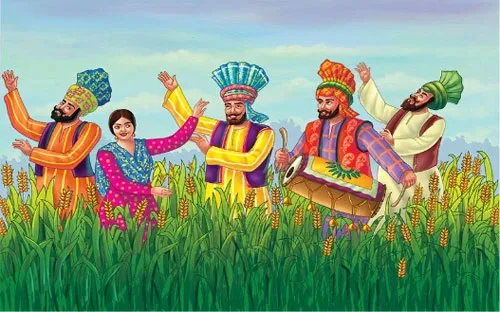
Baisakhi is intrinsically linked to agriculture, marking the readiness of Rabi crops like wheat, barley, and gram for harvest. Celebrating the harvest on Baisakhi (April 13) is not only considered auspicious but is also a source of immense joy for farmers and laborers, particularly in regions such as Haryana, Punjab, Delhi, and Uttar Pradesh. On this day, farmers take pride in their bountiful crops and engage in jubilant celebrations, including traditional dances like Bhangra and Gidda.
Sikhism and Baisakhi
In Sikhism, Baisakhi is celebrated with reverence and deep significance. On April 13, 1699, Guru Gobind Singh established the faith by initiating the Panj Pyaras (Five Beloved Ones) in Anandpur Sahib, Punjab. These five brave followers, hailing from diverse regions and castes, exemplified unity and commitment. Guru Gobind Singh’s call for sacrifice was met with their unwavering loyalty, leading to the creation of a distinct Sikh identity, marked by the administration of Amrit and the introduction of the five “Ks”: Kesh (hair), Kangha (comb), Kara (bracelet), Kachera (shorts), and Kirpan (sword). This moment solidified the uniqueness of Sikh identity.
During Baisakhi, Sikhs demonstrate their faith by paying homage at gurdwaras and participating in vibrant folk dances, bhangra, gidda, and Nagar Kirtan processions accompanied by drums. The atmosphere is electric, bringing together men, women, children, and the elderly in joyful celebration.
Baisakhi Festival Celebrations Across India
Baisakhi is recognized under various names throughout India, showcasing its widespread cultural relevance. In Uttarakhand, it is observed as ‘Bikhoti’, with residents viewing bathing in the Ganges at Haridwar and Rishikesh as sacred. Assamese communities celebrate it as ‘Bohag Bihu’, marking the Assamese New Year. In Bengal, April 14 is honored as ‘Pahela Baisakh‘, featuring lively processions in Tripura and Bengal. In Tamil Nadu, it takes the form of Puthandu or Puthuvarusham, celebrating the Tamil New Year, while in Bihar and the Mithila region, it is celebrated as Jur Sheetal. Baisakhi is not merely a festival; it is a testament to cultural unity and historical legacy that resonates across the nation.
Baisakhi Festival: A Global Celebration
Baisakhi is an important festival observed not just in India but also in neighbouring countries, including Nepal, Bangladesh, and Pakistan. Sikhs worldwide, including those in India, celebrate Baisakhi by visiting Gurdwaras, particularly in Nankana Sahib and Panja Sahib, which are significant as the birthplaces of Guru Nanak Dev Ji. The festival is also recognised in countries such as the United States, Canada, England, and Australia. Typical celebrations involve prayers at Gurdwaras, community service, Nagar Kirtan (spiritual singing), langar (community meals), and a variety of traditional activities that bring people together.
Historical Context: The Jallianwala Bagh Massacre and Udham Singh
The historical significance of Baisakhi is underscored by the tragic events of April 13, 1919. On this day, a peaceful protest against the Rowlatt Act occurred at Jallianwala Bagh in Amritsar, attended by approximately 20,000 individuals. In a horrific response, Brigadier General Richard Dyer ordered his troops to open fire without warning, leading to around 1,800 fatalities, as later confirmed by Amritsar’s Civil Surgeon, Dr. Sumith.
Udham Singh, who witnessed the massacre, resolved to seek justice for the victims. Although he initially aimed to assassinate Brigadier General Dyer—who had passed away in 1927—Singh fulfilled his vow on March 13, 1940, by assassinating Michael O’Dwyer during a speech at Caxton Hall in London. Following his act, Singh surrendered and was executed on July 31, 1940. In 1952, India’s Prime Minister Jawaharlal Nehru honoured Singh, designating him as “Shaheed-e-Azam Udham Singh,” and remarked, “I pay my respectful tribute to Shaheed-e-Azam Udham Singh, who kissed the noose so that we might be free.” The Jallianwala Bagh massacre, which occurred on Baisakhi, marked a crucial turning point in the Indian independence movement.
Baisakhi and Sir Chhotu Ram: The Honor of Deenbandhu
Sir Chhotu Ram holds a remarkable place in history, particularly in relation to Baisakhi. On April 13, 1938, he overcame tremendous obstacles to secure the allocation of 454,625 acres of cultivable government land to Scheduled Castes, transforming them into landowners at a mere rate of Rs. 3 per acre, interest-free for 12 years, and payable in manageable annual instalments of four annas (equivalent to 25 paise today).
This significant land distribution took place in the Multan district, now in Pakistan,coinciding perfectly with Baisakhi. That very day, members of the Scheduled Castes honoured Sir Chhotu Ram by carrying him on an elephant in a resplendent procession, drawing thousands from various castes to participate. In this vibrant gathering, Sir Chhotu Ram was celebrated with the title of Deenbandhu’, an accolade that far surpassed any recognition from universities or governments, solidifying his legacy as a champion of equality and social justice.
In conclusion, the Baisakhi festival encapsulates vital social, religious, and historical aspects, promoting ideals such as social harmony, unity, secularism, democracy,sacrifice, and dedication. In recognition of the cultural significance of Baisakhi, UNESCO included the Mangal Shobha Yatra in the Representative List of the Intangible Cultural Heritage of Humanity in 2016.